Close Menu
Illustrated Curiosity
    Facebook X (Twitter) Instagram YouTube
    Illustrated Curiosity
    • Earth
    • Economics
    • Environment
      • Climate
      • Environmental Tech
      • Pollution
      • Wildlife
    • Health
      • Health Tech
      • Medicine
      • Nutrition
      • Exercise
    • History
      • Prehistory
      • Ancient History
      • Postclassical Era
      • Modern History
    • Humans
      • Human Brain
      • Psychology
    • Life
      • Animals & Plants
      • Genetics
      • Paleontology
      • Evolution
      • Genetic Engineering
    • Physics
    • Space
      • Astrobiology
      • Astronomy
      • Extrasolar Planets
      • Space Tech
      • Spaceflight
    • Technology
      • Artificial Intelligence
      • Energy
      • Engineering
      • Materials
      • Robotics
      • Vehicles
    Illustrated Curiosity
    Home » Astronomers discover exoplanet hotter than most stars
    Extrasolar Planets

    Astronomers discover exoplanet hotter than most stars

    June 11, 2017No Comments2 Mins Read
    Share
    Facebook Twitter LinkedIn Pinterest Email

    Astronomers may have found the hitherto hottest planet known. Its extreme heat may also be about to break the planet down.
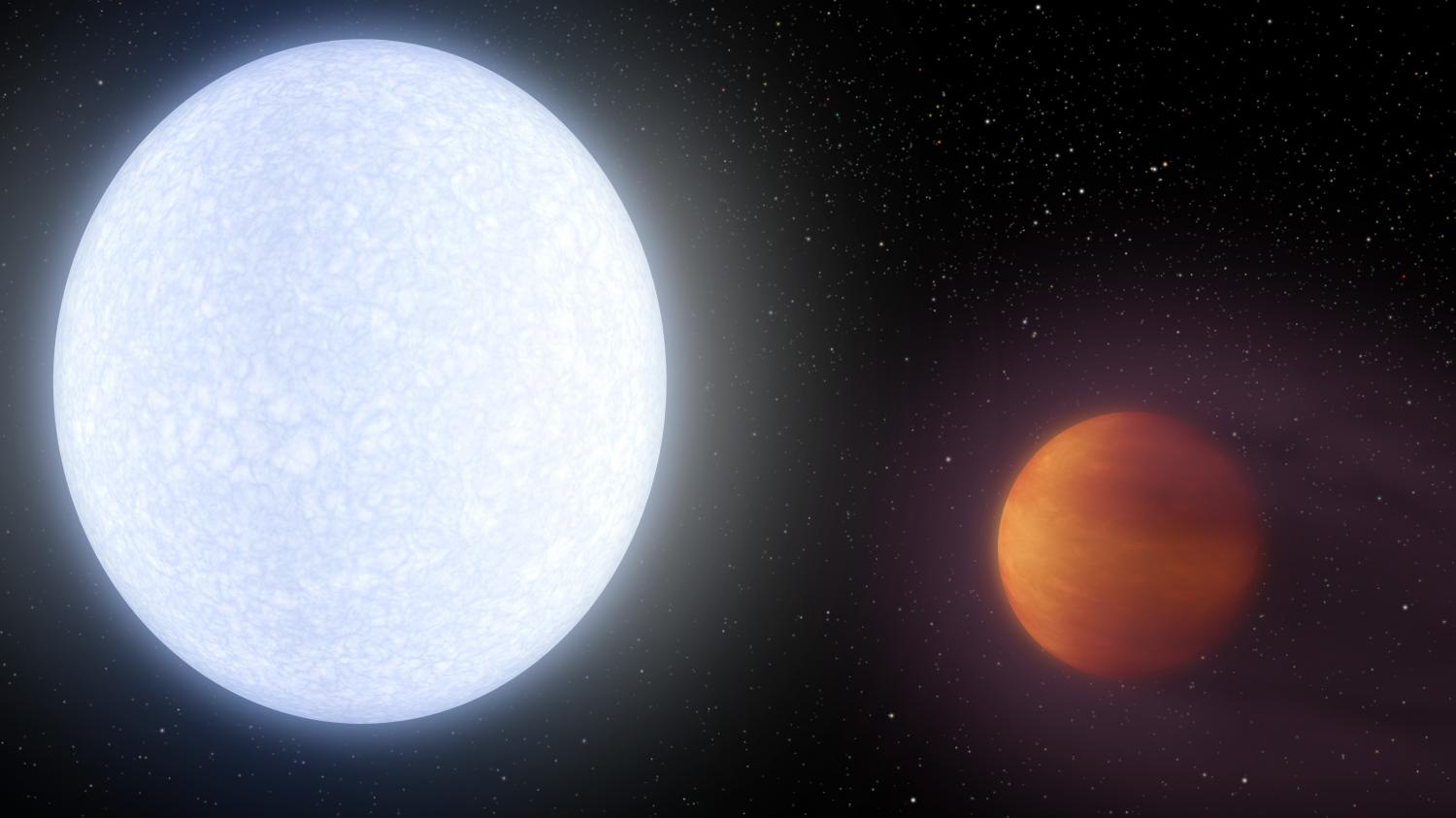
    Artist’s illustration of star KELT-9 and its super-heated planet KELT-9b. Credit: Robert Hurt / NASA/JPL-Caltech
    R

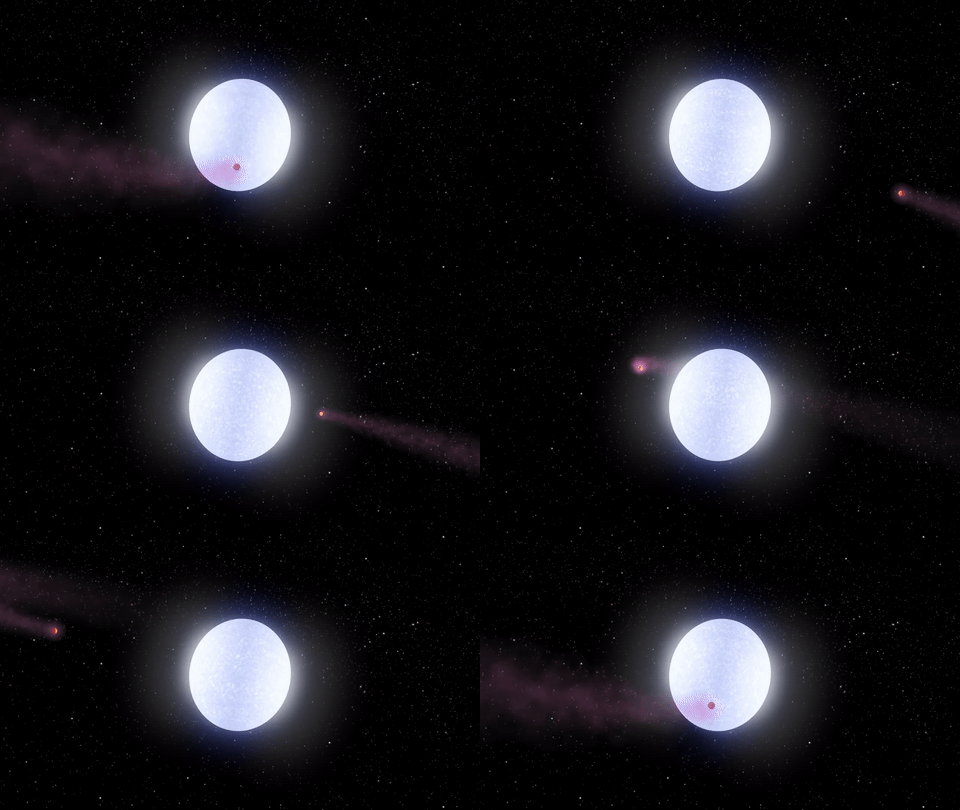
    It is a planet similar to Jupiter zipping around its host star every day and a half, superheated to temperatures hotter than most stars with a glowing gas tail like a comet.

    With a temperature of over 4,600 degrees Kelvin (4,300 degrees Celsius, 7,800 degrees Fahrenheit), the surface of the planet named KELT-9b is comparable to the surface temperature of some cool stars and almost as hot as the surface of our sun. The reason to its extreme temperature is that the planet orbits very close to its host star KELT-9.

    KELT-9b is a gas giant 2.8 times more massive than Jupiter but only half as dense, being inflated like a balloon being tidally locked to its star — like the moon is to Earth. These extremes are causing the planet to slowly disappear, causing the planet’s molecules to collapse and disappear in space, according to the astronomers.
    GIF: Vanderbilt University

    The exoplanet was discovered in 2014 by using one of two telescopes specially designed to detect planets orbiting bright stars—one in the northern and one in the southern hemisphere—jointly operated by Ohio State, Vanderbilt and Lehigh universities. These – “Kilodegree Extremely Little Telescopes” or KELTs – are relatively cheap and small instrument and fill a large gap in the available technologies for finding extrasolar planets.

    The discovery is described this week in a paper titled “A giant planet undergoing extreme-ultraviolet irradiation by its hot massive-star host” published by the journal Nature and in a presentation at the spring meeting of American Astronomical Society in Austin, Texas.

    Reference:

    Gaudi et al. A giant planet undergoing extreme ultraviolet radiation by its hot massive-star host, 2017. DOI: 10.1038 / nature22392.
    Gas giant
    Share. Facebook Twitter Pinterest LinkedIn Tumblr Email Copy Link

    Related Posts

    James Webb Telescope Discovers Methane & Carbon Dioxide in the Atmosphere of Exoplanet K2-18b

    September 14, 2023

    Tranquil Planetary System Just 11 Light-Years Away Raises Hopes of Habitability

    July 13, 2020

    TESS Mission Spots Earth-Size Potentially Habitable Planet 100 Light-Years Away

    January 8, 2020

    Water is Common—Yet Scarce—in Exoplanets

    December 17, 2019

    Astronomers Discover Jupiter-like Planet Orbiting A Tiny Star

    September 30, 2019

    Water Discovered in the Atmosphere of an Exoplanet in the Habitable zone

    September 12, 2019
    Recent Posts
    • How the End of Bretton Woods Reshaped Our Economies — and Our Politics
    • Can the U.S. Really Handle 250% Debt-to-GDP? Why Jackson Hole’s Daring Paper Is Wrong
    • Japan’s Fiscal Trap: What Happens If Austerity Is No Longer an Option?
    • The Rise of Range Extended Electric Vehicles (REEVs): A New Era of Hybrid Mobility
    • The Great Capital Rotation: A Shift from U.S. Treasuries to Gold and Real Assets
    • The Hidden Risks of Short-Term Debt: A Balancing Act in U.S. Fiscal Policy
    • The Looming U.S. Debt Spiral: Understanding the Risks
    • The Looming Recession: Seven Economic Indicators Flashing Red for 2025
    • Europa Clipper: NASA’s Mission to Unlock the Secrets of Jupiter’s Icy Moon
    • Could Hedge Funds Cause Chaos in the U.S. Treasury Market? And What About Inflation?
    © 2025 Illustrated Curiosity

    Type above and press Enter to search. Press Esc to cancel.

    This website uses cookies to improve your experience. We'll assume you're ok with this, but you can opt-out if you wish.Accept Reject Read More
    Privacy & Cookies Policy

    Privacy Overview

    This website uses cookies to improve your experience while you navigate through the website. Out of these, the cookies that are categorized as necessary are stored on your browser as they are essential for the working of basic functionalities of the website. We also use third-party cookies that help us analyze and understand how you use this website. These cookies will be stored in your browser only with your consent. You also have the option to opt-out of these cookies. But opting out of some of these cookies may affect your browsing experience.
    Necessary
    Always Enabled
    Necessary cookies are absolutely essential for the website to function properly. This category only includes cookies that ensures basic functionalities and security features of the website. These cookies do not store any personal information.
    Non-necessary
    Any cookies that may not be particularly necessary for the website to function and is used specifically to collect user personal data via analytics, ads, other embedded contents are termed as non-necessary cookies. It is mandatory to procure user consent prior to running these cookies on your website.
    SAVE & ACCEPT