Close Menu
Illustrated Curiosity
    Facebook X (Twitter) Instagram YouTube
    Illustrated Curiosity
    • Earth
    • Economics
    • Environment
      • Climate
      • Environmental Tech
      • Pollution
      • Wildlife
    • Health
      • Health Tech
      • Medicine
      • Nutrition
      • Exercise
    • History
      • Prehistory
      • Ancient History
      • Postclassical Era
      • Modern History
    • Humans
      • Human Brain
      • Psychology
    • Life
      • Animals & Plants
      • Genetics
      • Paleontology
      • Evolution
      • Genetic Engineering
    • Physics
    • Space
      • Astrobiology
      • Astronomy
      • Extrasolar Planets
      • Space Tech
      • Spaceflight
    • Technology
      • Artificial Intelligence
      • Energy
      • Engineering
      • Materials
      • Robotics
      • Vehicles
    Illustrated Curiosity
    Home » Dogs and wolves share sense of fair play
    Animals & Plants

    Dogs and wolves share sense of fair play

    June 12, 2017No Comments2 Mins Read
    Share
    Facebook Twitter LinkedIn Pinterest Email

    Dogs and wolves have the same sense of injustice, new research show. This behavior is a property that dogs probably inherited from a common ancestor with the wolf, rather than something that was introduced when the dog was domesticated, the researchers argue.
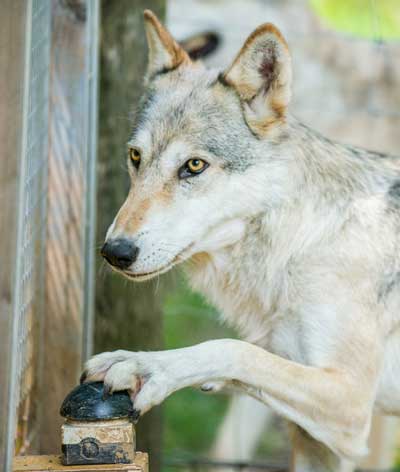
    Wolves recognise inequity similar to dogs and exhibit aversion against it. Photo: Rooobert Bayer

    The fact that we people generally have a sense of inequality or injustice is clear, it has been an evolutionary advantage to facilitate group cooperation and cohesiveness. Earlier research has shown that our primate cousins, e.g. chimps, also have a sense of injustice. And in 2008, this very same ability was seen in dogs.

    In a new study published in the scientific journal Current Biology, researchers have found that even wolves have this sense of “injustice” built in.

    Two animals of either wolves or dogs were allowed to push a button to receive food. One of each were placed within an enclosure together with a ‘food-machine’ right next to each other.

    Sometimes, both of them received food, and sometimes only the dog was fed. At those times only one of the animals were feed, the frustration over this maltreatment was clearly evident in its neighbor.

    The higher the social status of the dogs and wolves that did not receive food, the more dissatisfaction they showed. This frustration was not shown to the same extent when a wolf or dog stood alone and pushed the button without receiving food.

    Furthermore, the researchers were able to show that the dogs showed a kind of qualitative injustice, which in this case meant frustration when the food portions were smaller in comparison to the food portion its pal in the enclosure next door.

    Reference:
    Jennifer L. Essler et al. Domestication Does Not Explain the Presence of Inequity Aversion in Dogs DOI: http://dx.doi.org/10.1016/j.cub.2017.05.061

    Dogs Wolves
    Share. Facebook Twitter Pinterest LinkedIn Tumblr Email Copy Link

    Related Posts

    Kindness To Dogs During Training Matters

    December 28, 2020

    Solar Storms May Throw off Whale Navigation and Cause Strandings

    May 5, 2020

    Why Bats Are Breeding Grounds for Deadly Viruses Like Ebola and SARS

    March 5, 2020

    Cats can express emotions with subtle facial expressions

    February 12, 2020

    18,000-Year-Old Frozen Puppy Found Perfectly Preserved in Siberian Permafrost

    December 9, 2019

    Not Just Dogs, Study Reveals Cats Too Can Form Intense Bonds with Humans

    September 25, 2019
    Recent Posts
    • How the End of Bretton Woods Reshaped Our Economies — and Our Politics
    • Can the U.S. Really Handle 250% Debt-to-GDP? Why Jackson Hole’s Daring Paper Is Wrong
    • Japan’s Fiscal Trap: What Happens If Austerity Is No Longer an Option?
    • The Rise of Range Extended Electric Vehicles (REEVs): A New Era of Hybrid Mobility
    • The Great Capital Rotation: A Shift from U.S. Treasuries to Gold and Real Assets
    • The Hidden Risks of Short-Term Debt: A Balancing Act in U.S. Fiscal Policy
    • The Looming U.S. Debt Spiral: Understanding the Risks
    • The Looming Recession: Seven Economic Indicators Flashing Red for 2025
    • Europa Clipper: NASA’s Mission to Unlock the Secrets of Jupiter’s Icy Moon
    • Could Hedge Funds Cause Chaos in the U.S. Treasury Market? And What About Inflation?
    © 2025 Illustrated Curiosity

    Type above and press Enter to search. Press Esc to cancel.

    This website uses cookies to improve your experience. We'll assume you're ok with this, but you can opt-out if you wish.Accept Reject Read More
    Privacy & Cookies Policy

    Privacy Overview

    This website uses cookies to improve your experience while you navigate through the website. Out of these, the cookies that are categorized as necessary are stored on your browser as they are essential for the working of basic functionalities of the website. We also use third-party cookies that help us analyze and understand how you use this website. These cookies will be stored in your browser only with your consent. You also have the option to opt-out of these cookies. But opting out of some of these cookies may affect your browsing experience.
    Necessary
    Always Enabled
    Necessary cookies are absolutely essential for the website to function properly. This category only includes cookies that ensures basic functionalities and security features of the website. These cookies do not store any personal information.
    Non-necessary
    Any cookies that may not be particularly necessary for the website to function and is used specifically to collect user personal data via analytics, ads, other embedded contents are termed as non-necessary cookies. It is mandatory to procure user consent prior to running these cookies on your website.
    SAVE & ACCEPT