Close Menu
Illustrated Curiosity | Economics, History, Science, Space, Technology, Health, Physics, Earth
    Facebook X (Twitter) Instagram YouTube
    Illustrated Curiosity | Economics, History, Science, Space, Technology, Health, Physics, Earth
    • Earth
    • Economics
    • Environment
      • Environmental Tech
      • Pollution
      • Wildlife
    • Health
      • Health Tech
      • Medicine
      • Nutrition
      • Exercise
    • History
      • Prehistory
      • Ancient History
      • Postclassical Era
      • Modern History
    • Humans
      • Human Brain
      • Psychology
    • Life
      • Animals & Plants
      • Genetics
      • Paleontology
      • Evolution
      • Genetic Engineering
    • Physics
    • Space
      • Astrobiology
      • Astronomy
      • Extrasolar Planets
      • Space Tech
      • Spaceflight
    • Technology
      • Artificial Intelligence
      • Energy
      • Engineering
      • Materials
      • Robotics
      • Vehicles
    Illustrated Curiosity | Economics, History, Science, Space, Technology, Health, Physics, Earth
    Home » Some Deep-Sea Fish Can See Color in Near Total Darkness
    Animals & Plants

    Some Deep-Sea Fish Can See Color in Near Total Darkness

    May 13, 20192 Mins Read
    Image: Illustrated Curiosity
    Share
    Facebook Twitter LinkedIn Pinterest Email

    Scientists previously believed that the deeper a fish lives, the less complex their visual system would be. But according to a new study published on 9 May in Science, this may not be so accurate.

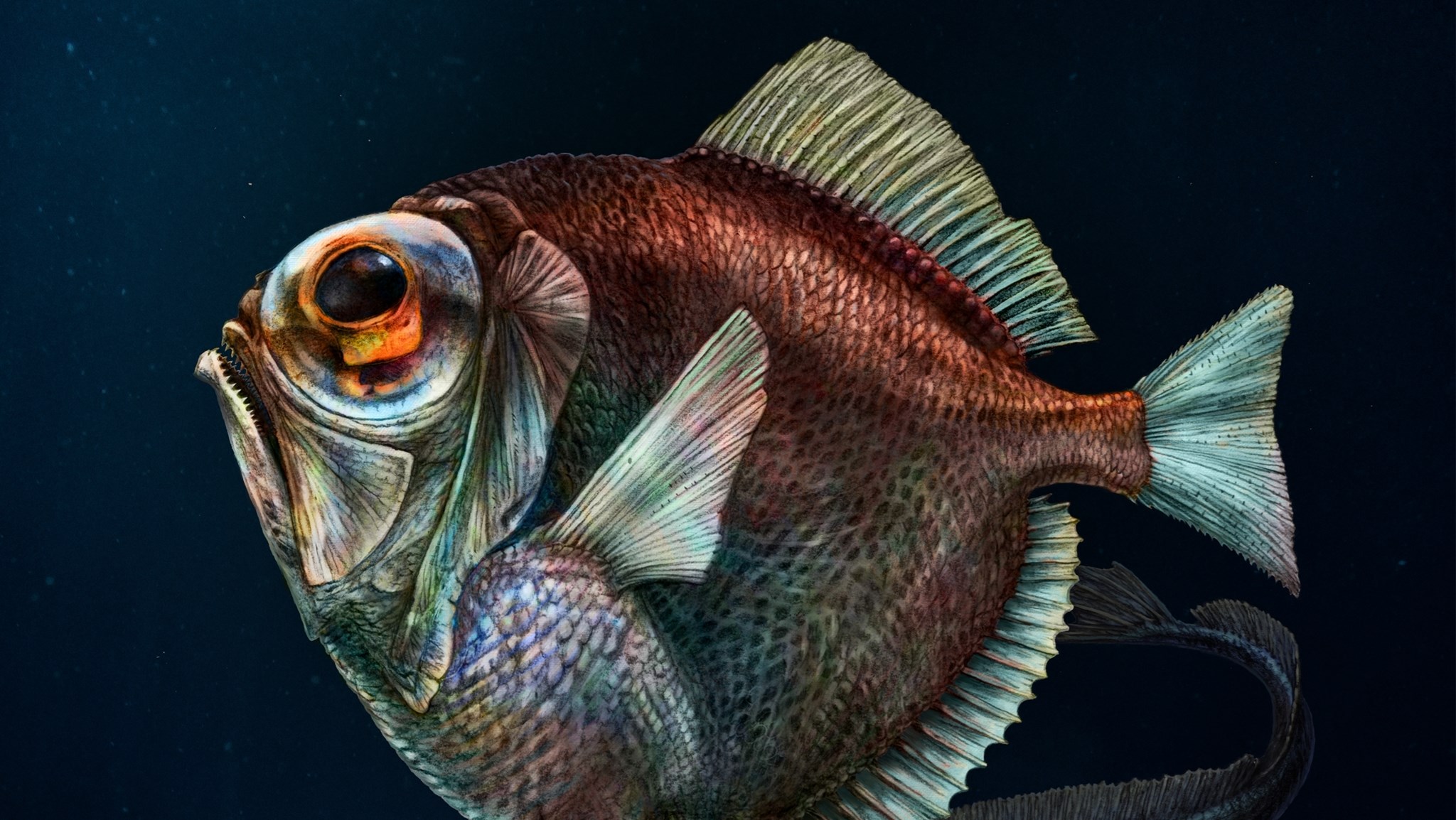
    The study shows that deep-sea fish species living in the near-total darkness have evolved highly sensitive vision.

    The research team led by Walter Salzburger and Zuzana Musilova from the University of Basel in Switzerland has identified a previously undocumented visual system in deep-sea fish

    The fish endowed with this highly sensitive form of vision, of which 13 species are now known, may discern certain wavelengths of color at depths reaching 1,500 meters (5000 feet), where light from the surface is practically non-existent.

    Deep-sea creatures have certainly adapted in many ways to the dark ocean environment, including increased eye or pupil sizes, extremely telescopic-shaped eyes, and modifications to the microscopic retina structure itself. But some deep-sea fish are also equipped with a series of distinct rod opsin photopigments, according to the new study.

    These rod opsins allow the fish to hone in on a wide range of visual wavelengths—namely, the wavelengths produced by bioluminescent deep-sea organisms. Opsins are proteins capable of absorbing light.

    “This is the first paper that examines a diverse set of fishes and finds how versatile and variable their visual systems can be,”

    “The genes that determine the spectrum of light our eyes are sensitive to turn out to be a much more variable set of genes, causing greater visual system evolution much more quickly than we anticipated.”

    – Karen Carleton, a biology professor at the University of Maryland and co-author of the paper.

    Reference:

    Musilova et al. “Vision using multiple distinct rod opsins in deep-sea fishes“. Science, 2019. Doi/10.1126/science.aav4632

    Share. Facebook Twitter Pinterest LinkedIn Tumblr Email Copy Link

    Related Posts

    Kindness To Dogs During Training Matters

    December 28, 2020

    Solar Storms May Throw off Whale Navigation and Cause Strandings

    May 5, 2020

    Why Bats Are Breeding Grounds for Deadly Viruses Like Ebola and SARS

    March 5, 2020

    Cats can express emotions with subtle facial expressions

    February 12, 2020

    Not Just Dogs, Study Reveals Cats Too Can Form Intense Bonds with Humans

    September 25, 2019

    These Tiny Fish May Be as Self-Aware as Chimpanzees and Dolphins

    February 18, 2019
    Recent Posts
    • The Day the Alliance Died
    • Evaluating Heart Disease: How Cumulative Diet Choices Compound Your Risk
    • What Would Happen If China Attacked Taiwan?
    • Geopoliticisation as a Structural Tailwind for Commodity Prices
    • America’s Economic Remodel: Who’s Really Paying the Bill?
    • Why Inflation May Be Preparing for a Second Act
    • How the End of Bretton Woods Reshaped Our Economies — and Our Politics
    • Can the U.S. Really Handle 250% Debt-to-GDP? Why Jackson Hole’s Daring Paper Is Wrong
    • Japan’s Fiscal Trap: What Happens If Austerity Is No Longer an Option?
    • The Rise of Range Extended Electric Vehicles (REEVs): A New Era of Hybrid Mobility
    © 2025 Illustrated Curiosity

    Type above and press Enter to search. Press Esc to cancel.