Close Menu
Illustrated Curiosity
    Facebook X (Twitter) Instagram YouTube
    Illustrated Curiosity
    • Earth
    • Economics
    • Environment
      • Climate
      • Environmental Tech
      • Pollution
      • Wildlife
    • Health
      • Health Tech
      • Medicine
      • Nutrition
      • Exercise
    • History
      • Prehistory
      • Ancient History
      • Postclassical Era
      • Modern History
    • Humans
      • Human Brain
      • Psychology
    • Life
      • Animals & Plants
      • Genetics
      • Paleontology
      • Evolution
      • Genetic Engineering
    • Physics
    • Space
      • Astrobiology
      • Astronomy
      • Extrasolar Planets
      • Space Tech
      • Spaceflight
    • Technology
      • Artificial Intelligence
      • Energy
      • Engineering
      • Materials
      • Robotics
      • Vehicles
    Illustrated Curiosity
    Home » Apollo Deep Space Astronauts Are Five Times More Likely To Die From Heart Disease
    Spaceflight

    Apollo Deep Space Astronauts Are Five Times More Likely To Die From Heart Disease

    July 30, 2016No Comments4 Mins Read
    Share
    Facebook Twitter LinkedIn Pinterest Email
    Apollo 11 crew, who made the first manned landing: commander Neil Armstrong, CM pilot Michael Collins, and LM pilot Buzz Aldrin.

    We are to travel to Mars in the near future but now U.S. scientists warn that cardiovascular diseases may be an overlooked risk of prolonged space travel.

    The scientists have studied the effects of the type of radiation found in space. This research is indeed timely as longer and longer manned space flights will characterize our endeavors in space during the coming decades.

    There is a need for more research on the so-called cosmic radiation according to Micheal Delp at the Florida State University and first author of the study published this week in Nature.

    “With all of these plans for going into deep space we have only had this one really small group [of Apollo astronauts] that has actually done it,” said Michael Delp. “Previous to this study nobody had ever looked at their long-term health consequences – really pulling out the Apollo astronauts out of the group of other astronauts.”

    Delp and his colleagues have compared the causes of death in different groups of astronauts – those that went to the moon and thereby lacked the protection of Earth’s magnetic field – those who instead went into close orbit around Earth and those that did not travel into space at all.

    They compared the causes of death for the seven Apollo astronauts who had died up to that point with those of the 35 low Earth orbit astronauts from the same era, and 35 non-flight astronauts. The resulting data indicates that those astronauts that went to the moon were four to five times more likely to die of cardiovascular disease compared to the other astronauts.
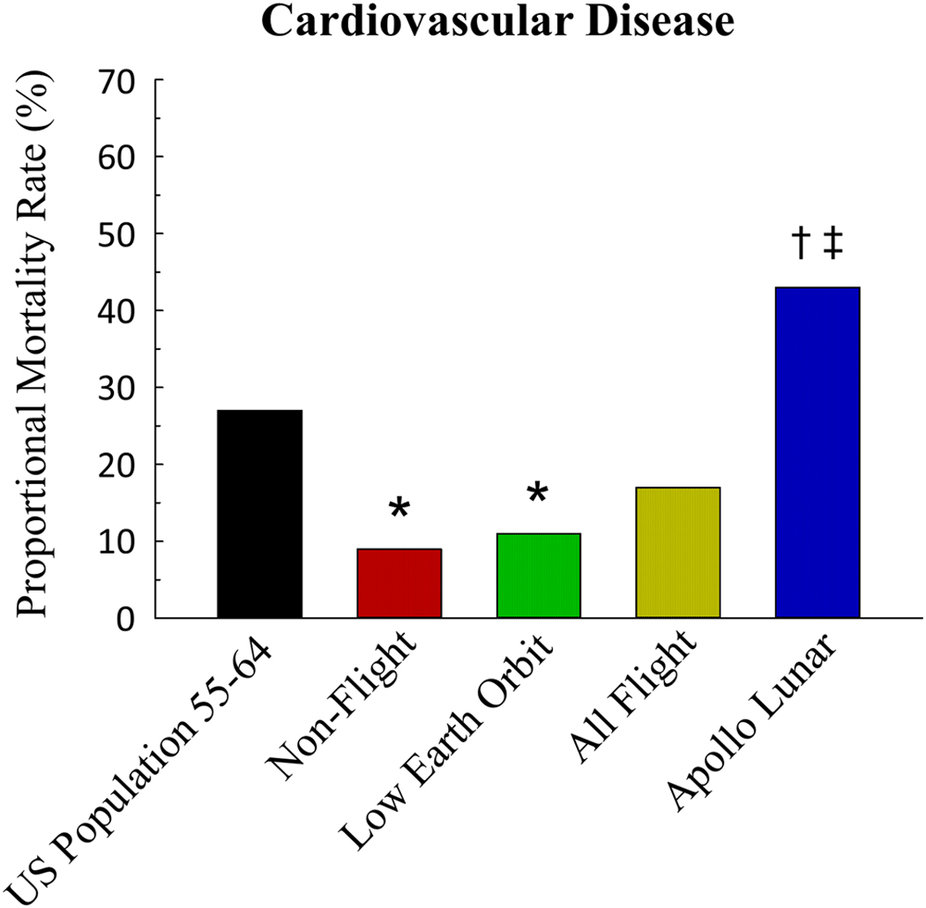
    The proportional mortality rate due to cardiovascular disease in the United States among individuals age 55–64 years, non-flight astronauts, astronauts that flew only low Earth orbit missions, all flight astronauts, and Apollo astronauts that flew missions to the Moon.

    The number of deaths due to cardiovascular disease for the Apollo astronauts only count to seven people, which is a tiny sample size and a clear limitation to the study. Even so, the results reveal that 45% of the Apollo astronauts died from cardiovascular disease, compared to only 9% of non-flight astronauts and 11% of low Earth orbit astronauts.

    There is, however, no difference when the rate was compared to that of the general population, but this can be explained by the fact that astronauts are very fit and healthy, whereas the members of the public suffer from a wide range of conditions that could increase their risk of cardiovascular disease, according to Delp.

    “Part of the reason why this cardiovascular effect has never been uncovered is because you are always looking and comparing [astronauts with] a general population,” he said.

    To further investigate whether deep space radiation might be the direct cause behind these findings, the researchers exposed mice to conditions that simulated weightlessness as well as the radiation found in deep space. The results revealed that while weightlessness did not cause any lasting cardiovascular harm, the radiation did. The mice exposed to radiation were found to have sustained damage to the cells lining their blood vessels. Damage that could increase the risk of cardiovascular disease

    “I think it is really important that Nasa and the European Space Agency, the Canadian Space Agency, and so on, recognize now that the cardiovascular system should be an important focus, one they look at, when they send astronauts beyond low Earth orbit,” Delp adds.

    Researchers already fear that high levels of cosmic radiation could increase the risks of cancer and we still don’t know much about the adverse effects of deep space radiation on human health. But Delp’s team has given us the first glimpse into this complicated and ever more relevant problem.

    _____________
    Michael D. Delp et al. Apollo Lunar Astronauts Show Higher Cardiovascular Disease Mortality: Possible Deep Space Radiation Effects on the Vascular Endothelium. Scientific Reports 28 July 2016. DOI: 10.1038/srep29901
    __________________________
    Apollo Program Cardiovascular Disease Human Spaceflight
    Share. Facebook Twitter Pinterest LinkedIn Tumblr Email Copy Link

    Related Posts

    Europa Clipper: NASA’s Mission to Unlock the Secrets of Jupiter’s Icy Moon

    October 20, 2024

    Spinlaunch Hurls Satellites into Orbit With a Giant Centrifuge

    December 6, 2021

    SpaceX Capsule and NASA Crew Make Historic Splashdown

    August 3, 2020

    NASA and SpaceX are Making History Launching Astronauts to Space! | NASA Live

    May 27, 2020

    Red Space Salad Given Green Light

    May 26, 2020

    NASA Will Launch a Lunar VIPER to Hunt Moon Water in 2022

    November 12, 2019
    Recent Posts
    • How the End of Bretton Woods Reshaped Our Economies — and Our Politics
    • Can the U.S. Really Handle 250% Debt-to-GDP? Why Jackson Hole’s Daring Paper Is Wrong
    • Japan’s Fiscal Trap: What Happens If Austerity Is No Longer an Option?
    • The Rise of Range Extended Electric Vehicles (REEVs): A New Era of Hybrid Mobility
    • The Great Capital Rotation: A Shift from U.S. Treasuries to Gold and Real Assets
    • The Hidden Risks of Short-Term Debt: A Balancing Act in U.S. Fiscal Policy
    • The Looming U.S. Debt Spiral: Understanding the Risks
    • The Looming Recession: Seven Economic Indicators Flashing Red for 2025
    • Europa Clipper: NASA’s Mission to Unlock the Secrets of Jupiter’s Icy Moon
    • Could Hedge Funds Cause Chaos in the U.S. Treasury Market? And What About Inflation?
    © 2025 Illustrated Curiosity

    Type above and press Enter to search. Press Esc to cancel.

    This website uses cookies to improve your experience. We'll assume you're ok with this, but you can opt-out if you wish.Accept Reject Read More
    Privacy & Cookies Policy

    Privacy Overview

    This website uses cookies to improve your experience while you navigate through the website. Out of these, the cookies that are categorized as necessary are stored on your browser as they are essential for the working of basic functionalities of the website. We also use third-party cookies that help us analyze and understand how you use this website. These cookies will be stored in your browser only with your consent. You also have the option to opt-out of these cookies. But opting out of some of these cookies may affect your browsing experience.
    Necessary
    Always Enabled
    Necessary cookies are absolutely essential for the website to function properly. This category only includes cookies that ensures basic functionalities and security features of the website. These cookies do not store any personal information.
    Non-necessary
    Any cookies that may not be particularly necessary for the website to function and is used specifically to collect user personal data via analytics, ads, other embedded contents are termed as non-necessary cookies. It is mandatory to procure user consent prior to running these cookies on your website.
    SAVE & ACCEPT