Close Menu
Illustrated Curiosity
    Facebook X (Twitter) Instagram YouTube
    Illustrated Curiosity
    • Earth
    • Economics
    • Environment
      • Climate
      • Environmental Tech
      • Pollution
      • Wildlife
    • Health
      • Health Tech
      • Medicine
      • Nutrition
      • Exercise
    • History
      • Prehistory
      • Ancient History
      • Postclassical Era
      • Modern History
    • Humans
      • Human Brain
      • Psychology
    • Life
      • Animals & Plants
      • Genetics
      • Paleontology
      • Evolution
      • Genetic Engineering
    • Physics
    • Space
      • Astrobiology
      • Astronomy
      • Extrasolar Planets
      • Space Tech
      • Spaceflight
    • Technology
      • Artificial Intelligence
      • Energy
      • Engineering
      • Materials
      • Robotics
      • Vehicles
    Illustrated Curiosity
    Home » Renaissance of the VTVL
    Space Tech

    Renaissance of the VTVL

    October 20, 2013No Comments3 Mins Read
    Share
    Facebook Twitter LinkedIn Pinterest Email
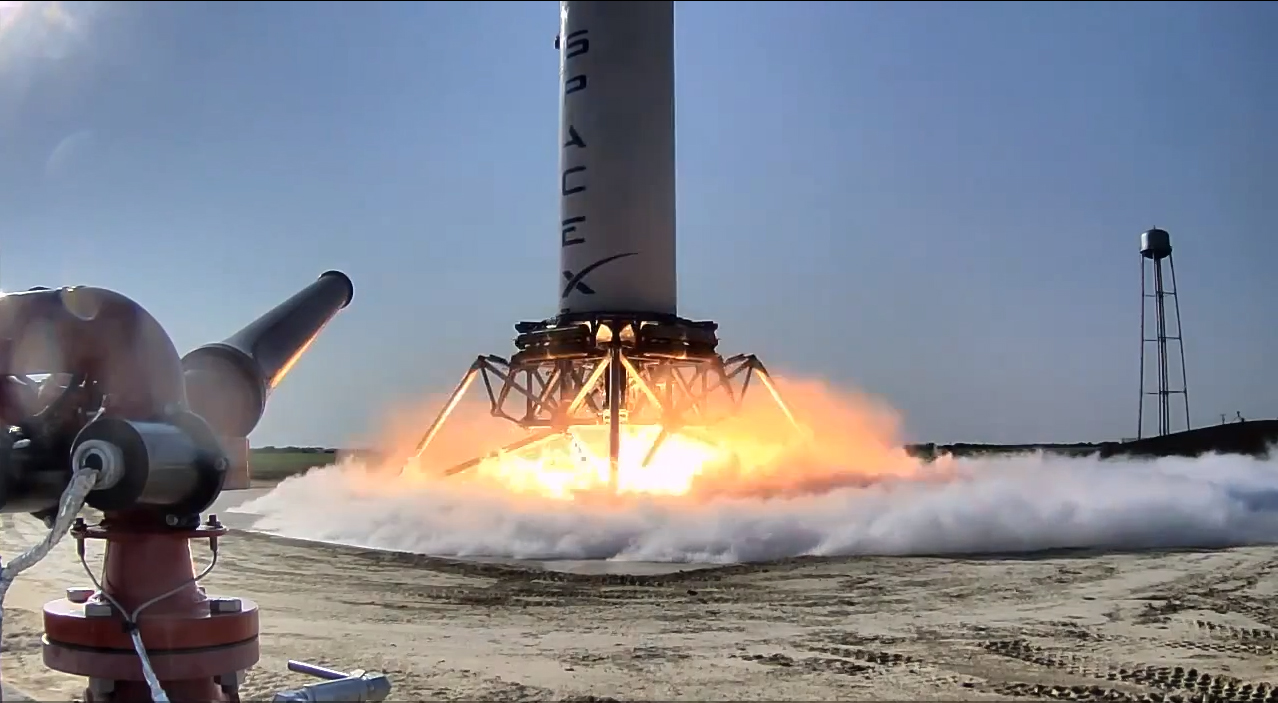
    The launch of the Grasshopper. Credit: SpaceX


    Vertical takeoff, vertical landing (VTVL) is a form of takeoff and landing for rockets. VTVL technologies were developed substantially with small rockets after 2000, in part due to incentive prize competitions like the Lunar Lander Challenge.

    Recently, the private space enterprise SpaceX undertook a new test attempt with their Grasshopper VTVL-rocket, this time they managed to fly to an altitude of 744 meters (2441 feet) and then land again.

    In the clip below, a single camera follows the rocket as it gains height, reaches its peak, begins descending, and then lands again, all vertically.

    The Grasshopper rockets are being developed by SpaceX for use in resupply missions to the International Space Station and beyond. The rockets will be reusable and thereby make them a much more cost-efficient solution for future space entry and exit.

    The Grasshopper project was announced by SpaceX in 2011 and began low-altitude, low-velocity hover/landing testing in 2012. What makes the project unusual is that it is being developed and tested by a private company, Space Exploration Technologies (SpaceX).
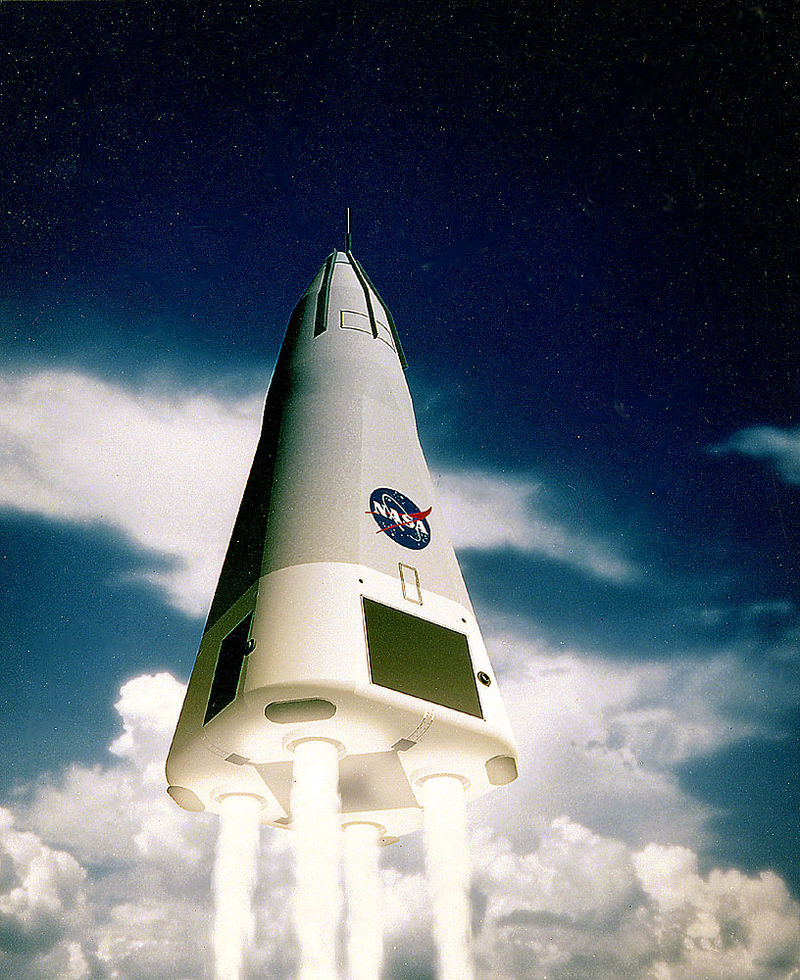
    McDonnell Douglas DC-XA Reusable Launch Vehicle (RLV) concept. Credit: McDonnell Douglas/NASA

    The Grasshopper rocket is however not the first of its kind. The concept of Vertical Takeoff and Vertical Landing (VTVL) has been tested since the 1960s, with multiple VTVL craft developed and flown since.

    One of the more famous of these was the McDonnell Douglas DC-X that was in development during the 1990s. The DC-X was a prototype and never designed to achieve orbital altitudes or velocity. Instead, it was to demonstrate the concept of vertical take-off and landing.

    The DC-X made several successful flights, but on its last one, it fell over and was heavily damaged. Normally the structural damage from such a fall would only constitute a smaller setback, but due to a new focus by NASA on budget constraints – the project was scrapped.
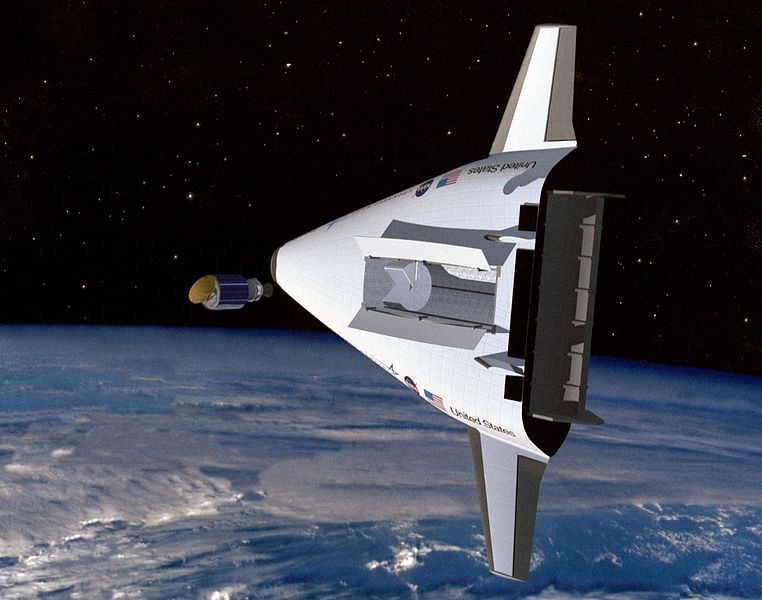
    A Simulated view of the VentureStar in low earth orbit. Credit: NASA/Lockheed Martin

    At the time, the DC-X project was also in competition for funding by the Lockheed Martin X-33/VentureStar project. The VentureStar was to be a single-stage-to-orbit vehicle, launching vertically but returning as an airplane. However, failures in VentureStar’s technology demonstrator, the X-33, and in particular its composite liquid hydrogen tank, led to programs cancellation and the removal of federal funding in February 2001.

    What makes the VentureStar program even more impressive is that it would have been much more environmentally friendly than the Space Shuttle program (STS). Since, instead of using solid rocket boosters with chemical wastes during launch, the VentureStar’s exhausts would have consisted of only water vapor, with its main fuels being liquid hydrogen and liquid oxygen.
     

    SpaceX Vertical Landing VTVL - Vertical Takeoff
    Share. Facebook Twitter Pinterest LinkedIn Tumblr Email Copy Link

    Related Posts

    NASA Unleashes the Future of Rocketry with the Rotating Detonation Rocket Engine

    December 25, 2023

    Follow the Journey of the James Webb Telescope to its Final Destination

    December 27, 2021

    SpaceX Capsule and NASA Crew Make Historic Splashdown

    August 3, 2020

    NASA and SpaceX are Making History Launching Astronauts to Space! | NASA Live

    May 27, 2020

    NASA Designing Advanced Shapeshifting Robots for Saturn’s Moons

    October 21, 2019

    NASA’s InSight Lander Plops Seismometer on Mars to Hunt Marsquakes

    December 24, 2018
    Recent Posts
    • How the End of Bretton Woods Reshaped Our Economies — and Our Politics
    • Can the U.S. Really Handle 250% Debt-to-GDP? Why Jackson Hole’s Daring Paper Is Wrong
    • Japan’s Fiscal Trap: What Happens If Austerity Is No Longer an Option?
    • The Rise of Range Extended Electric Vehicles (REEVs): A New Era of Hybrid Mobility
    • The Great Capital Rotation: A Shift from U.S. Treasuries to Gold and Real Assets
    • The Hidden Risks of Short-Term Debt: A Balancing Act in U.S. Fiscal Policy
    • The Looming U.S. Debt Spiral: Understanding the Risks
    • The Looming Recession: Seven Economic Indicators Flashing Red for 2025
    • Europa Clipper: NASA’s Mission to Unlock the Secrets of Jupiter’s Icy Moon
    • Could Hedge Funds Cause Chaos in the U.S. Treasury Market? And What About Inflation?
    © 2025 Illustrated Curiosity

    Type above and press Enter to search. Press Esc to cancel.

    This website uses cookies to improve your experience. We'll assume you're ok with this, but you can opt-out if you wish.Accept Reject Read More
    Privacy & Cookies Policy

    Privacy Overview

    This website uses cookies to improve your experience while you navigate through the website. Out of these, the cookies that are categorized as necessary are stored on your browser as they are essential for the working of basic functionalities of the website. We also use third-party cookies that help us analyze and understand how you use this website. These cookies will be stored in your browser only with your consent. You also have the option to opt-out of these cookies. But opting out of some of these cookies may affect your browsing experience.
    Necessary
    Always Enabled
    Necessary cookies are absolutely essential for the website to function properly. This category only includes cookies that ensures basic functionalities and security features of the website. These cookies do not store any personal information.
    Non-necessary
    Any cookies that may not be particularly necessary for the website to function and is used specifically to collect user personal data via analytics, ads, other embedded contents are termed as non-necessary cookies. It is mandatory to procure user consent prior to running these cookies on your website.
    SAVE & ACCEPT