
Close Menu
Illustrated Curiosity
    Facebook X (Twitter) Instagram YouTube
    Illustrated Curiosity
    • Earth
    • Economics
    • Environment
      • Climate
      • Environmental Tech
      • Pollution
      • Wildlife
    • Health
      • Health Tech
      • Medicine
      • Nutrition
      • Exercise
    • History
      • Prehistory
      • Ancient History
      • Postclassical Era
      • Modern History
    • Humans
      • Human Brain
      • Psychology
    • Life
      • Animals & Plants
      • Genetics
      • Paleontology
      • Evolution
      • Genetic Engineering
    • Physics
    • Space
      • Astrobiology
      • Astronomy
      • Extrasolar Planets
      • Space Tech
      • Spaceflight
    • Technology
      • Artificial Intelligence
      • Energy
      • Engineering
      • Materials
      • Robotics
      • Vehicles
    Illustrated Curiosity
    Home » A Solar-Powered Machine That Makes Drinkable Water Out of Urine
    Environmental Tech

    A Solar-Powered Machine That Makes Drinkable Water Out of Urine

    July 28, 20162 Mins Read
    Share
    Facebook Twitter LinkedIn Pinterest Email

    Public domain.

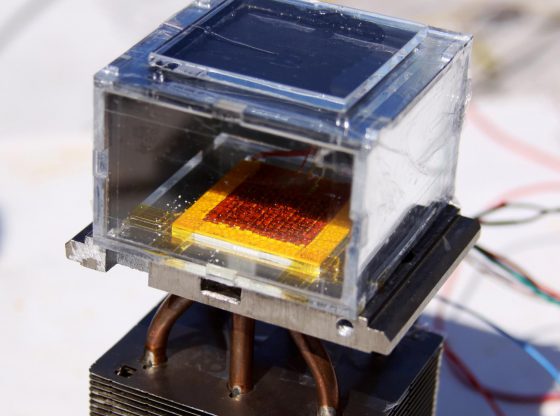
    Researchers at the University of Ghent in Belgium have made a solar powered machine that converts urine into drinkable water and fertilizers.

    As proof of concept, the researchers tested the machine on festival visitors, during a music festival in Ghent. The festival resulted in one thousand liters of water that was recovered from the visitors’ urine, according to the researchers.

    The urine is first stored in a large tank that is heated by a solar powered boiler. The content is then filtered so that the water is recovered and other substances such as nitrogen, phosphorus and potassium are separated.

    The use of solar power certainly increase the environmental and sustainability aspects of the machine, but this isn’t the most fascinating aspect of this pee-converter – it’s the use of a process of membrane distillation capable of removing around 95% of the ammonia found in urine.

    “Human urine offers some interesting possibilities for ammonia and potable water recovery,” the team writes in a press release. “Membrane distillation holds possible advantages over existing urine treatment technologies, specifically regarding ammonia recovery.”

    “The possibility of potable water production was investigated in human urine by assessing the permeate water quality, maximum recovery, and mid-term process stability,” they add. “It was shown that at least 75% of the available water could be recovered from non-hydrolyzed human urine without process failure. As such, membrane distillation is a viable alternative for existing urine treatment.”

    A machine like this could be used in developing countries and in rural areas where the need for drinking water is large and the power supply inadequate, according to the researchers.

    The goal now is to install larger versions of the machine at airports and sports stadiums. The water that was filtered out at the music festival will now be used in the production of Belgian beer.

    _____________
    Full nitrogen recovery and potable water production from human urine by membrane distillation
    __________________________
    Drinkable Water Recycling Sustainability Sustainable Food Production
    Share. Facebook Twitter Pinterest LinkedIn Tumblr Email Copy Link

    Related Posts

    This Plastic Can Be Recycled An “Infinite” Number of Times

    May 8, 2018

    Video | Feeding the Planet in 2025: Marriage of Food & Technology

    December 6, 2017

    Plants under attack can turn hungry caterpillars into cannibals

    September 22, 2017

    Video | Managing water resources

    August 30, 2017

    Small fraction of worlds oceans could meet world’s fish demand

    August 17, 2017

    Protein produced with electricity to alleviate world hunger

    July 25, 2017
    Recent Posts
    • America’s Quiet Shift Into Fiscal Dominance: Why Inflation May Be Preparing for a Second Act
    • How the End of Bretton Woods Reshaped Our Economies — and Our Politics
    • Can the U.S. Really Handle 250% Debt-to-GDP? Why Jackson Hole’s Daring Paper Is Wrong
    • Japan’s Fiscal Trap: What Happens If Austerity Is No Longer an Option?
    • The Rise of Range Extended Electric Vehicles (REEVs): A New Era of Hybrid Mobility
    • The Great Capital Rotation: A Shift from U.S. Treasuries to Gold and Real Assets
    • The Hidden Risks of Short-Term Debt: A Balancing Act in U.S. Fiscal Policy
    • The Looming U.S. Debt Spiral: Understanding the Risks
    • The Looming Recession: Seven Economic Indicators Flashing Red for 2025
    • Europa Clipper: NASA’s Mission to Unlock the Secrets of Jupiter’s Icy Moon
    © 2025 Illustrated Curiosity

    Type above and press Enter to search. Press Esc to cancel.

    This website uses cookies to improve your experience. We'll assume you're ok with this, but you can opt-out if you wish.Accept Reject Read More
    Privacy & Cookies Policy

    Privacy Overview

    This website uses cookies to improve your experience while you navigate through the website. Out of these, the cookies that are categorized as necessary are stored on your browser as they are essential for the working of basic functionalities of the website. We also use third-party cookies that help us analyze and understand how you use this website. These cookies will be stored in your browser only with your consent. You also have the option to opt-out of these cookies. But opting out of some of these cookies may affect your browsing experience.
    Necessary
    Always Enabled
    Necessary cookies are absolutely essential for the website to function properly. This category only includes cookies that ensures basic functionalities and security features of the website. These cookies do not store any personal information.
    Non-necessary
    Any cookies that may not be particularly necessary for the website to function and is used specifically to collect user personal data via analytics, ads, other embedded contents are termed as non-necessary cookies. It is mandatory to procure user consent prior to running these cookies on your website.
    SAVE & ACCEPT