Close Menu
Illustrated Curiosity | Economics, History, Science, Space, Technology, Health, Physics, Earth
    Facebook X (Twitter) Instagram YouTube
    Illustrated Curiosity | Economics, History, Science, Space, Technology, Health, Physics, Earth
    • Earth
    • Economics
    • Environment
      • Environmental Tech
      • Pollution
      • Wildlife
    • Health
      • Health Tech
      • Medicine
      • Nutrition
      • Exercise
    • History
      • Prehistory
      • Ancient History
      • Postclassical Era
      • Modern History
    • Humans
      • Human Brain
      • Psychology
    • Life
      • Animals & Plants
      • Genetics
      • Paleontology
      • Evolution
      • Genetic Engineering
    • Physics
    • Space
      • Astrobiology
      • Astronomy
      • Extrasolar Planets
      • Space Tech
      • Spaceflight
    • Technology
      • Artificial Intelligence
      • Energy
      • Engineering
      • Materials
      • Robotics
      • Vehicles
    Illustrated Curiosity | Economics, History, Science, Space, Technology, Health, Physics, Earth
    Home » Astronomers discover traces of methyl chloride around infant stars and nearby comet
    Astrobiology

    Astronomers discover traces of methyl chloride around infant stars and nearby comet

    October 3, 20172 Mins Read
    Illustration by Illustrated Curiosity
    Share
    Facebook Twitter LinkedIn Pinterest Email

    Astronomers have detected traces of an organic compound known as methyl chloride around a group of young stars.
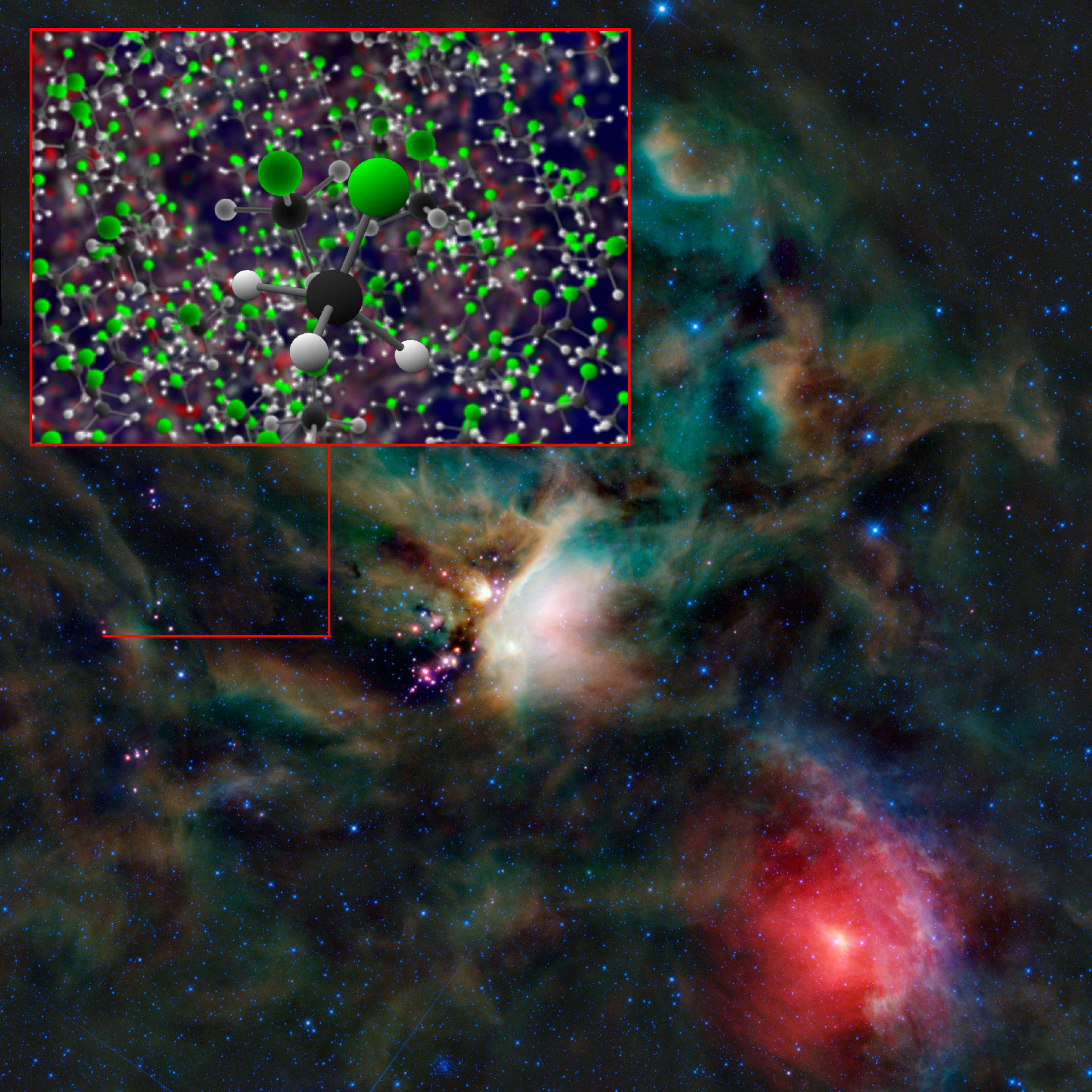
    The Freon-40 molecule was detected in a young solar system 400 light-years away, and previously also on comet 67P/Churyumov-Gerasimenko (67P/C-G) within our own solar system.

    Freon-40, or methyl chloride as it is also called, is formed on Earth through biological and industrial processes. Therefore, it has been assumed that these types of molecules could be signs of life.

    But the research team believes that life cannot have occurred at the places where they have now discovered freon-40 and that therefore squashes the idea of using freon-40 as an indicator of extraterrestrial life.

    Freon is a halogen, a reactive, non-metallic element that produces acidic compounds when introduced to hydrogen, and also includes the elements fluorine, chlorine, bromine, iodine, and astatine.

    “This does, however, raise the question: How much of the comet’s organic content is directly inherited from the early stages of star formation?”

    “Additional searches for organohalogens around other protostars and comets need to be undertaken to help find the answer.”

    – Lead author Edith Fayolle, a researcher with the Harvard-Smithsonian Center for Astrophysics (CfA) in Cambridge, Massachusetts.

    The astronomers were able to detect the methyl chloride by taking advantage of ALMA’s (Atacama Large Millimeter Array) molecule sniffing capabilities. This dish can detect faint radio signals emitted by collections of molecules in space.

    The comet 67P/C-G was investigated by the Rosetta space probe.

    Reference:

    Edith C. Fayolle et al., Protostellar and Cometary Detections of Organohalogens, Nature Astronomy 1, 703-708 (2017), doi: 10.1038 / s41550-017-0237-7
    ALMA - tacama Large Millimeter Array
    Share. Facebook Twitter Pinterest LinkedIn Tumblr Email Copy Link

    Related Posts

    Europa Clipper: NASA’s Mission to Unlock the Secrets of Jupiter’s Icy Moon

    October 20, 2024

    The Phosphine Discovered in Venus’ Clouds May Be a Big Deal

    September 21, 2020

    There Is Definitely Methane on Mars, Scientists Say. But Is It a Sign of Life?

    April 4, 2019

    NASA Is Working With Billionaire Yuri Milner To Search For Life On Enceladus

    November 12, 2018

    Salty Water Under the Surface of Mars Could Have Enough Oxygen for Life

    November 2, 2018

    NASA Finds ‘Organic’ Substances on Mars

    June 18, 2018
    Recent Posts
    • The Day the Alliance Died
    • Evaluating Heart Disease: How Cumulative Diet Choices Compound Your Risk
    • What Would Happen If China Attacked Taiwan?
    • Geopoliticisation as a Structural Tailwind for Commodity Prices
    • America’s Economic Remodel: Who’s Really Paying the Bill?
    • Why Inflation May Be Preparing for a Second Act
    • How the End of Bretton Woods Reshaped Our Economies — and Our Politics
    • Can the U.S. Really Handle 250% Debt-to-GDP? Why Jackson Hole’s Daring Paper Is Wrong
    • Japan’s Fiscal Trap: What Happens If Austerity Is No Longer an Option?
    • The Rise of Range Extended Electric Vehicles (REEVs): A New Era of Hybrid Mobility
    © 2025 Illustrated Curiosity

    Type above and press Enter to search. Press Esc to cancel.