
Light on a microchip, this is what researchers at the University of Sydney have managed by dramatically slowing down digital information carried as light waves by transferring the data into sound waves in an integrated circuit, or microchip.
The exponential increase in computer speed has been a sort of zero-sum game between three major players: size, power, and heat. There are no escaping the fact that we are approaching the end of Moore’s law given present silicon semiconductor technology and electron data transmission.
Physicists and companies like IBM and Intel are working to find an alternative and faster source of information transmission than electricity. Light is perfect for the task – and in order to store and process data as light, they will need to develop a photonic chip.
Lightspeed
The particles of light, photons, do not generate heat. In addition, the data is transmitted faster than electrons, bandwidth is increased, less energy consumed, there is no heat associated with electronic resistance, and without electromagnetic fields noise due to interference from electromagnetic radiation.
But the researchers are struggling with a major problem: How can the photonic chip be able to receive data and process it when light travels at 300,000 kilometers per second.
Turn light into sound
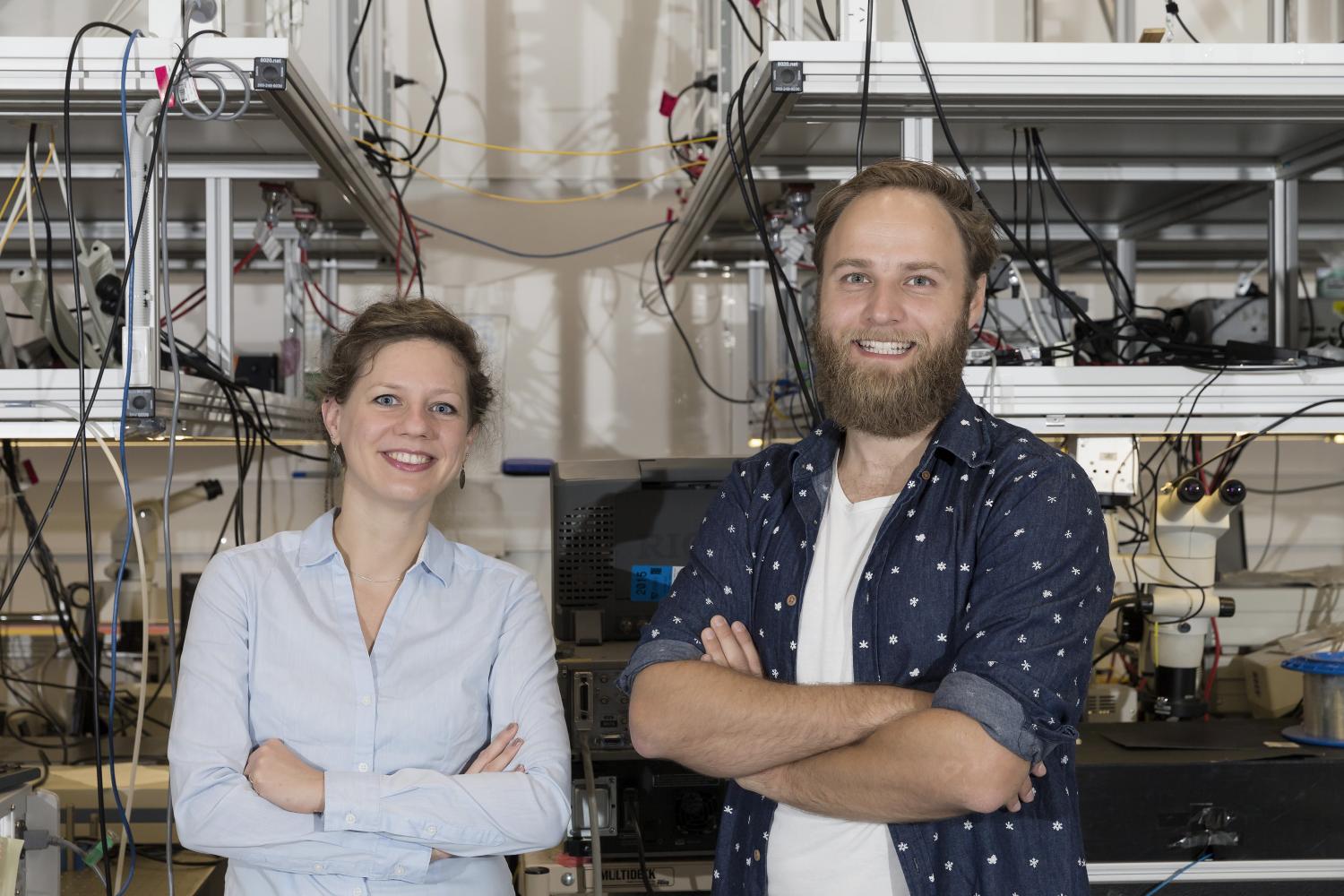
Researchers from the University of Sydney in Australia has found an answer to this problem. They have managed to ‘break’ the photons in a microchip and “park” data in a sound wave so the data stays in the chip five times longer.
This will facilitate a pause, during which the computer is able to retrieve and process data from the chip, and this with greater precision than is possible today.
“Storing or delaying optical signals has been a major driving force for a wide variety of research efforts as it offers new possibilities in all-optical processing and enhanced light-matter interactions,”
“An optical buffer that is able to maintain the coherence of the optical signal… and is able to operate at multiple wavelengths would greatly enhance the capacity of photonic integrated circuits and optically interconnects.”
– The authors write in their paper – A chip-integrated coherent photonic-phononic memory – published in Nature Communications.
However, more trials and more development are required before the microchip can move from prototype to any computer near you. And whether future computers might use atoms, DNA or light. Or whether computers will go from quartz to quantum, researchers around the world are working on breaking Moores law.
Reference:
Moritz Merklein, Birgit Stiller, Khu Vu, Stephen J. Madden & Benjamin J. Eggleton A chip-integrated coherent photonic-phononic memory Nature Communications 8, Article number: 574 (2017)
doi:10.1038/s41467-017-00717-y