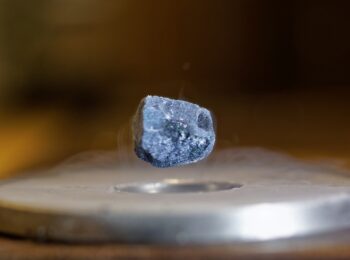


For the first time, researchers have been able to create three-dimensional moving images that also sound and feel, using ultrasound and technology reminiscent of an old television set.
The first time Luke Skywalker gets to see Princess Leia, it’s as a talking hologram, a three-dimensional image projected by R2-D2.
“Help me, Obi-Wan Kenobi; you’re my only hope.”
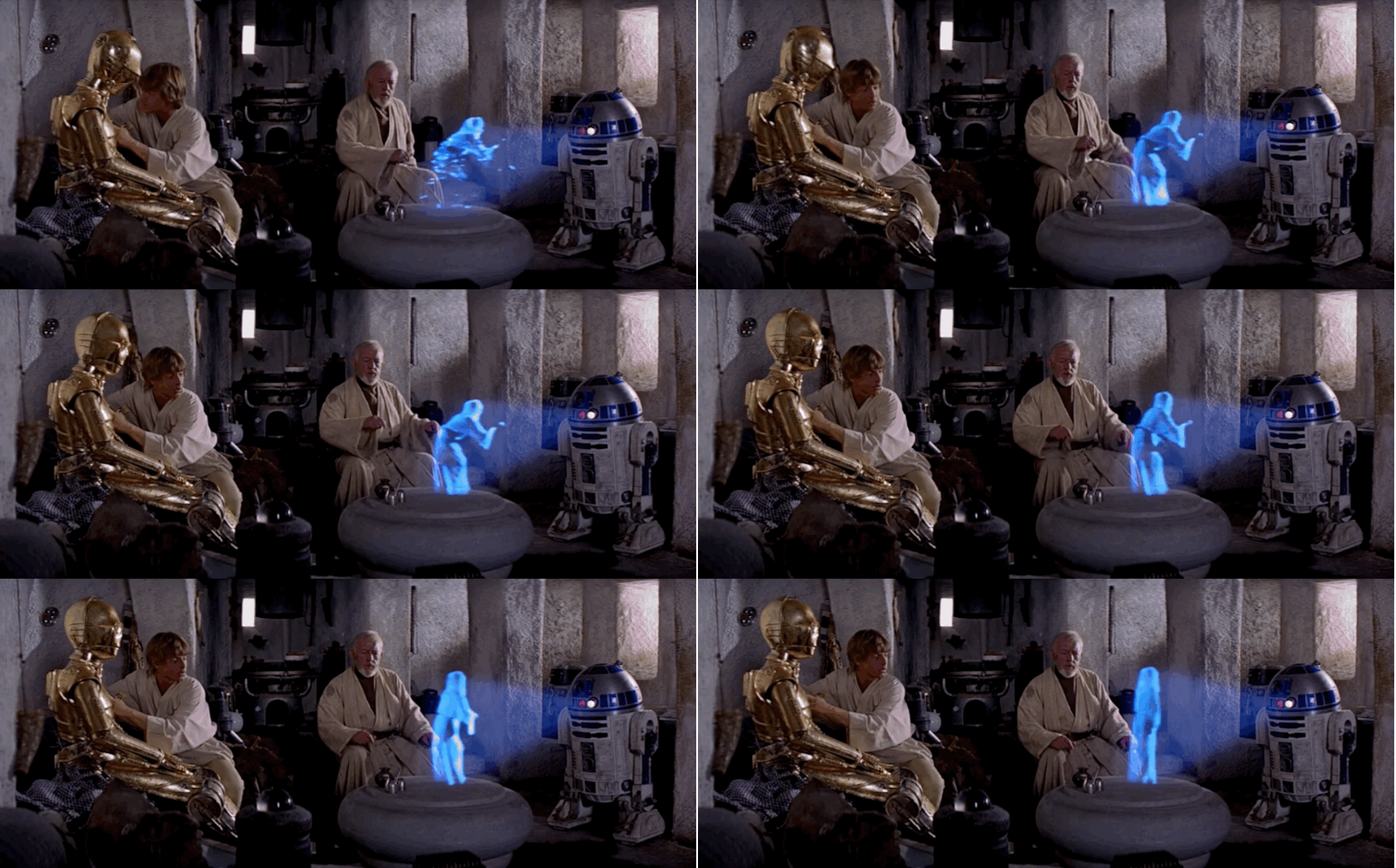
Ryuji Hirayama at the Department of Informatics at the University of Sussex in the United Kingdom and his team have for the first time managed to create something very similar: a three-dimensional image that can move and sound, and also with a sensation of touch.
“I believe that in the future, such displays will allow us to interact with our family and friends as if they are close by, so you can see, touch and hear them,”
– Ryuji Hirayama said.
There are several different technologies for creating three-dimensional images and holograms, for example using lasers that create brilliant plasma and generate three-dimensional images. But the new method can also add sound and touch for a more interesting sensation.
So far, there are small and simple images the scientists have created – a small colorful butterfly that flies through the air, emojis, numbers and letters. But no special glasses or tools are needed to see them, and when you extend your hand to touch them you feel them, a sensation similar to the feeling of touching a jet of flowing air.
The Hungarian physicist Dennis Gabor was the first to develop a technical method for making three-dimensional images. He experimented with a heavily filtered mercury arc light source and in 1948 he got the idea for the hologram. But it was only when the first laser was built in 1960 that it became possible in practice. Dennis Gabor received the Nobel Prize in physics in 1971 for the discovery, which provides images that look three-dimensional when viewed, despite the fact that the image is two-dimensional.
Since then, more modern approaches are to create figures using laser beams. The laser hit containers filled with a liquid or gas that is normally transparent but that is lit by the laser. Another method is to allow lasers to heat up the air itself in a small area so much that the electrons in the air molecules can leave their atomic nuclei so that it becomes plasma, ie a luminous charged gas.
Ryuji Hirayama and his co-workers have instead taken inspiration from old TV screens. There, a colored beam swept across the screen so fast that the brain perceived it as a single image. Scientists in Sussex use a small plastic ball, only one millimeter in size, that is kept floating in the air and is controlled by ultrasound from rows of small speakers. The ball moves back and forth quickly, building up the three-dimensional images line by line, much like the beam of light that sweeps across the TV screen. The image gets color from LED lights that glow on the ball.
The team demonstrates a small butterfly about two inches wide, close to the limit of how big the holograms can be if they are to look real to a viewer in the room. The whole picture has to be built up very quickly in real-time, in about 100 milliseconds, in order for it to look like a whole object, like the butterfly. The researchers present their results in the journal Nature. The article also contains pictures and films on a globe with a diameter of more than six centimeters.
Ultrasound is sound waves with really high frequencies, higher than 20 kilohertz and higher than we can hear with hearing. The sound waves contain enough energy to capture and control the plastic ball. The sound of the image is generated by so-called amplitude modulation, AM, the same technology used in old radio transmitters. The amplitude, or the maximum impact on the ultrasonic waves, is varied to produce waves with lower frequencies, that is, sounds that we can hear.
The ultrasonic speakers can also form a shape that can be felt by hand. The team generates ultrasound for two separate reasons, one that holds the ball and one that generates a sensation of touch. They are not in the exact same place, but they also do not disturb each other. You can only feel the hologram from the front and the sides but if you put your hand under or over the picture you disturb the ultrasonic waves so that the ball falls down.
The team is now experimenting with using multiple bullets at the same time to create more advanced images.
“We are up in six or eight balls. With eight bullets it is eight times faster to swipe the image, and it becomes possible to make more complex shapes.”
– Ryuji Hirayama.
Larger and stronger speakers would also give better pictures, higher sounds, and more sophisticated sensations.
The technology is cheap because the researchers have only used ready-made components that are available for purchase in regular stores. Ryuji Hirayama sees many applications other than three-dimensional images.
“We can lift much more than plastic balls, such as diamonds or small liquid droplets. It is useful for chemical applications, when we can lift, control and mix drops of different substances without any vessels to have them in. It is really interesting.”
– Ryuji Hirayama.
Reference:
Ryuji Hirayama, Diego Martinez Plasencia, Nobuyuki Masuda & Sriram Subramanian A volumetric display for visual, tactile and audio presentation using acoustic trapping