Close Menu
Illustrated Curiosity | Economics, History, Science, Space, Technology, Health, Physics, Earth
    Facebook X (Twitter) Instagram YouTube
    Illustrated Curiosity | Economics, History, Science, Space, Technology, Health, Physics, Earth
    • Earth
    • Economics
    • Environment
      • Environmental Tech
      • Pollution
      • Wildlife
    • Health
      • Health Tech
      • Medicine
      • Nutrition
      • Exercise
    • History
      • Prehistory
      • Ancient History
      • Postclassical Era
      • Modern History
    • Humans
      • Human Brain
      • Psychology
    • Life
      • Animals & Plants
      • Genetics
      • Paleontology
      • Evolution
      • Genetic Engineering
    • Physics
    • Space
      • Astrobiology
      • Astronomy
      • Extrasolar Planets
      • Space Tech
      • Spaceflight
    • Technology
      • Artificial Intelligence
      • Energy
      • Engineering
      • Materials
      • Robotics
      • Vehicles
    Illustrated Curiosity | Economics, History, Science, Space, Technology, Health, Physics, Earth
    Home » Huge Water Reserves Spotted On Mars
    Astrobiology

    Huge Water Reserves Spotted On Mars

    January 12, 20183 Mins Read
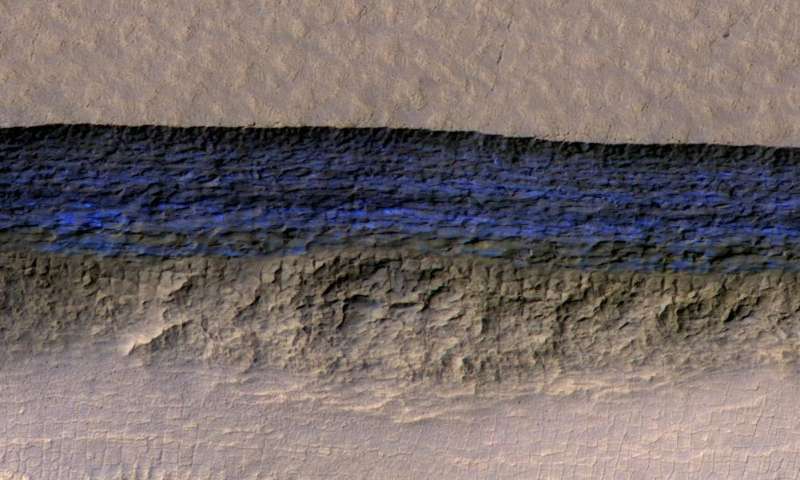
    A cross-section of a thick sheet of underground ice is exposed at the steep slope (or scarp) that appears bright blue in this enhanced-color view from the High Resolution Imaging Science Experiment (HiRISE) camera on NASA's Mars Reconnaissance Orbiter. The view covers an area about 550 yards (500 meters) wide. Figure 1 includes a 100-meter (109-yard) scale bar. North is toward the top. The upper third of the image shows level ground that is about 140 yards (130 meters) higher in elevation than the ground in the bottom third. In between, the scarp descends sharply, exposing about 260 vertical feet (80 vertical meters) of water ice. Color is exaggerated to make differences in surface materials easier to see. The presence of exposed water ice at this site was confirmed by observation with the same orbiter's Compact Reconnaissance Imaging Spectrometer for Mars (CRISM). Image: NASA
    Share
    Facebook Twitter LinkedIn Pinterest Email

    Astronomers have found sheets of ice just below the surface of Mars. The NASA images show layers of ice peeking out of eroded cliffs. A potential blessing for future humans on the red planet.

    By examining images from the Mars Reconnaissance Orbiter (MRO) in orbit around Mars, American scientists have discovered eight scarps with steep slopes that reveal new information about the internal layered structure of previously detected underground ice sheets in Mars’ middle latitudes.

    “There is shallow ground ice under roughly a third of the Martian surface, which records the recent history of Mars,”

    “What we’ve seen here are cross-sections through the ice that give us a 3-D view with more detail than ever before.”

    – Study’s lead author, Colin Dundas of the U.S. Geological Survey’s Astrogeology Science Center in Flagstaff, Arizona.

    The ice, which is weathered by wind, begins a few meters below the surface itself and is in some places over 100 meters thick.

    According to earlier estimates, the underground ice covers one-third of the surface on Mars, but how much and how clean it is has been unclear.

    Scientists have not determined how these particular scarps initially form. We do know that Mars had a watery past, and it’s expected that much of the water is still on the planet. But the researchers’ reason is that this particular ice is probably formed by snow falling on Mars during the periods when the planet’s polar axis leans more, which occurs at intervals of about 120,000 years.

    At these intervals, it gets warmer in the north and south, and frozen water turns into steam, which then results in snowing closer to the equator on Mars, and this is where scientists have found the big ice sheets.
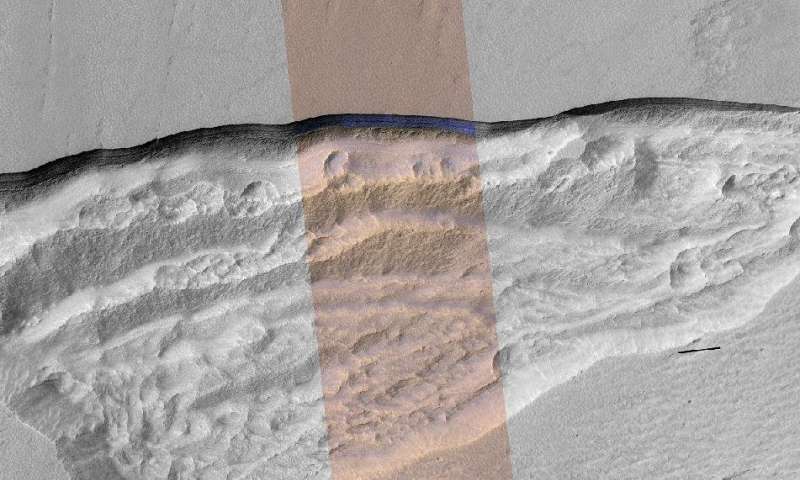
    At this wedge-shaped pit on Mars, the steep slope (or scarp) at the northern edge (toward the top of the image) exposes a cross-section of a thick sheet of underground water ice. The image is from the High Resolution Imaging Stereo Experiment (HiRISE) camera on NASA’s Mars Reconnaissance Orbiter. The gray-scale portions on the left and right are from a single waveband in the red-light portion of the visible spectrum. The middle section, in enhanced color, combines data from red, near-infrared, and blue-green wavebands. The scene covers an area about three miles (five kilometers) wide. Figure 1 includes a one-kilometer scale bar. One kilometer is about six-tenths of a mile. The ice-exposing scarp at the northern edge of the pit has a steepness of about 45 to 55 degrees, plunging from the relatively level ground outside the pit. Image: NASA

    The very smooth sectional area that emerged along the rocks indicates that the ice is hard, solid, and relatively clean from soil and sand. The color of the ice can tell you how the climate changed on Mars and can also contain clues in the quest for life, but to investigate it requires more image analysis and actual samples of the ice.

    While we’ve found plenty of ice near the pole during the Phoenix Lander mission, that’s not a very convenient location for future landings. This newly found underground ice could become a future water reservoir for man as we begin our quest to colonize the red planet. According to NASA, the first astronauts will set foot on Mars within 20 years.

    Reference:

    Colin M. Dundas et. Al. “Exposed subsurface ice sheets in the Martian mid-latitudes“, Science 2018, DOI:10.1126/science.aao1619.
    Extraterrestrial water Mars (Planet)
    Share. Facebook Twitter Pinterest LinkedIn Tumblr Email Copy Link

    Related Posts

    Europa Clipper: NASA’s Mission to Unlock the Secrets of Jupiter’s Icy Moon

    October 20, 2024

    The Phosphine Discovered in Venus’ Clouds May Be a Big Deal

    September 21, 2020

    There Is Definitely Methane on Mars, Scientists Say. But Is It a Sign of Life?

    April 4, 2019

    NASA Is Working With Billionaire Yuri Milner To Search For Life On Enceladus

    November 12, 2018

    Salty Water Under the Surface of Mars Could Have Enough Oxygen for Life

    November 2, 2018

    NASA Finds ‘Organic’ Substances on Mars

    June 18, 2018
    Recent Posts
    • Largest Battles in History: Cannae — Rome’s Darkest Day
    • The Day the Alliance Died
    • Evaluating Heart Disease: How Cumulative Diet Choices Compound Your Risk
    • What Would Happen If China Attacked Taiwan?
    • Geopoliticisation as a Structural Tailwind for Commodity Prices
    • America’s Economic Remodel: Who’s Really Paying the Bill?
    • Why Inflation May Be Preparing for a Second Act
    • How the End of Bretton Woods Reshaped Our Economies — and Our Politics
    • Can the U.S. Really Handle 250% Debt-to-GDP? Why Jackson Hole’s Daring Paper Is Wrong
    • Japan’s Fiscal Trap: What Happens If Austerity Is No Longer an Option?
    © 2025 Illustrated Curiosity

    Type above and press Enter to search. Press Esc to cancel.