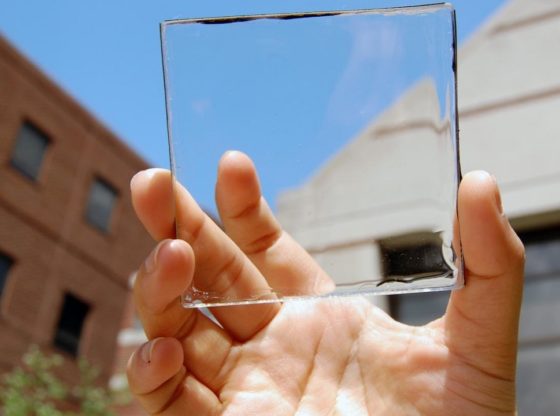

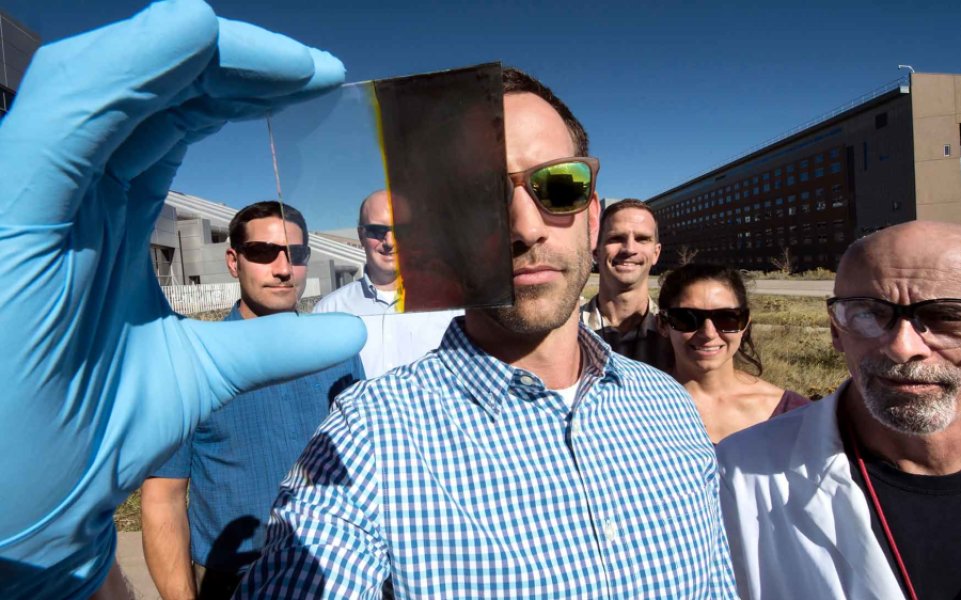
Windows that can harvest solar energy. That’s what researchers working at the U.S. National Renewable Energy Laboratory has managed to accomplish thanks to a new material.
Windows is something that every home, car, and office building has. They are everywhere. We people need light. Imagine if your windows could act as power plants during those moments when you’re not in the room or in your car. This may soon be possible thanks to research at the US National Renewable Energy Laboratory (NREL).
Basically, solar cells and windows can be said to be each other’s opposites. The former shall absorb sunlight, the other shall let it through. To address this problem, the researchers working at NREL used an experimental perovskit material. We recently wrote about this remarkable material, Promising solar cell material Perovskite now water resistant.
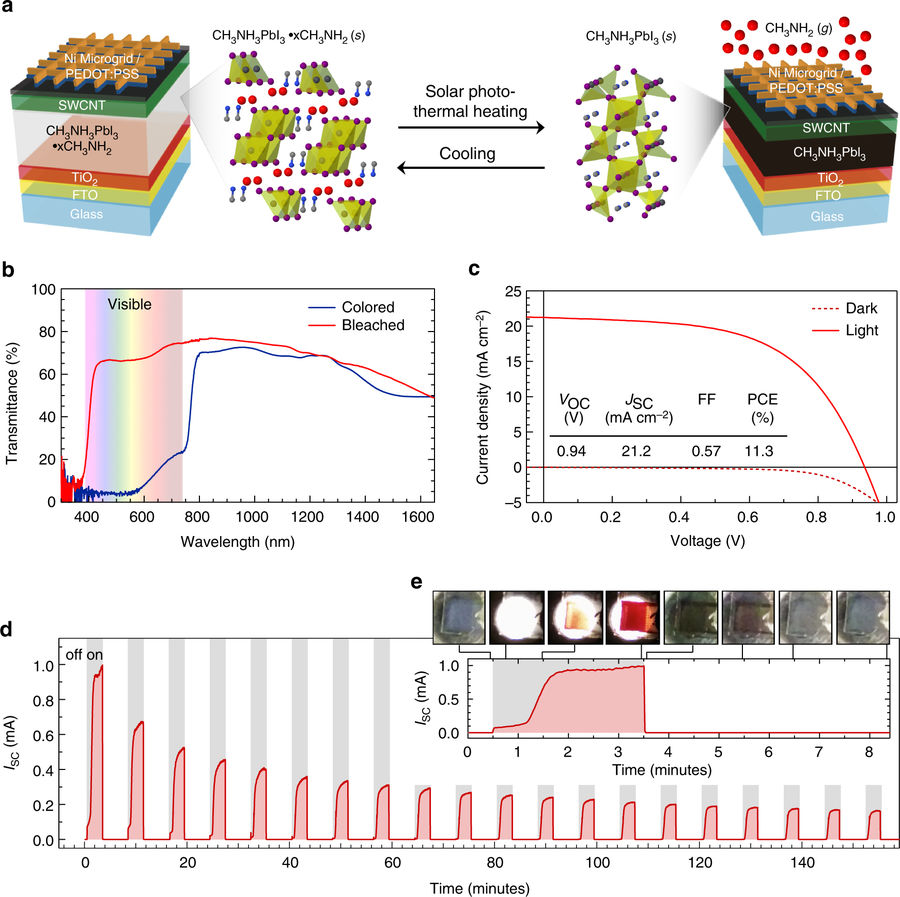
Perovskites denote a group of ceramics whose chemical composition can be varied almost in infinity. This gives enormous possibilities to customize electronic components to achieve just the right features. This what the researchers at NREL have achieved, as they have produced a material that acts as a window and a solar panel, with a solar conversion rate of 11.3 percent.
“There is a fundamental tradeoff between a good window and a good solar cell,”
“This technology bypasses that. We have a good solar cell when there’s lots of sunshine and we have a good window when there’s not.”
– Lance M. Wheeler, lead author of the study.
The solar-cell-window, or ‘smart window’, lets through 68 percent of the visible sunlight spectrum when transparent. When converted to solar cells, a change that takes only three minutes, only three percent of the light is allowed through the window, the rest is used to generate electricity.
In large cities, where the vertical area of buildings far exceeds the horizontal. It would be enormously attractive to be able to harness the sunlight hitting these large surfaces. In fact, heat is a problem in many cities around the world, the hard, dark asphalt and brick surface absorbing almost all the incoming short-wave radiation from the sun, creating what is known as ‘urban heat islands’.


With the costs of cooling down buildings using expensive air condition rising rapidly. These smart windows would essentially kill two birds with one stone, regarding the sunlight as a source of energy and income, instead of as a nuisance and cost.
Even in the automotive industry, the windows of vehicles could act as solar cells when the ignition is turned off, charging the batteries of future electric vehicles.
The potential of these smart windows able to turn into solar panels is unquestionably immense, with many businesses now keen on switching to 100 percent renewable energy, the technology could be a win-win situation, instead of covering office buildings with solar panels at the cost of losing windows, commercial establishments can now have both in one device.
The technology is not ready for the market just yet, though. One major problem is the lifespan of the material. The researchers have noticed that their solar cell windows lose performance after 20 cycles. In comparison, a standard photovoltaic panel can easily keep 80 percent energy conversion efficiency over a period of 25 years. This problem is now their primary focus, but their hope is that commercialization isn’t too far off.
Their research study Switchable Photovoltaic Windows Enabled by Reversible Photothermal Complex Dissociation from Methylammonium Lead Iodide has been published in Nature.
Reference:
Lance M. Wheeler, David T. Moore et al. Switchable Photovoltaic Windows Enabled by Reversible Photothermal Complex Dissociation from Methylammonium Lead Iodide Article number: 1722 (2017) doi:10.1038/s41467-017-01842-4