Close Menu
Illustrated Curiosity
    Facebook X (Twitter) Instagram YouTube
    Illustrated Curiosity
    • Earth
    • Economics
    • Environment
      • Climate
      • Environmental Tech
      • Pollution
      • Wildlife
    • Health
      • Health Tech
      • Medicine
      • Nutrition
      • Exercise
    • History
      • Prehistory
      • Ancient History
      • Postclassical Era
      • Modern History
    • Humans
      • Human Brain
      • Psychology
    • Life
      • Animals & Plants
      • Genetics
      • Paleontology
      • Evolution
      • Genetic Engineering
    • Physics
    • Space
      • Astrobiology
      • Astronomy
      • Extrasolar Planets
      • Space Tech
      • Spaceflight
    • Technology
      • Artificial Intelligence
      • Energy
      • Engineering
      • Materials
      • Robotics
      • Vehicles
    Illustrated Curiosity
    Home » Cheap and Effective “Bio Domes” To Treat Wastewater
    Environmental Tech

    Cheap and Effective “Bio Domes” To Treat Wastewater

    November 30, 2013No Comments2 Mins Read
    Share
    Facebook Twitter LinkedIn Pinterest Email
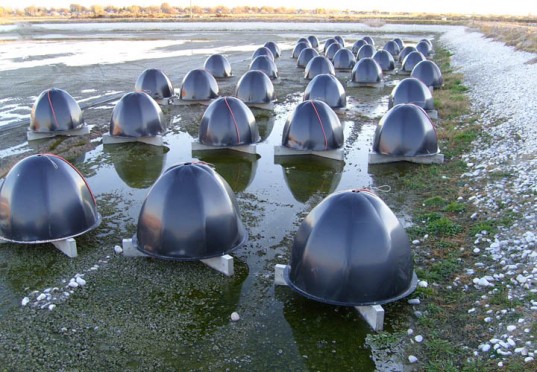
    Credit: Wastewater Compliance Systems

    New technology could lead to simpler wastewater treatment in developing countries, making it both cheaper and more effective.

    The plastic domes are filled with bacteria that makes them as effective in treating wastewater as sewage ponds and expensive purification plants, cleaning wastewater from both organic waste and from chemicals. This is the conclusion after having been tested in several U.S. cities.

    These “Bio Domes” have been developed by engineers at the company Wastewater Compliance Systems in Salt Lake City.

    Plenty of Room for Germs

    Inside each dome, there is a set of a further four domes, and each of these is filled with a crumpled plastic material with a total area that is approximately 260 square meters (2,798 square feet). And thus provide far more living space for the purifying bacteria compared to more traditional sewage ponds, where the bacteria only have the surface water to live on.

    The domes also implement another method to speed up the cleaning process, which is to let the bacteria live in total darkness. Because of this, algae is inhibited to grow and thereby enables the bacteria to eat away alone.

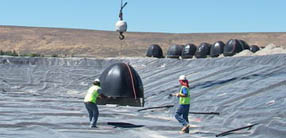
    Because of this darkness, the Bio Domes can be placed on the bottom. Then air is pumped through the domes, to provide oxygen for the bacteria and circulate the wastewater.
    Bio-domes placed on the bottom of an artificial lake. Credit: Wastewater Compliance Systems.

    Cheap and Effective

    The Bio Domes has been tested in several U.S cities and the resulting data indicates that organic waste and suspended solids were reduced consistently by 85 percent; ammonia levels dropped by 98 percent in warm water and 93 percent with a temperature below 50 degrees. Also, nitrogen levels fell by 68 percent in warmer water and 55 percent in cooler water.

    Due to their eco-friendliness, affordable nature and effectiveness – they are indeed a good choice for developing and developed countries alike.

    _______________
    http://www.wastewater-compliance-systems.com/products.html
    ______________________________
    Wastewater
    Share. Facebook Twitter Pinterest LinkedIn Tumblr Email Copy Link

    Related Posts

    Surfers More Likely to Harbour Antibiotic Resistant Superbugs, Study Finds

    January 15, 2018

    Ocean Cleanup to start cleaning plastic from Pacific next year

    May 20, 2017

    Use of electric vehicles can save $60 billion by 2030: Niti Aayog

    May 17, 2017

    A device that pulls drinking water straight out of the air — and runs entirely on the sun’s energy

    April 25, 2017

    Video | A biodegradable robot that eats pollution

    March 22, 2017

    Carbon dioxide can ‘quickly’ be stored as stone

    November 29, 2016
    Recent Posts
    • How the End of Bretton Woods Reshaped Our Economies — and Our Politics
    • Can the U.S. Really Handle 250% Debt-to-GDP? Why Jackson Hole’s Daring Paper Is Wrong
    • Japan’s Fiscal Trap: What Happens If Austerity Is No Longer an Option?
    • The Rise of Range Extended Electric Vehicles (REEVs): A New Era of Hybrid Mobility
    • The Great Capital Rotation: A Shift from U.S. Treasuries to Gold and Real Assets
    • The Hidden Risks of Short-Term Debt: A Balancing Act in U.S. Fiscal Policy
    • The Looming U.S. Debt Spiral: Understanding the Risks
    • The Looming Recession: Seven Economic Indicators Flashing Red for 2025
    • Europa Clipper: NASA’s Mission to Unlock the Secrets of Jupiter’s Icy Moon
    • Could Hedge Funds Cause Chaos in the U.S. Treasury Market? And What About Inflation?
    © 2025 Illustrated Curiosity

    Type above and press Enter to search. Press Esc to cancel.

    This website uses cookies to improve your experience. We'll assume you're ok with this, but you can opt-out if you wish.Accept Reject Read More
    Privacy & Cookies Policy

    Privacy Overview

    This website uses cookies to improve your experience while you navigate through the website. Out of these, the cookies that are categorized as necessary are stored on your browser as they are essential for the working of basic functionalities of the website. We also use third-party cookies that help us analyze and understand how you use this website. These cookies will be stored in your browser only with your consent. You also have the option to opt-out of these cookies. But opting out of some of these cookies may affect your browsing experience.
    Necessary
    Always Enabled
    Necessary cookies are absolutely essential for the website to function properly. This category only includes cookies that ensures basic functionalities and security features of the website. These cookies do not store any personal information.
    Non-necessary
    Any cookies that may not be particularly necessary for the website to function and is used specifically to collect user personal data via analytics, ads, other embedded contents are termed as non-necessary cookies. It is mandatory to procure user consent prior to running these cookies on your website.
    SAVE & ACCEPT