Close Menu
Illustrated Curiosity
    Facebook X (Twitter) Instagram YouTube
    Illustrated Curiosity
    • Earth
    • Economics
    • Environment
      • Climate
      • Environmental Tech
      • Pollution
      • Wildlife
    • Health
      • Health Tech
      • Medicine
      • Nutrition
      • Exercise
    • History
      • Prehistory
      • Ancient History
      • Postclassical Era
      • Modern History
    • Humans
      • Human Brain
      • Psychology
    • Life
      • Animals & Plants
      • Genetics
      • Paleontology
      • Evolution
      • Genetic Engineering
    • Physics
    • Space
      • Astrobiology
      • Astronomy
      • Extrasolar Planets
      • Space Tech
      • Spaceflight
    • Technology
      • Artificial Intelligence
      • Energy
      • Engineering
      • Materials
      • Robotics
      • Vehicles
    Illustrated Curiosity
    Home » Biggest battles in history: The Battle of Changping
    Ancient History

    Biggest battles in history: The Battle of Changping

    December 10, 20162 Comments4 Mins Read
    Share
    Facebook Twitter LinkedIn Pinterest Email

    Battles change the course of history, they win wars, they topple thrones and redraw borders. Battles have been a part of human history since the beginning of time. They are an intricate part of wars and the events that set the path of events to follow, as instruments molding the future.

    By deciding which group, nation or alliance that ends up victorious, they influence the spread of ideology, culture, civilization and religious dogma. Some battles are not directly influential on the path of history on their own, but rather, influential as instruments of propaganda with an impact on public opinion.

    This series of articles highlights some of these decisive engagements, but rather than ranking the battles according to their influence on history. Each article will detail the narrative, what happened, what the participants, the leaders and the people of that time thought in those rare cases where their words have been documented parts of history.

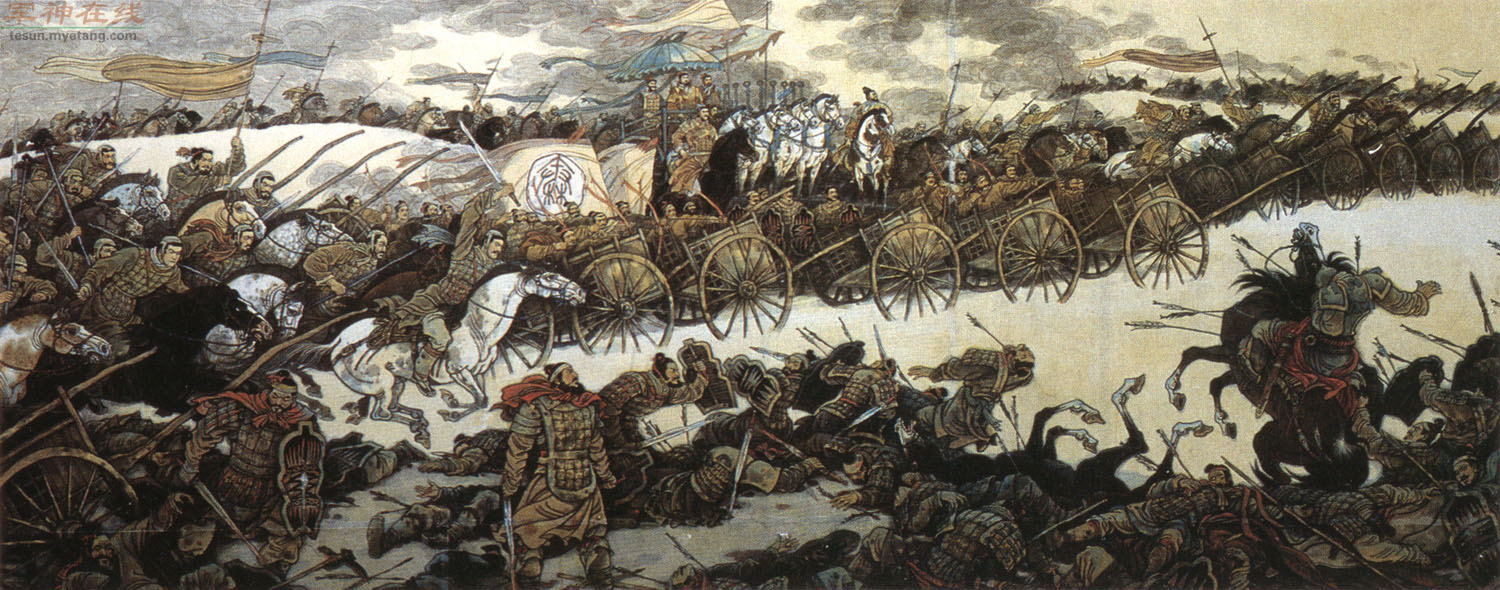
    The Battle of Changping (長平之戰) was a military campaign during the Warring States period in ancient China. It was a decisive battle in the history of ancient China and a decisive victory for the State of Qin over the State of Zhao in 260 BCE.
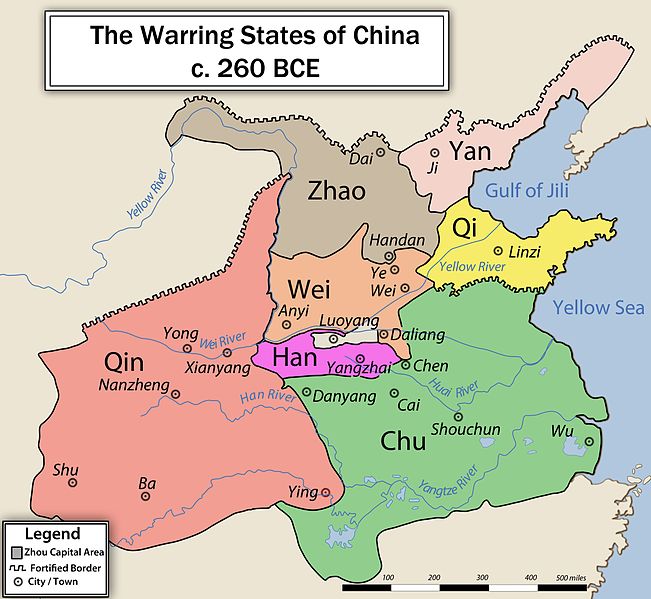
    China Map 260BCE Warring States Period

    The Warring States period was a period in ancient China when the Kingdom of Qin would unify China under the Qin dynasty. The political landscape in China previous to the unification was split between seven major states, Qin, The Three Jins, Qi, Chu, and Yan.
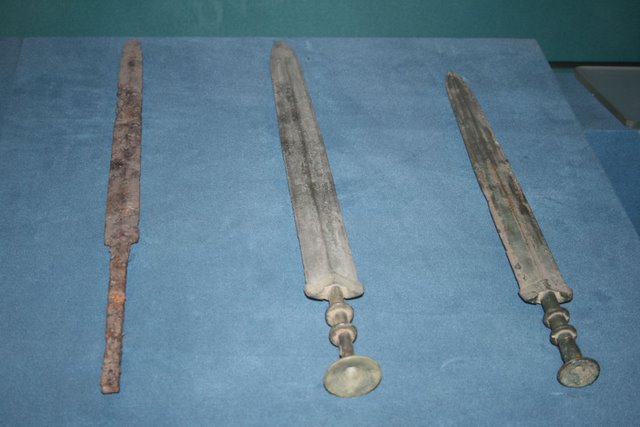
    An iron sword and two bronze swords from the Chinese Warring States Period.

    Most armies in the Warring States period consisted of a combination of infantry and cavalry, and the earlier use of chariots gradually fell into disfavor.

    The weapons and armor for soldiers gradually changed during the war, from using weapons out of bronze, to iron. So-called ‘Dagger-axes’ were common, and the Qin who produced 18-foot-long pikes.

    This was also around the time when the legendary military strategist Sun Tzu wrote The Art of War ( 孫子兵法). It presents a philosophy of war for managing conflicts and winning battles. It is accepted as a masterpiece on strategy and has been frequently cited and referred to by generals and theorists.

    All warfare is based on deception. Hence, when we are able to attack, we must seem unable; when using our forces, we must appear inactive; when we are near, we must make the enemy believe we are far away; when far away, we must make him believe we are near.

    – Sun Tzu

    Towards the end of the Warring States Period, the state of Qin had become more powerful compared to the other six states. This resulted in policies of the other six states to become more oriented towards dealing with the Qin threat together. It was largely unsuccessful, however, as the Qin was victorious in battle after battle; as Qin conquered the Shu area in 316 BCE, in 293 BCE. the Battle of Yique between Wei allied with Han resulted in a victory for the Qin, Qin attacked the Chu in In 278 BCE and captured their capital city, Ying and in 260 BCE, the Battle of Changping was fought between the Qin and the Zhao.
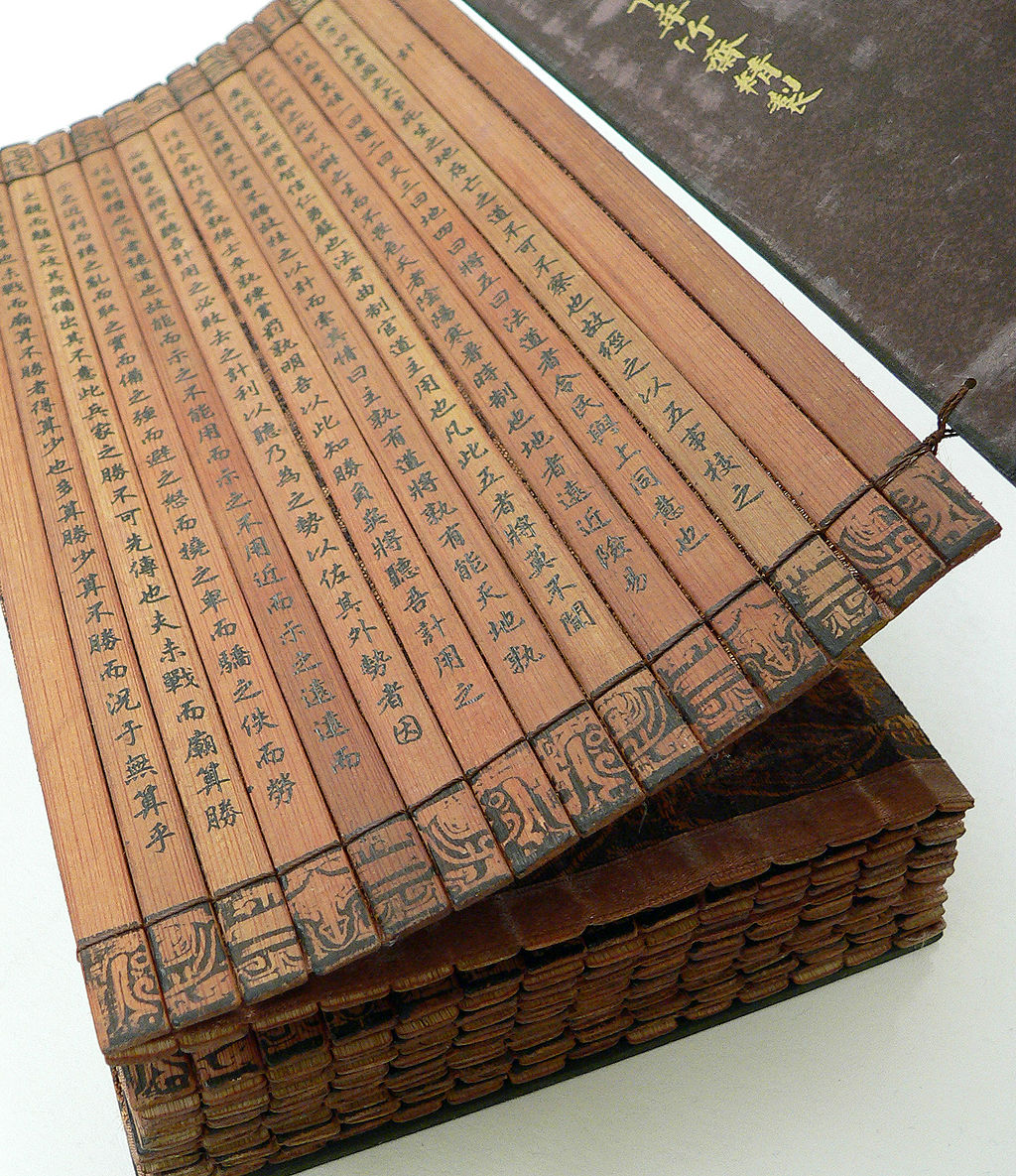
    A bamboo version of The Art of War

    Zhao Kuo commanded an army of approximately 400,000 men. Zhao Kuo was to meet the Qin army in the field but attacked the Qin camp in what was to be a surprise attack. The Qin general Bai Qi responded with a Cannae-like maneuver with his estimated 550,000 soldiers. Just as Hannibal did against the Romans at the Battle of Cannae, the Qin army withdrew at the center, toward the Qin fortress, drawing Zhao Kuo after them, then a body of 25,000 cavalries and 5,000 light cavalries with bows and crossbows remained behind to spring the trap.

    With the enemy trapped, Bai Qi launched a counterattack. The Zhao army was split in two and its supply lines cut. The forces dug down for siege warfare but the Zhao army finally surrendered after 46 days of siege.

    Bai Qi ordered the captured soldiers to be executed. The Chinese ancient historian Sima Qian claimed that over 450,000 Zhao soldiers were killed during and after the battle. The battle would mark the definite defeat of all other kingdoms and Qin to gain military dominance over the other states. And in 221 BCE, the Qin would use this dominance to unify China.


    Ancient China
    Share. Facebook Twitter Pinterest LinkedIn Tumblr Email Copy Link

    Related Posts

    Native Americans of South America sailed to Polynesia in the 12th century

    July 27, 2020

    Oldest and Largest Maya Structure on Record Discovered in Southern Mexico

    June 22, 2020

    Archaeologists in Greece Find 3,500-Year-Old Royal Tombs

    December 23, 2019

    World’s Oldest Intact Shipwreck Discovered in Black Sea

    November 1, 2018

    What Farmers Ate 8,000 Years Ago in Çatalhöyük

    October 9, 2018

    A Remarkably Preserved Sandstone Sphinx Discovered in Egypt

    September 26, 2018
    Recent Posts
    • How the End of Bretton Woods Reshaped Our Economies — and Our Politics
    • Can the U.S. Really Handle 250% Debt-to-GDP? Why Jackson Hole’s Daring Paper Is Wrong
    • Japan’s Fiscal Trap: What Happens If Austerity Is No Longer an Option?
    • The Rise of Range Extended Electric Vehicles (REEVs): A New Era of Hybrid Mobility
    • The Great Capital Rotation: A Shift from U.S. Treasuries to Gold and Real Assets
    • The Hidden Risks of Short-Term Debt: A Balancing Act in U.S. Fiscal Policy
    • The Looming U.S. Debt Spiral: Understanding the Risks
    • The Looming Recession: Seven Economic Indicators Flashing Red for 2025
    • Europa Clipper: NASA’s Mission to Unlock the Secrets of Jupiter’s Icy Moon
    • Could Hedge Funds Cause Chaos in the U.S. Treasury Market? And What About Inflation?
    © 2025 Illustrated Curiosity

    Type above and press Enter to search. Press Esc to cancel.

    This website uses cookies to improve your experience. We'll assume you're ok with this, but you can opt-out if you wish.Accept Reject Read More
    Privacy & Cookies Policy

    Privacy Overview

    This website uses cookies to improve your experience while you navigate through the website. Out of these, the cookies that are categorized as necessary are stored on your browser as they are essential for the working of basic functionalities of the website. We also use third-party cookies that help us analyze and understand how you use this website. These cookies will be stored in your browser only with your consent. You also have the option to opt-out of these cookies. But opting out of some of these cookies may affect your browsing experience.
    Necessary
    Always Enabled
    Necessary cookies are absolutely essential for the website to function properly. This category only includes cookies that ensures basic functionalities and security features of the website. These cookies do not store any personal information.
    Non-necessary
    Any cookies that may not be particularly necessary for the website to function and is used specifically to collect user personal data via analytics, ads, other embedded contents are termed as non-necessary cookies. It is mandatory to procure user consent prior to running these cookies on your website.
    SAVE & ACCEPT