Close Menu
Illustrated Curiosity
    Facebook X (Twitter) Instagram YouTube
    Illustrated Curiosity
    • Earth
    • Economics
    • Environment
      • Climate
      • Environmental Tech
      • Pollution
      • Wildlife
    • Health
      • Health Tech
      • Medicine
      • Nutrition
      • Exercise
    • History
      • Prehistory
      • Ancient History
      • Postclassical Era
      • Modern History
    • Humans
      • Human Brain
      • Psychology
    • Life
      • Animals & Plants
      • Genetics
      • Paleontology
      • Evolution
      • Genetic Engineering
    • Physics
    • Space
      • Astrobiology
      • Astronomy
      • Extrasolar Planets
      • Space Tech
      • Spaceflight
    • Technology
      • Artificial Intelligence
      • Energy
      • Engineering
      • Materials
      • Robotics
      • Vehicles
    Illustrated Curiosity
    Home » The Virus That Shows Where the Vikings Have Been
    Ancient History

    The Virus That Shows Where the Vikings Have Been

    July 9, 20182 Mins Read
    Share
    Facebook Twitter LinkedIn Pinterest Email
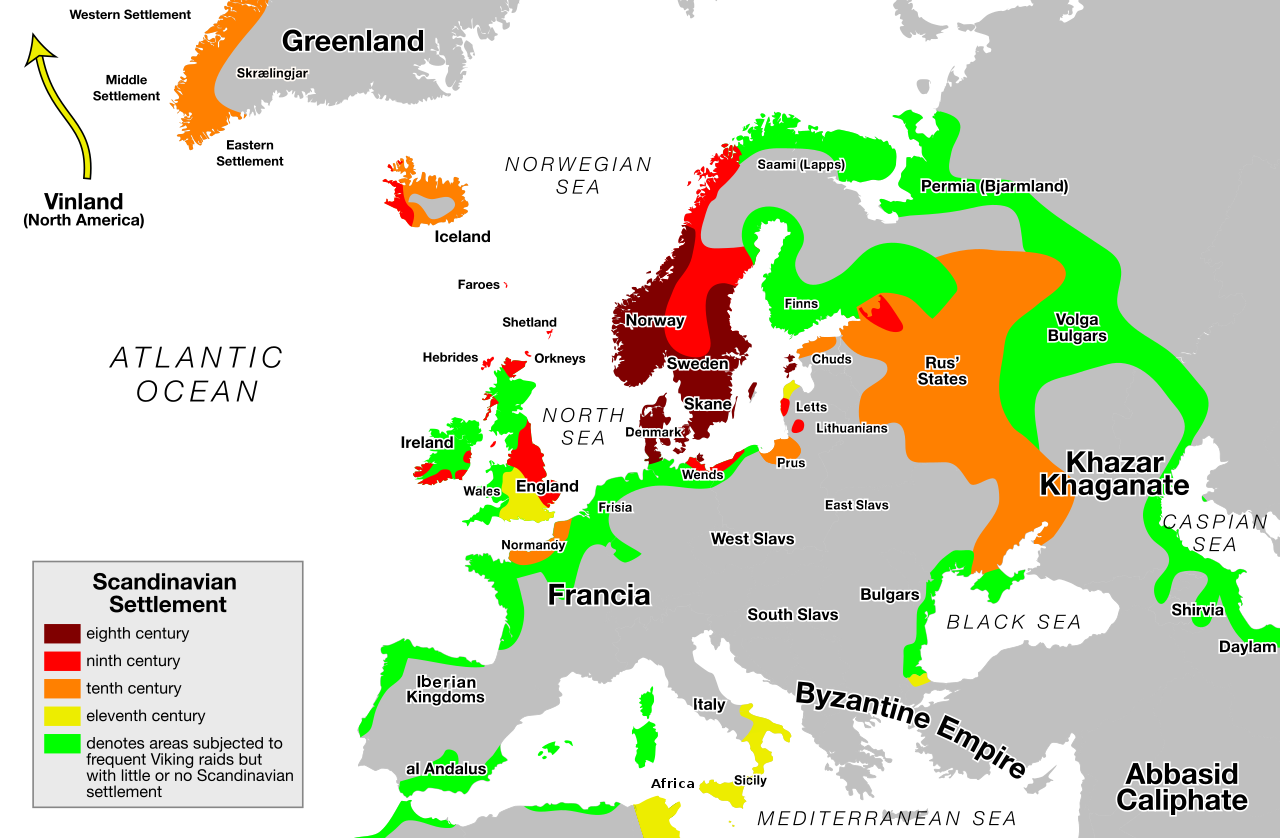
    Map showing area of Scandinavian settlement in the eighth (dark red), ninth (red), tenth (orange) centuries. Yellow denotes areas conquered by the Normans in the 11th century, partly descendants of the Vikings. Green denotes areas subjected to Viking raids.

    Finding the parvovirus B19 in archaeological skeletal findings can both provide new knowledge about future diseases and also, what contacts the Vikings had with the world beyond.

    A virus found in the remains of Vikings can provide new knowledge about which diseases we are likely to suffer from in the future. It can also teach us how ancient peoples migrated.

    Lead researcher Terry Jones, at the University in Cambridge, together with other researchers, has isolated virus DNA from human archaeological skeletal findings from, among others, Greenland, Russia, England and Sweden.

    The virus they looked at is found in the bone marrow and is called human parvovirus B19. The name is derived from Latin, parvum meaning small, reflecting the fact that B19 ranks among the smallest DNA viruses.

    Since this virus has been around for several thousands of years, it may be possible to track this particular mutation of the virus around the world and thereby assess how ancient peoples traveled.

    If, for example, similar variants of the virus are found in Sweden and North Africa, one can wonder if the virus has mutated at two independent occasions in the exact same way, or if it was spread over the continents through human contact.

    The older variants of the virus that the scientists have now found could be used to recreate just those variants inside the lab and see if they are dangerous, and if they occur again, it could be a way to prepare and prevent disease.

    Access to viral sequences isolated from individuals living thousands of years ago greatly improves our understanding of the timescales of virus evolution, spatiotemporal distribution, and their substitution rates, and can uncover genetic diversity that is now extinct.

    Future research may just show how ancient Vikings traveled across Europe, and beyond. The study has been published in the journal ‘Proceedings of the National Academy of Sciences of the United States of America’.

    Reference:

    Barbara Mühlemann et al. Ancient human parvovirus B19 in Eurasia reveals its long-term association with humans. PNAS 2 July 2018. DOI: 10.1073 / pnas.1804921115


    Share. Facebook Twitter Pinterest LinkedIn Tumblr Email Copy Link

    Related Posts

    Native Americans of South America sailed to Polynesia in the 12th century

    July 27, 2020

    Oldest and Largest Maya Structure on Record Discovered in Southern Mexico

    June 22, 2020

    Archaeologists in Greece Find 3,500-Year-Old Royal Tombs

    December 23, 2019

    World’s Oldest Intact Shipwreck Discovered in Black Sea

    November 1, 2018

    What Farmers Ate 8,000 Years Ago in Çatalhöyük

    October 9, 2018

    A Remarkably Preserved Sandstone Sphinx Discovered in Egypt

    September 26, 2018
    Recent Posts
    • America’s Quiet Shift Into Fiscal Dominance: Why Inflation May Be Preparing for a Second Act
    • How the End of Bretton Woods Reshaped Our Economies — and Our Politics
    • Can the U.S. Really Handle 250% Debt-to-GDP? Why Jackson Hole’s Daring Paper Is Wrong
    • Japan’s Fiscal Trap: What Happens If Austerity Is No Longer an Option?
    • The Rise of Range Extended Electric Vehicles (REEVs): A New Era of Hybrid Mobility
    • The Great Capital Rotation: A Shift from U.S. Treasuries to Gold and Real Assets
    • The Hidden Risks of Short-Term Debt: A Balancing Act in U.S. Fiscal Policy
    • The Looming U.S. Debt Spiral: Understanding the Risks
    • The Looming Recession: Seven Economic Indicators Flashing Red for 2025
    • Europa Clipper: NASA’s Mission to Unlock the Secrets of Jupiter’s Icy Moon
    © 2025 Illustrated Curiosity

    Type above and press Enter to search. Press Esc to cancel.

    This website uses cookies to improve your experience. We'll assume you're ok with this, but you can opt-out if you wish.Accept Reject Read More
    Privacy & Cookies Policy

    Privacy Overview

    This website uses cookies to improve your experience while you navigate through the website. Out of these, the cookies that are categorized as necessary are stored on your browser as they are essential for the working of basic functionalities of the website. We also use third-party cookies that help us analyze and understand how you use this website. These cookies will be stored in your browser only with your consent. You also have the option to opt-out of these cookies. But opting out of some of these cookies may affect your browsing experience.
    Necessary
    Always Enabled
    Necessary cookies are absolutely essential for the website to function properly. This category only includes cookies that ensures basic functionalities and security features of the website. These cookies do not store any personal information.
    Non-necessary
    Any cookies that may not be particularly necessary for the website to function and is used specifically to collect user personal data via analytics, ads, other embedded contents are termed as non-necessary cookies. It is mandatory to procure user consent prior to running these cookies on your website.
    SAVE & ACCEPT