Close Menu
Illustrated Curiosity
    Facebook X (Twitter) Instagram YouTube
    Illustrated Curiosity
    • Earth
    • Economics
    • Environment
      • Climate
      • Environmental Tech
      • Pollution
      • Wildlife
    • Health
      • Health Tech
      • Medicine
      • Nutrition
      • Exercise
    • History
      • Prehistory
      • Ancient History
      • Postclassical Era
      • Modern History
    • Humans
      • Human Brain
      • Psychology
    • Life
      • Animals & Plants
      • Genetics
      • Paleontology
      • Evolution
      • Genetic Engineering
    • Physics
    • Space
      • Astrobiology
      • Astronomy
      • Extrasolar Planets
      • Space Tech
      • Spaceflight
    • Technology
      • Artificial Intelligence
      • Energy
      • Engineering
      • Materials
      • Robotics
      • Vehicles
    Illustrated Curiosity
    Home » Human intelligence can be traced to a tiny change with considerable consequences
    Evolution

    Human intelligence can be traced to a tiny change with considerable consequences

    December 15, 2016No Comments2 Mins Read
    Share
    Facebook Twitter LinkedIn Pinterest Email

    A single small change in one of our genes may have been enough for the human brain to grow big and smart, according to new research at the Max Planck institute.
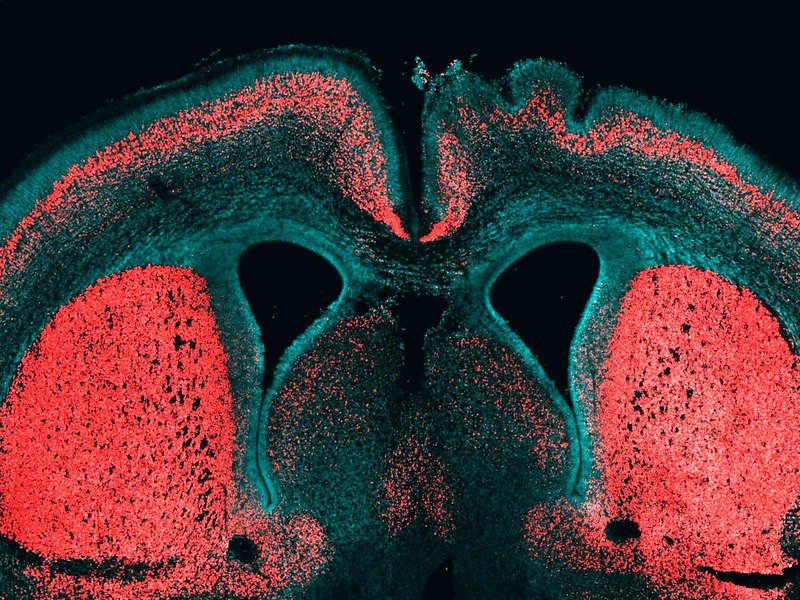
    This image shows a cerebral cortex of an embryonic mouse. The cell nuclei are marked in blue and the deep-layer neurons in red. The human-specific gene ARHGAP11B was selectively expressed in the right half of the brain, which is visible by the folding of the neocortical surface. Credit: MPI f. Molecular Cell Biology and Genetics | Max Planck institute

    The reason that we humans stand apart from the rest of the animal kingdom is that evolution took a different turn with our ancestors – enabling them to use their brains to manipulate their surroundings and to allow creativity to solve problems rather than the usual solution by natural selection and adaptation – to get faster, stronger, bigger or perhaps smaller.

    The Neocortex is the outer part of our cerebral cortex, and could perhaps be compared to the Earth’s crust. It consists of six layers of neurons and contributes greatly to how we humans reason and take part in social interactions, but it is also important for our sight and hearing.

    New research indicates that the development of the neocortex in humans is partly due to a mutation in a specific gene, for which only one of the roughly 3.1 billion base pairs that make up our DNA strand, changed.

    The gene that had this mutation is called ARHGAP11B and the version that all modern humans carry first appeared some 500,000 years ago and is not found in the genome of Neanderthals, for example.

    This gene is originally a kind of improved copy of another gene: ARHGAP11A. This old gene version still exists as nature sometimes creates a copy of a gene but leaves the original intact to continue doing what it’s good at.

    This new gene variant is associated with a protein important to how brain cells are able to come apart. The gene thus ultimately increased the number of brain cells, which consequently may have been located to our neocortex, growing larger and smarter. All thanks to a single change in a single gene and a single base pair.

    Reference:

    Marta Florio et al. A single splice site mutation in human-specific ARHGAP11B causes basal progenitor amplification. Advances Science, 2016, DOI: 10.1126 / sciadv.1601941

    Homo Sapiens Human Brain Language Neocortex Social Relation
    Share. Facebook Twitter Pinterest LinkedIn Tumblr Email Copy Link

    Related Posts

    Use of Evolution to Design Molecules Nets Nobel Prize in Chemistry for 3 Scientists

    October 4, 2018

    This Is How the Bottlenose Dolphin Avoids Divers’ Disease

    August 14, 2018

    88,000-Year-Old Finger Bone Found in Saudi Arabia Pushes Back Human Migration Dates

    April 17, 2018

    These Skates Are Made for Walking

    February 23, 2018

    Oldest Human Fossil Outside Africa Found in Israel

    January 30, 2018

    Homo sapiens emerged more than 300,000 years ago, according to new study

    September 29, 2017
    Recent Posts
    • How the End of Bretton Woods Reshaped Our Economies — and Our Politics
    • Can the U.S. Really Handle 250% Debt-to-GDP? Why Jackson Hole’s Daring Paper Is Wrong
    • Japan’s Fiscal Trap: What Happens If Austerity Is No Longer an Option?
    • The Rise of Range Extended Electric Vehicles (REEVs): A New Era of Hybrid Mobility
    • The Great Capital Rotation: A Shift from U.S. Treasuries to Gold and Real Assets
    • The Hidden Risks of Short-Term Debt: A Balancing Act in U.S. Fiscal Policy
    • The Looming U.S. Debt Spiral: Understanding the Risks
    • The Looming Recession: Seven Economic Indicators Flashing Red for 2025
    • Europa Clipper: NASA’s Mission to Unlock the Secrets of Jupiter’s Icy Moon
    • Could Hedge Funds Cause Chaos in the U.S. Treasury Market? And What About Inflation?
    © 2025 Illustrated Curiosity

    Type above and press Enter to search. Press Esc to cancel.

    This website uses cookies to improve your experience. We'll assume you're ok with this, but you can opt-out if you wish.Accept Reject Read More
    Privacy & Cookies Policy

    Privacy Overview

    This website uses cookies to improve your experience while you navigate through the website. Out of these, the cookies that are categorized as necessary are stored on your browser as they are essential for the working of basic functionalities of the website. We also use third-party cookies that help us analyze and understand how you use this website. These cookies will be stored in your browser only with your consent. You also have the option to opt-out of these cookies. But opting out of some of these cookies may affect your browsing experience.
    Necessary
    Always Enabled
    Necessary cookies are absolutely essential for the website to function properly. This category only includes cookies that ensures basic functionalities and security features of the website. These cookies do not store any personal information.
    Non-necessary
    Any cookies that may not be particularly necessary for the website to function and is used specifically to collect user personal data via analytics, ads, other embedded contents are termed as non-necessary cookies. It is mandatory to procure user consent prior to running these cookies on your website.
    SAVE & ACCEPT