Close Menu
Illustrated Curiosity
    Facebook X (Twitter) Instagram YouTube
    Illustrated Curiosity
    • Earth
    • Economics
    • Environment
      • Climate
      • Environmental Tech
      • Pollution
      • Wildlife
    • Health
      • Health Tech
      • Medicine
      • Nutrition
      • Exercise
    • History
      • Prehistory
      • Ancient History
      • Postclassical Era
      • Modern History
    • Humans
      • Human Brain
      • Psychology
    • Life
      • Animals & Plants
      • Genetics
      • Paleontology
      • Evolution
      • Genetic Engineering
    • Physics
    • Space
      • Astrobiology
      • Astronomy
      • Extrasolar Planets
      • Space Tech
      • Spaceflight
    • Technology
      • Artificial Intelligence
      • Energy
      • Engineering
      • Materials
      • Robotics
      • Vehicles
    Illustrated Curiosity
    Home » All Native Americans Descended from One Ancestral Population
    Genetics

    All Native Americans Descended from One Ancestral Population

    January 5, 2018No Comments4 Mins Read
    Share
    Facebook Twitter LinkedIn Pinterest Email
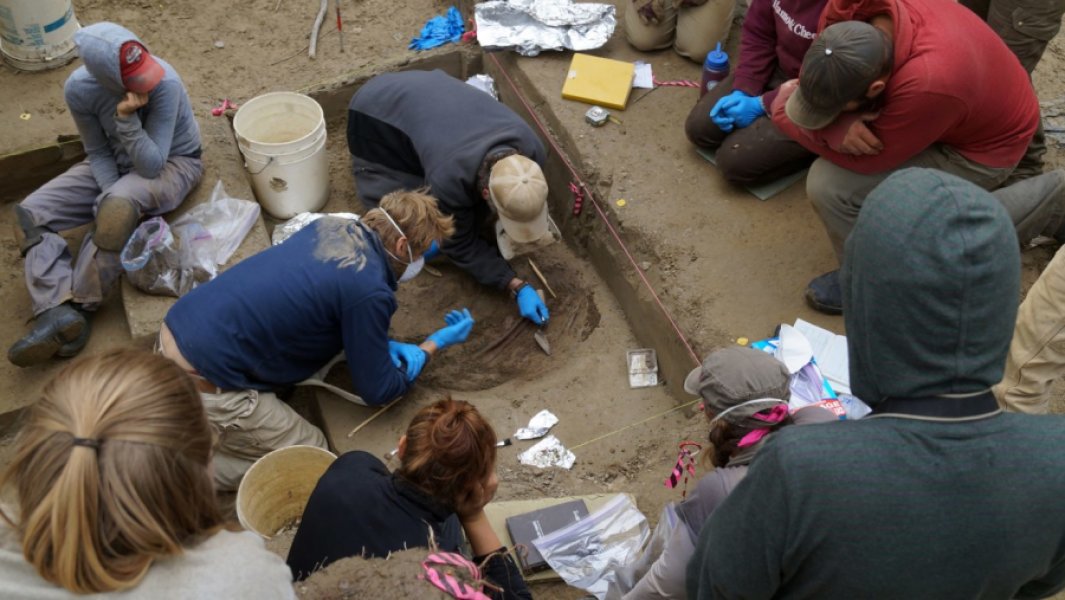
    Members of the archaeology field team watch as University of Alaska Fairbanks professors Ben Potter and Josh Reuther excavate at the Upward Sun River site. Credit: UAF photo courtesy of Ben Potter

    We now have new genetic clues to the origins of the American indigenous people. All Native Americans originate from a single group of people that across the Bering Sound to North America. They migrated across from Asia to America in one wave of immigration and not several. This, according to the first major genetic evidence analysis of ancient DNA.

    A little over 11,000 years ago, a grieving family in Central Alaska laid to rest a six-week-old baby girl, a three-year-old child, and a preterm female fetus. An international team of researchers led by the Universities of Cambridge and Copenhagen sequenced the full genome of this infant girl named “Xach’itee’aanenh t’eede gay”, or “Sunrise Child-girl” by the local Native community – “USR1” by the researchers – whose remains were found at the Upward Sun River archaeological site in Alaska in 2013.

    They found that although the child lived around 11,500 years ago, long after people first arrived in the region, her genetic information did not match either of the two recognized branches of early Native Americans, referred to as Northern and Southern. Instead, she appeared to have belonged to an entirely distinct Native American population, called Ancient Beringians.

    Further analyses then revealed that the Ancient Beringians was an offshoot of the same ancestor population as the Northern and Southern Native American groups, but that they separated from that population earlier in its history.

    “We didn’t know this population existed,”

    “These data also provide the first direct evidence of the initial founding Native American population, which sheds new light on how these early populations were migrating and settling throughout North America.”

    – Ben Potter, one of the lead authors of the study and a professor of anthropology at the University of Alaska Fairbanks.

    Genetic analysis and demographic modeling indicate that a single founding ancestral Native American group split from East Asians about 35,000 years ago. Then, about 20,000 years ago, that group split into two groups: the Ancient Beringians and the ancestors of all other Native Americans.

    The study compared data from the Upward Sun River remains with both ancient genomes and those of numerous present-day populations. Allowing the researchers to establish that the Ancient Beringian group was more closely related to early Native Americans than their Asian and Eurasian ancestors, and then to determine the precise nature of that relationship and how, over time, they split into distinct populations.
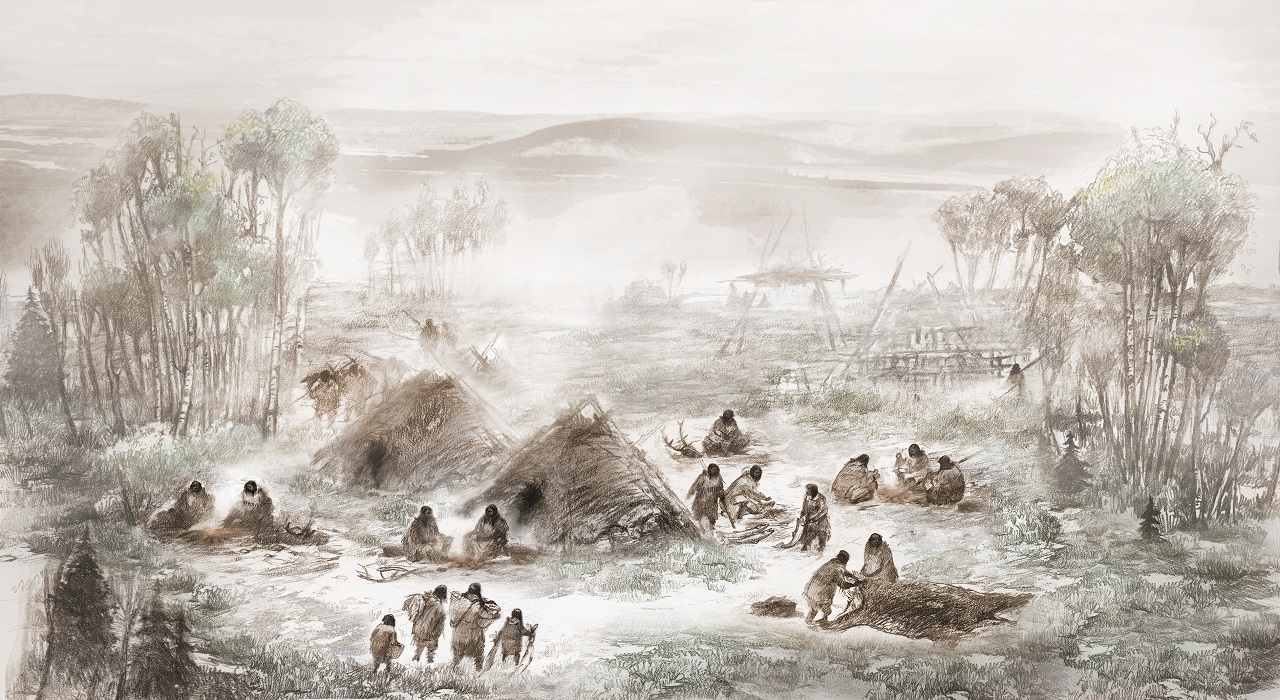
    Illustration by Eric S. Carlson in collaboration with Ben A. Potter
    A scientific illustration of the Upward Sun River camp in what is now Interior Alaska.

    The findings suggest two scenarios for populating the New World. One is that there were two distinct groups of people who crossed over the Beringian land bridge prior to 15,700 years ago. And a second that one group of people crossed over the land bridge and then split into the two groups mentioned above: Ancient Beringians and other Native Americans, with the latter moving south of the ice sheets 15,700 years ago. The latter is a more plausible scenario according to the researchers.

    The Ancient Beringian people remained in the Far North for thousands of years, while the ancestors of other Native American peoples spread south throughout the rest of North America. The genetic evidence then suggests that Athabascan ancestors moved north again, possibly around 6,000 years ago, and eventually assimilated or replaced the Ancient Beringian population.

    The study, Terminal Pleistocene Alaskan genome reveals a first founding population of Native Americans, is published in Nature.

    Reference:

    J. Víctor Moreno-Mayar et al. Terminal Pleistocene Alaskan Genome reveals the first founding population of Native Americans. Nature January 3, 2018. DOI: 10.1038 / nature25173

    Native Americans
    Share. Facebook Twitter Pinterest LinkedIn Tumblr Email Copy Link

    Related Posts

    Northern Europeans’ Genetic Pre-Historic is Repeated Genocide

    February 6, 2024

    Prehistoric Europeans Consumed Milk Thousands of Years Before Lactose Tolerance

    July 31, 2022

    The Nobel Prize in Chemistry 2020 Was Awarded to Scientists for Work on Genome Editing

    October 7, 2020

    Nemuri is the Gene That Puts Flies to Sleep and Helps Them Fight Infection

    February 15, 2019

    First Ancient DNA from Mainland Finland Reveals Origins of Siberian Ancestry in Region

    December 7, 2018

    First Mammal with Two Mothers Is Born as Gene-Editing Breakthrough Creates Mouse with No Father

    October 15, 2018
    Recent Posts
    • How the End of Bretton Woods Reshaped Our Economies — and Our Politics
    • Can the U.S. Really Handle 250% Debt-to-GDP? Why Jackson Hole’s Daring Paper Is Wrong
    • Japan’s Fiscal Trap: What Happens If Austerity Is No Longer an Option?
    • The Rise of Range Extended Electric Vehicles (REEVs): A New Era of Hybrid Mobility
    • The Great Capital Rotation: A Shift from U.S. Treasuries to Gold and Real Assets
    • The Hidden Risks of Short-Term Debt: A Balancing Act in U.S. Fiscal Policy
    • The Looming U.S. Debt Spiral: Understanding the Risks
    • The Looming Recession: Seven Economic Indicators Flashing Red for 2025
    • Europa Clipper: NASA’s Mission to Unlock the Secrets of Jupiter’s Icy Moon
    • Could Hedge Funds Cause Chaos in the U.S. Treasury Market? And What About Inflation?
    © 2025 Illustrated Curiosity

    Type above and press Enter to search. Press Esc to cancel.

    This website uses cookies to improve your experience. We'll assume you're ok with this, but you can opt-out if you wish.Accept Reject Read More
    Privacy & Cookies Policy

    Privacy Overview

    This website uses cookies to improve your experience while you navigate through the website. Out of these, the cookies that are categorized as necessary are stored on your browser as they are essential for the working of basic functionalities of the website. We also use third-party cookies that help us analyze and understand how you use this website. These cookies will be stored in your browser only with your consent. You also have the option to opt-out of these cookies. But opting out of some of these cookies may affect your browsing experience.
    Necessary
    Always Enabled
    Necessary cookies are absolutely essential for the website to function properly. This category only includes cookies that ensures basic functionalities and security features of the website. These cookies do not store any personal information.
    Non-necessary
    Any cookies that may not be particularly necessary for the website to function and is used specifically to collect user personal data via analytics, ads, other embedded contents are termed as non-necessary cookies. It is mandatory to procure user consent prior to running these cookies on your website.
    SAVE & ACCEPT