Close Menu
Illustrated Curiosity
    Facebook X (Twitter) Instagram YouTube
    Illustrated Curiosity
    • Earth
    • Economics
    • Environment
      • Climate
      • Environmental Tech
      • Pollution
      • Wildlife
    • Health
      • Health Tech
      • Medicine
      • Nutrition
      • Exercise
    • History
      • Prehistory
      • Ancient History
      • Postclassical Era
      • Modern History
    • Humans
      • Human Brain
      • Psychology
    • Life
      • Animals & Plants
      • Genetics
      • Paleontology
      • Evolution
      • Genetic Engineering
    • Physics
    • Space
      • Astrobiology
      • Astronomy
      • Extrasolar Planets
      • Space Tech
      • Spaceflight
    • Technology
      • Artificial Intelligence
      • Energy
      • Engineering
      • Materials
      • Robotics
      • Vehicles
    Illustrated Curiosity
    Home » Genome of American Cockroach Sequenced for the First Time
    Genetics

    Genome of American Cockroach Sequenced for the First Time

    April 5, 20182 Mins Read
    Share
    Facebook Twitter LinkedIn Pinterest Email
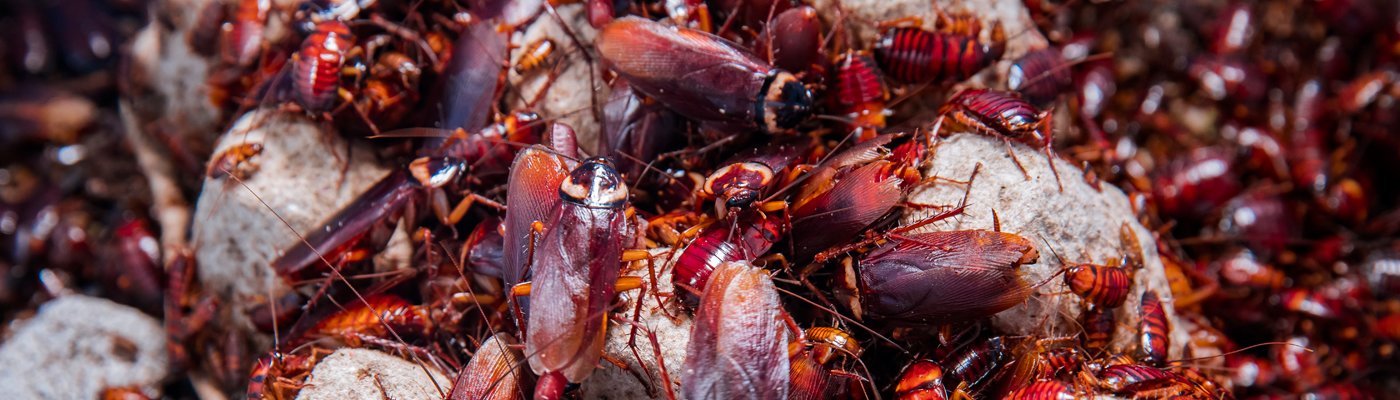
    A close-up image of the American cockroach colony. Credit: Sheng Li

    It’s fast-growing, loves damp places, rotten food, thrives in human proximity and is extremely resilient. Chinese researchers have sequenced and analyzed the DNA of the American cockroach (Periplaneta americana).

    The American cockroach, oddly enough, did not actually evolve in America; it arrived via ships from Africa hundreds of years ago. The Chinese research team led by Sheng Li describes their efforts in sequencing the cockroach genome and offers some insights regarding the findings.

    It turns out that the cockroach, which thrives in human proximity, and that likes to live on our waste, has one of the largest genomes yet studied.

    The insect has approximately 20,000 genes, surprisingly near the number of human genes. The genome is among the largest in the insect world, smaller only than that of the locust, though many of its segments, they found, appeared to be repetitive.

    Those genes that are particularly many are associated with the ability to react to chemical signals in the environment, such as traces of rotten food, and to resist poisoning, the researchers report.

    The researchers suggest the American cockroach has a genome that provides it with the tools needs to exist in a host of sometimes hostile environments, which explains how it has become the largest insect that lives among humans.

    The team’s research paper, ‘The genomic and functional landscapes of developmental plasticity in the American cockroach’, was published online in Nature Communications on March 21. It also consolidates the close genetic relationship between cockroaches and termites.

    Reference:

    Zhan et al. “The genomic and functional landscapes of developmental plasticity in the American cockroach“. Nature Communications. DOI: 10.1038 / s41467-018-03281-1.

    Share. Facebook Twitter Pinterest LinkedIn Tumblr Email Copy Link

    Related Posts

    Northern Europeans’ Genetic Pre-Historic is Repeated Genocide

    February 6, 2024

    Prehistoric Europeans Consumed Milk Thousands of Years Before Lactose Tolerance

    July 31, 2022

    The Nobel Prize in Chemistry 2020 Was Awarded to Scientists for Work on Genome Editing

    October 7, 2020

    Nemuri is the Gene That Puts Flies to Sleep and Helps Them Fight Infection

    February 15, 2019

    First Ancient DNA from Mainland Finland Reveals Origins of Siberian Ancestry in Region

    December 7, 2018

    First Mammal with Two Mothers Is Born as Gene-Editing Breakthrough Creates Mouse with No Father

    October 15, 2018
    Recent Posts
    • America’s Quiet Shift Into Fiscal Dominance: Why Inflation May Be Preparing for a Second Act
    • How the End of Bretton Woods Reshaped Our Economies — and Our Politics
    • Can the U.S. Really Handle 250% Debt-to-GDP? Why Jackson Hole’s Daring Paper Is Wrong
    • Japan’s Fiscal Trap: What Happens If Austerity Is No Longer an Option?
    • The Rise of Range Extended Electric Vehicles (REEVs): A New Era of Hybrid Mobility
    • The Great Capital Rotation: A Shift from U.S. Treasuries to Gold and Real Assets
    • The Hidden Risks of Short-Term Debt: A Balancing Act in U.S. Fiscal Policy
    • The Looming U.S. Debt Spiral: Understanding the Risks
    • The Looming Recession: Seven Economic Indicators Flashing Red for 2025
    • Europa Clipper: NASA’s Mission to Unlock the Secrets of Jupiter’s Icy Moon
    © 2025 Illustrated Curiosity

    Type above and press Enter to search. Press Esc to cancel.

    This website uses cookies to improve your experience. We'll assume you're ok with this, but you can opt-out if you wish.Accept Reject Read More
    Privacy & Cookies Policy

    Privacy Overview

    This website uses cookies to improve your experience while you navigate through the website. Out of these, the cookies that are categorized as necessary are stored on your browser as they are essential for the working of basic functionalities of the website. We also use third-party cookies that help us analyze and understand how you use this website. These cookies will be stored in your browser only with your consent. You also have the option to opt-out of these cookies. But opting out of some of these cookies may affect your browsing experience.
    Necessary
    Always Enabled
    Necessary cookies are absolutely essential for the website to function properly. This category only includes cookies that ensures basic functionalities and security features of the website. These cookies do not store any personal information.
    Non-necessary
    Any cookies that may not be particularly necessary for the website to function and is used specifically to collect user personal data via analytics, ads, other embedded contents are termed as non-necessary cookies. It is mandatory to procure user consent prior to running these cookies on your website.
    SAVE & ACCEPT