Close Menu
Illustrated Curiosity
    Facebook X (Twitter) Instagram YouTube
    Illustrated Curiosity
    • Earth
    • Economics
    • Environment
      • Climate
      • Environmental Tech
      • Pollution
      • Wildlife
    • Health
      • Health Tech
      • Medicine
      • Nutrition
      • Exercise
    • History
      • Prehistory
      • Ancient History
      • Postclassical Era
      • Modern History
    • Humans
      • Human Brain
      • Psychology
    • Life
      • Animals & Plants
      • Genetics
      • Paleontology
      • Evolution
      • Genetic Engineering
    • Physics
    • Space
      • Astrobiology
      • Astronomy
      • Extrasolar Planets
      • Space Tech
      • Spaceflight
    • Technology
      • Artificial Intelligence
      • Energy
      • Engineering
      • Materials
      • Robotics
      • Vehicles
    Illustrated Curiosity
    Home » Scientists discovered protein in tardigrades that protects from radiation damage
    Genetics

    Scientists discovered protein in tardigrades that protects from radiation damage

    September 23, 2016No Comments2 Mins Read
    Share
    Facebook Twitter LinkedIn Pinterest Email

    A protein that protects one of the most resistant species from damage by radiation has been found by Japanese researchers. They now hope that this discovery will be able to protect people as well.
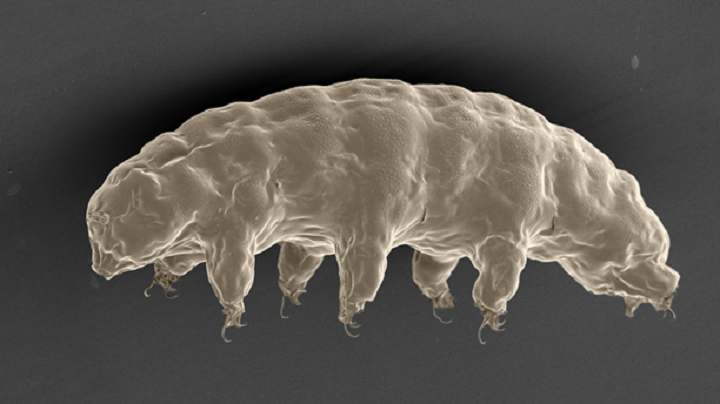
    Tardigrades are between 0.05 and 1.2 mm long. Photo: Tanaka S, Sagara H, Kunieda

    Tardigrades are microscopic animals known to withstand very harsh environmental conditions. For example, dehydration over a long period, extreme temperatures, and intense radiation.
    Credit: NPG Press/YouTub
    A tardigrade in motion.

    Studies have shown that they can withstand temperature ranges from 1 K (−458 °F; −272 °C) (close to absolute zero) to about 420 K (300 °F; 150 °C), pressures about six times greater than those found in the deepest ocean trenches, ionizing radiation at doses hundreds of times higher than the lethal dose for a human, and the vacuum of outer space.

    How these remarkable micro-animals manage to tolerate these extreme conditions that would be deadly to most animals remains largely a mystery.

    Now, Japanese scientists have mapped the genome and found a unique protein that appears to protect the tardigrade DNA from radiation.

    “Tolerance against X-ray is thought to be a side-product of [the] animal’s adaptation to severe dehydration,” says lead study author Takekazu Kunieda, a molecular biologist at the University of Tokyo.

    This protein also gave increased protection against radiation in cultured human cells. The discovery, therefore, raises hope for medical uses, as to reduce damage in patients who will undergo some form of radiation therapy.

    Reference:

    Takuma Hashimoto et al. Extremotolerant tardigrade genome and improved radiotolerance of human cultured cells bytardigrade-unique protein. Nature communications, 20 September 2016. DOI: 10.1038/ncomms12808


    Protein Radiation Tardigrade
    Share. Facebook Twitter Pinterest LinkedIn Tumblr Email Copy Link

    Related Posts

    Northern Europeans’ Genetic Pre-Historic is Repeated Genocide

    February 6, 2024

    Prehistoric Europeans Consumed Milk Thousands of Years Before Lactose Tolerance

    July 31, 2022

    The Nobel Prize in Chemistry 2020 Was Awarded to Scientists for Work on Genome Editing

    October 7, 2020

    A Highly Radioactive Wild Boar Shoot in Sweden – 33 Years since Chernobyl

    July 4, 2019

    Nemuri is the Gene That Puts Flies to Sleep and Helps Them Fight Infection

    February 15, 2019

    First Ancient DNA from Mainland Finland Reveals Origins of Siberian Ancestry in Region

    December 7, 2018
    Recent Posts
    • How the End of Bretton Woods Reshaped Our Economies — and Our Politics
    • Can the U.S. Really Handle 250% Debt-to-GDP? Why Jackson Hole’s Daring Paper Is Wrong
    • Japan’s Fiscal Trap: What Happens If Austerity Is No Longer an Option?
    • The Rise of Range Extended Electric Vehicles (REEVs): A New Era of Hybrid Mobility
    • The Great Capital Rotation: A Shift from U.S. Treasuries to Gold and Real Assets
    • The Hidden Risks of Short-Term Debt: A Balancing Act in U.S. Fiscal Policy
    • The Looming U.S. Debt Spiral: Understanding the Risks
    • The Looming Recession: Seven Economic Indicators Flashing Red for 2025
    • Europa Clipper: NASA’s Mission to Unlock the Secrets of Jupiter’s Icy Moon
    • Could Hedge Funds Cause Chaos in the U.S. Treasury Market? And What About Inflation?
    © 2025 Illustrated Curiosity

    Type above and press Enter to search. Press Esc to cancel.

    This website uses cookies to improve your experience. We'll assume you're ok with this, but you can opt-out if you wish.Accept Reject Read More
    Privacy & Cookies Policy

    Privacy Overview

    This website uses cookies to improve your experience while you navigate through the website. Out of these, the cookies that are categorized as necessary are stored on your browser as they are essential for the working of basic functionalities of the website. We also use third-party cookies that help us analyze and understand how you use this website. These cookies will be stored in your browser only with your consent. You also have the option to opt-out of these cookies. But opting out of some of these cookies may affect your browsing experience.
    Necessary
    Always Enabled
    Necessary cookies are absolutely essential for the website to function properly. This category only includes cookies that ensures basic functionalities and security features of the website. These cookies do not store any personal information.
    Non-necessary
    Any cookies that may not be particularly necessary for the website to function and is used specifically to collect user personal data via analytics, ads, other embedded contents are termed as non-necessary cookies. It is mandatory to procure user consent prior to running these cookies on your website.
    SAVE & ACCEPT