Close Menu
Illustrated Curiosity
    Facebook X (Twitter) Instagram YouTube
    Illustrated Curiosity
    • Earth
    • Economics
    • Environment
      • Climate
      • Environmental Tech
      • Pollution
      • Wildlife
    • Health
      • Health Tech
      • Medicine
      • Nutrition
      • Exercise
    • History
      • Prehistory
      • Ancient History
      • Postclassical Era
      • Modern History
    • Humans
      • Human Brain
      • Psychology
    • Life
      • Animals & Plants
      • Genetics
      • Paleontology
      • Evolution
      • Genetic Engineering
    • Physics
    • Space
      • Astrobiology
      • Astronomy
      • Extrasolar Planets
      • Space Tech
      • Spaceflight
    • Technology
      • Artificial Intelligence
      • Energy
      • Engineering
      • Materials
      • Robotics
      • Vehicles
    Illustrated Curiosity
    Home » X-Rays Capture Unprecedented Images of Photosynthesis in Action
    Animals & Plants

    X-Rays Capture Unprecedented Images of Photosynthesis in Action

    August 2, 2018No Comments3 Mins Read
    Share
    Facebook Twitter LinkedIn Pinterest Email
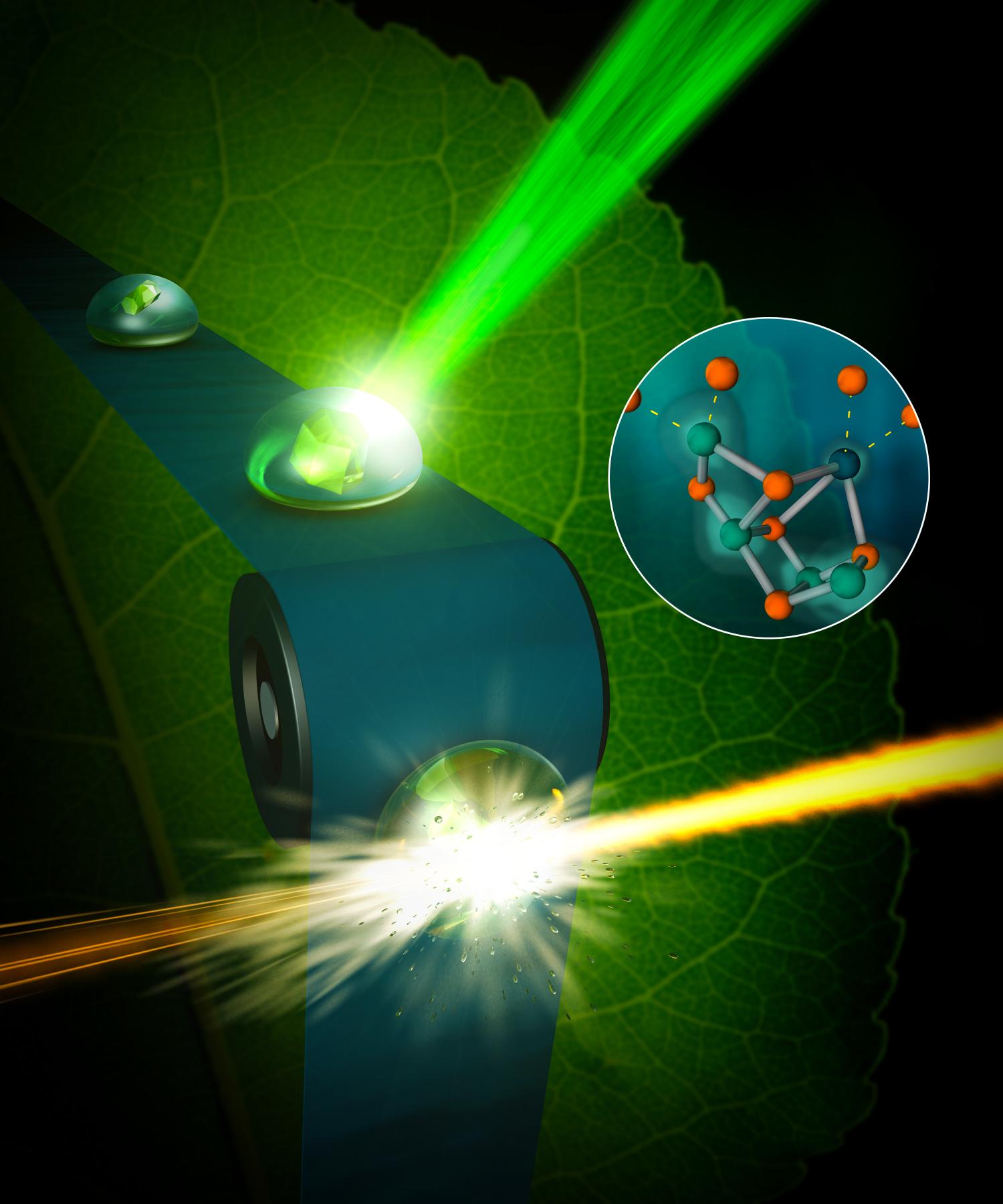
    Credit: SLAC National Accelerator Laboratory
    A femtosecond X-ray pulse from an X-ray free electron laser intersecting a droplet that contains photosystem II crystals, the protein extracted and crystallized from cyanobacteria.

    Researchers have long dreamed of replicating the photosynthesis of plants by artificial photosynthesis. A new study might just make this a reality since the researchers have filmed the process.

    Photosynthesis, in which solar energy plants convert carbon dioxide and water into sugar and oxygen, is a complicated process, so researchers have not yet managed to copy the process through artificial photosynthesis.

    Many believe that artificial photosynthesis may prove very useful in the future since it enables us to harness the energy that flows from the sun could to be used to make fuel and replace today’s fossil fuels without releasing greenhouse gases.

    To be able to mimic and replicate photosynthesis, we need to understand in meticulous detail how the process works and a big step in that direction was made just recently when researchers at Berkeley Laboratory in the United States was able to film parts of the photosynthesis process at the micronuclear level.

    “The eventual goal is to emulate what photosynthesis has been doing for about three billion years. This has been a research challenge for decades,”

    “We now have the right tool, the femtosecond X-ray laser pulses created at LCLS, that allows us to observe the water-splitting reaction as it happens, in real time, and as it happens in nature.”

    – Junko Yano, principal investigator and senior scientist at Lawrence Berkeley National Laboratory.

    The team filmed the part of the process by which the plant decomposes water using the enzyme “photosystem II, “, in order to gain access to the electrons needed to convert the carbon dioxide into sugar.

    Previously, researchers have only been able to capture stills of how it looks after the process is frozen down to extremely low temperatures. But it is now possible to film the process at room temperature, at temperatures when photosynthesis normally work.
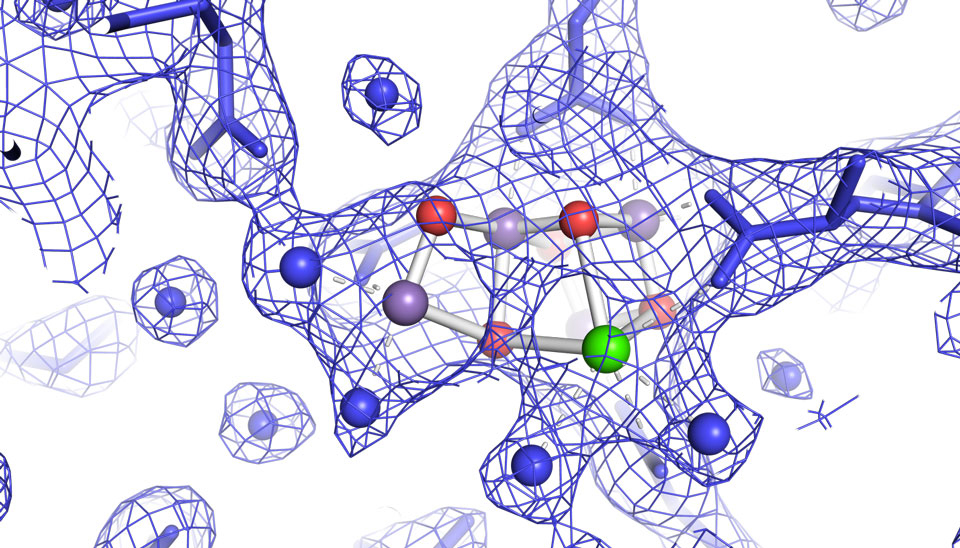
    Credit: Jan Kern/Berkeley Lab
    Structure of the oxygen evolving complex in photosystem II in a light-activated state. Water molecules are shown as blue spheres, the four manganese atoms in purple, the calcium in green and the bridging oxygen atoms in red. The blue mesh is the experimental electron density, and the blue solid lines are the protein side chains that provide a scaffold for the catalytic complex.

    The images, published recently in the journal Nature, provide the first high-resolution 3-D view of photosystem II in action, a feat accomplished by using unimaginably fast X-ray free-electron laser (XFEL) pulses from the Linac Coherent Light Source (LCLS) at SLAC National Accelerator Laboratory, a DOE Office of Science User Facility.

    The clips are super short, shorter than one billionth of a second, but the films may nevertheless help scientists to gather more knowledge about how the process works.

    Reference:

    Iris D. Young, Mohamed Ibrahim et al. Structure of photosystem II and substrate binding at room temperature


    Share. Facebook Twitter Pinterest LinkedIn Tumblr Email Copy Link

    Related Posts

    Kindness To Dogs During Training Matters

    December 28, 2020

    Solar Storms May Throw off Whale Navigation and Cause Strandings

    May 5, 2020

    Why Bats Are Breeding Grounds for Deadly Viruses Like Ebola and SARS

    March 5, 2020

    Cats can express emotions with subtle facial expressions

    February 12, 2020

    Not Just Dogs, Study Reveals Cats Too Can Form Intense Bonds with Humans

    September 25, 2019

    Some Deep-Sea Fish Can See Color in Near Total Darkness

    May 13, 2019
    Recent Posts
    • How the End of Bretton Woods Reshaped Our Economies — and Our Politics
    • Can the U.S. Really Handle 250% Debt-to-GDP? Why Jackson Hole’s Daring Paper Is Wrong
    • Japan’s Fiscal Trap: What Happens If Austerity Is No Longer an Option?
    • The Rise of Range Extended Electric Vehicles (REEVs): A New Era of Hybrid Mobility
    • The Great Capital Rotation: A Shift from U.S. Treasuries to Gold and Real Assets
    • The Hidden Risks of Short-Term Debt: A Balancing Act in U.S. Fiscal Policy
    • The Looming U.S. Debt Spiral: Understanding the Risks
    • The Looming Recession: Seven Economic Indicators Flashing Red for 2025
    • Europa Clipper: NASA’s Mission to Unlock the Secrets of Jupiter’s Icy Moon
    • Could Hedge Funds Cause Chaos in the U.S. Treasury Market? And What About Inflation?
    © 2025 Illustrated Curiosity

    Type above and press Enter to search. Press Esc to cancel.

    This website uses cookies to improve your experience. We'll assume you're ok with this, but you can opt-out if you wish.Accept Reject Read More
    Privacy & Cookies Policy

    Privacy Overview

    This website uses cookies to improve your experience while you navigate through the website. Out of these, the cookies that are categorized as necessary are stored on your browser as they are essential for the working of basic functionalities of the website. We also use third-party cookies that help us analyze and understand how you use this website. These cookies will be stored in your browser only with your consent. You also have the option to opt-out of these cookies. But opting out of some of these cookies may affect your browsing experience.
    Necessary
    Always Enabled
    Necessary cookies are absolutely essential for the website to function properly. This category only includes cookies that ensures basic functionalities and security features of the website. These cookies do not store any personal information.
    Non-necessary
    Any cookies that may not be particularly necessary for the website to function and is used specifically to collect user personal data via analytics, ads, other embedded contents are termed as non-necessary cookies. It is mandatory to procure user consent prior to running these cookies on your website.
    SAVE & ACCEPT