Close Menu
Illustrated Curiosity
    Facebook X (Twitter) Instagram YouTube
    Illustrated Curiosity
    • Earth
    • Economics
    • Environment
      • Climate
      • Environmental Tech
      • Pollution
      • Wildlife
    • Health
      • Health Tech
      • Medicine
      • Nutrition
      • Exercise
    • History
      • Prehistory
      • Ancient History
      • Postclassical Era
      • Modern History
    • Humans
      • Human Brain
      • Psychology
    • Life
      • Animals & Plants
      • Genetics
      • Paleontology
      • Evolution
      • Genetic Engineering
    • Physics
    • Space
      • Astrobiology
      • Astronomy
      • Extrasolar Planets
      • Space Tech
      • Spaceflight
    • Technology
      • Artificial Intelligence
      • Energy
      • Engineering
      • Materials
      • Robotics
      • Vehicles
    Illustrated Curiosity
    Home » The Voyager Space Probes are Leaving Our Solar System
    Spaceflight

    The Voyager Space Probes are Leaving Our Solar System

    June 24, 2012No Comments3 Mins Read
    Share
    Facebook Twitter LinkedIn Pinterest Email
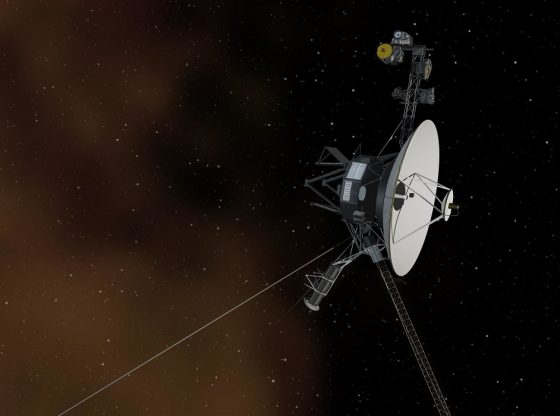
    Concept art of Voyager 1. Credit: NASA.

    NASA launched the spacecraft Voyager 1 in 1977 to study the outer Solar System and the interstellar medium. The spacecraft has ever since been receiving routine commands and transmitting data back to the Deep Space Network. It is the farthest man-made object from Earth, at a distance of 120 astronomical units (1.8×10^10 km) as of February 2012.

    Voyager 1 and 2 Enters Interstellar Space

    Voyager 1 is believed to leave our solar system within one to two years and will thus be the first physical man-made objects to do so.
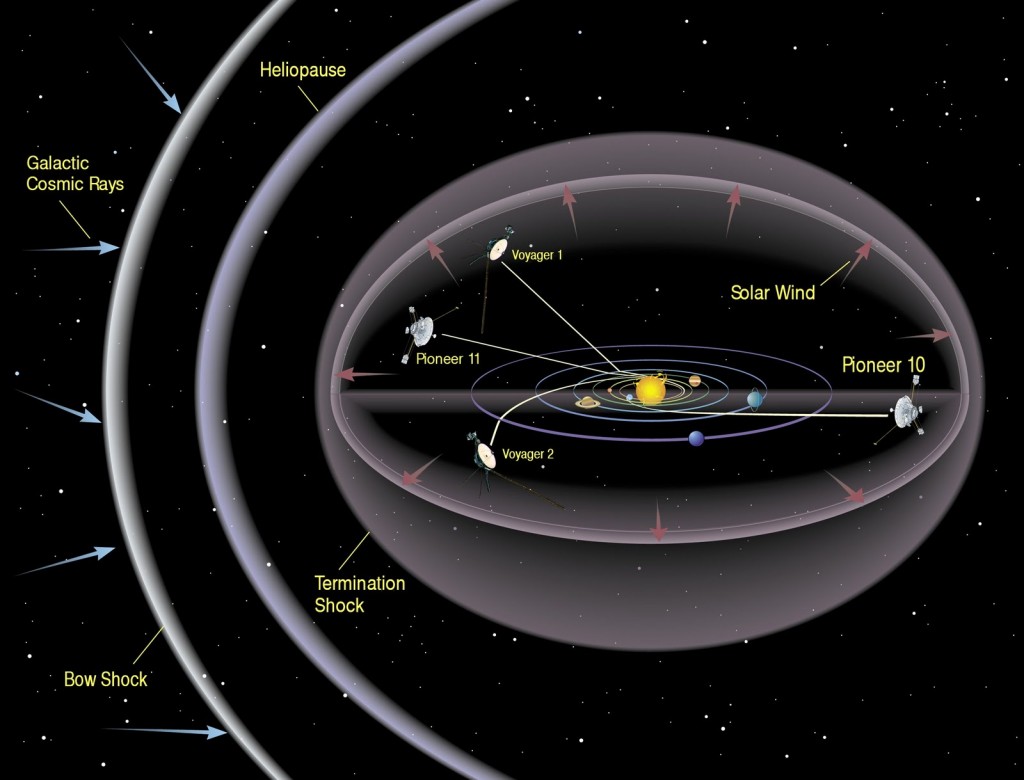
    Voyager 1 and 2, Pioneer 10 and 11. Probes that will leave our solar system. Credit: NASA.

    The data that Voyager 1 still sends back home now indicates that it has reached a new type of surrounding where conditions change rapidly. Based on this data NASA believes that Voyager 1 is near the “heliopause”, located at the boundary where our solar system ends.

    A few months before the Voyager 1 was launched its sister spacecraft Voyager 2 was launched and it will soon also leave our solar system and continue into interstellar space until it will eventually crash into something.

    Hello From Earth

    Both Voyager spacecraft carry a “Voyager Golden Record”, these are phonograph records that contain sounds and images selected to portray the diversity of life and culture on Earth. And are intended for any intelligent extraterrestrial life form, or perhaps future humans who may find them.

    As the celebrated astronomer, Carl Sagan noted “The spacecrafts will be encountered and the record played only if there are advanced space-faring civilizations in interstellar space. But the launching of this ‘bottle’ into the cosmic ‘ocean’ says something very hopeful about life on this planet”.
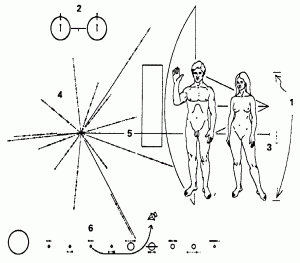
    Pioneer 10 plaque.

    The Voyager probes were not the first equipped with means of communicating with potential probe finders. The Pioneer 10 and 11 probes were launched in 1972 and 1973, pioneered the idea of communicating with ET. As both carry small metal plaques identifying their time and place of origin for the benefit of any other spacefarers that might find them in the distant future.

    Instruments is What makes the Probe

    Voyager 1 has 16 hydrazine thrusters, three-axis stabilization gyroscopes, and referencing instruments (Sun sensor/Canopus Star Tracker) to keep the probe’s radio antenna pointed towards Earth.

    The communication system of Voyager 1 was designed to be used to and beyond the limits of the solar system. The radio system includes a 3.7 meter in diameter parabolic dish to send and receive radio waves via the three Deep Space Network stations on the Earth.

    Voyager 1s engine consists of three large, so-called “radioisotope thermoelectric generators”. Each contains 24 pressed plutonium-238 oxide spheres. The heat from these spheres generated about 157 watts of electric power at the launch, with the remainder being dissipated as waste heat. The total amount of electricity generated is about 470 watts.

    The Voyager 1 and 2 will probably stop sending data back to Earth sometime between 2020 and 2025.

    ______________
    NASA Voyager
    NASA Voyager Mission
    ____________________________
    Interstellar Space Voyager Space Probes (NASA)
    Share. Facebook Twitter Pinterest LinkedIn Tumblr Email Copy Link

    Related Posts

    Europa Clipper: NASA’s Mission to Unlock the Secrets of Jupiter’s Icy Moon

    October 20, 2024

    Spinlaunch Hurls Satellites into Orbit With a Giant Centrifuge

    December 6, 2021

    SpaceX Capsule and NASA Crew Make Historic Splashdown

    August 3, 2020

    NASA and SpaceX are Making History Launching Astronauts to Space! | NASA Live

    May 27, 2020

    Red Space Salad Given Green Light

    May 26, 2020

    NASA Will Launch a Lunar VIPER to Hunt Moon Water in 2022

    November 12, 2019
    Recent Posts
    • How the End of Bretton Woods Reshaped Our Economies — and Our Politics
    • Can the U.S. Really Handle 250% Debt-to-GDP? Why Jackson Hole’s Daring Paper Is Wrong
    • Japan’s Fiscal Trap: What Happens If Austerity Is No Longer an Option?
    • The Rise of Range Extended Electric Vehicles (REEVs): A New Era of Hybrid Mobility
    • The Great Capital Rotation: A Shift from U.S. Treasuries to Gold and Real Assets
    • The Hidden Risks of Short-Term Debt: A Balancing Act in U.S. Fiscal Policy
    • The Looming U.S. Debt Spiral: Understanding the Risks
    • The Looming Recession: Seven Economic Indicators Flashing Red for 2025
    • Europa Clipper: NASA’s Mission to Unlock the Secrets of Jupiter’s Icy Moon
    • Could Hedge Funds Cause Chaos in the U.S. Treasury Market? And What About Inflation?
    © 2025 Illustrated Curiosity

    Type above and press Enter to search. Press Esc to cancel.

    This website uses cookies to improve your experience. We'll assume you're ok with this, but you can opt-out if you wish.Accept Reject Read More
    Privacy & Cookies Policy

    Privacy Overview

    This website uses cookies to improve your experience while you navigate through the website. Out of these, the cookies that are categorized as necessary are stored on your browser as they are essential for the working of basic functionalities of the website. We also use third-party cookies that help us analyze and understand how you use this website. These cookies will be stored in your browser only with your consent. You also have the option to opt-out of these cookies. But opting out of some of these cookies may affect your browsing experience.
    Necessary
    Always Enabled
    Necessary cookies are absolutely essential for the website to function properly. This category only includes cookies that ensures basic functionalities and security features of the website. These cookies do not store any personal information.
    Non-necessary
    Any cookies that may not be particularly necessary for the website to function and is used specifically to collect user personal data via analytics, ads, other embedded contents are termed as non-necessary cookies. It is mandatory to procure user consent prior to running these cookies on your website.
    SAVE & ACCEPT