Close Menu
Illustrated Curiosity
    Facebook X (Twitter) Instagram YouTube
    Illustrated Curiosity
    • Earth
    • Economics
    • Environment
      • Climate
      • Environmental Tech
      • Pollution
      • Wildlife
    • Health
      • Health Tech
      • Medicine
      • Nutrition
      • Exercise
    • History
      • Prehistory
      • Ancient History
      • Postclassical Era
      • Modern History
    • Humans
      • Human Brain
      • Psychology
    • Life
      • Animals & Plants
      • Genetics
      • Paleontology
      • Evolution
      • Genetic Engineering
    • Physics
    • Space
      • Astrobiology
      • Astronomy
      • Extrasolar Planets
      • Space Tech
      • Spaceflight
    • Technology
      • Artificial Intelligence
      • Energy
      • Engineering
      • Materials
      • Robotics
      • Vehicles
    Illustrated Curiosity
    Home » ET HTS maglev is a super fast Chinese train
    Vehicles

    ET HTS maglev is a super fast Chinese train

    May 24, 2014No Comments3 Mins Read
    Share
    Facebook Twitter LinkedIn Pinterest Email
    Credit: Southwest Jiaotong University in Chengdu

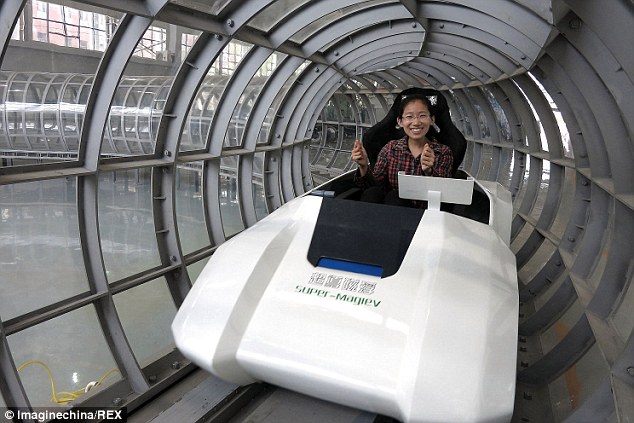
    The Chinese Southwest Jiaotong University has taken the first steps towards making a future super-fast maglev train a reality – when they recently tested the propulsion of high-temperature superconductors.

    The test was conducted on a much smaller scale, though, on a model at the University. This model train track is oval with a radius of only 6 meters (20 feet) and with a speed restricted to only 25 kilometers an hour.

    The test was proven successful and the project has now entered the next phase, for which the model train will travel in a vacuum. This concept of using maglev trains in a vacuum is nothing new but does imply remarkable performance gains and great advantages to maximum speed.

    A maglev train uses magnetic levitation to propel the train, and with magnets rather than wheels, axles, and bearings – this enables the train to reduce friction almost completely. Air resistance is, however, a real factor when approaching higher speeds.
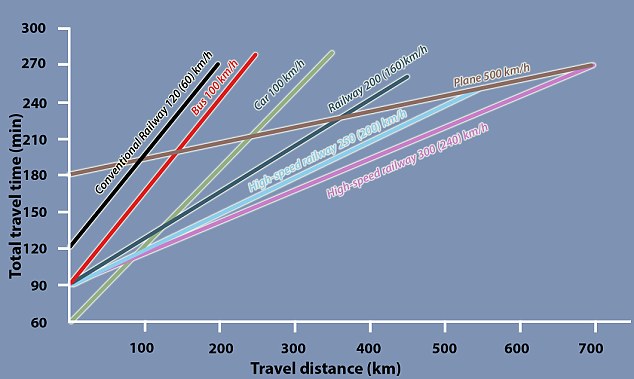
    Travel time speed graph. Credit: Southwest Jiaotong University in Chengdu

    If you run the train through evacuated (air-less) or partly evacuated tubes or tunnels (vactrain (or vacuum tube train)) this permits this vactrain to run much more efficiently with less air resistance and less power usage.

    It also enables the vactrain to move at extremely high speeds. The lack of air resistance actually permits trains to travel at speeds of up to 4,000–5,000 mph (6,400–8,000 km/h), or 5–6 times the speed of sound.

    The world’s only commercial maglev train is presently operational in Shanghai, China. On a 30 kilometer long path to the city’s international airport. This train is able to reach a maximum speed of 430 km/h (267 mph).

    Deng Ziagang at Jiaotong University explains that “at speeds over 400 km/h, more than 83 percent of the propulsion energy is used to overcome air resistance”.

    The obvious solution, therefore, would be to reduce air resistance around the train, hence a vacuum tunnel. Allowing the train to travel much faster at increased energy efficiency.

    The university has built a tunnel around the test track, for which they have managed to lower the air pressure to one-tenth of the atmospheric pressure at sea level.

    This test track, called ET HTS Maglev (Evacuation Tube High-Temperature Superconducting) has accelerated a train to 50 km/h (31 mph). Eventually, Zigang hopes to reach speeds of 3,000 km/h (ca 1900 mph).

    _______________
    Southwest Jiaotong University in Chengdu

    ______________________________

    China Maglev - Magnetic Levitation Train Vactrain - Vacuum Tube Train
    Share. Facebook Twitter Pinterest LinkedIn Tumblr Email Copy Link

    Related Posts

    The Rise of Range Extended Electric Vehicles (REEVs): A New Era of Hybrid Mobility

    February 6, 2025

    Across The Atlantic On Hydrogen? A Liquid Hydrogen Plane Paves Way for Zero Emission Flight

    December 12, 2021

    The Experimental Engine That Could Get Us Anywhere in the World in 2 Hours

    December 11, 2020

    What Can 6,000 Electric Vehicles Tell Us about Ev Battery Health?

    January 23, 2020

    Making a Case for Returning Airships to the Skies

    August 29, 2019

    Alaka’i Technologies Unveils Skai, a Hydrogen-Powered Air Taxi

    June 23, 2019
    Recent Posts
    • How the End of Bretton Woods Reshaped Our Economies — and Our Politics
    • Can the U.S. Really Handle 250% Debt-to-GDP? Why Jackson Hole’s Daring Paper Is Wrong
    • Japan’s Fiscal Trap: What Happens If Austerity Is No Longer an Option?
    • The Rise of Range Extended Electric Vehicles (REEVs): A New Era of Hybrid Mobility
    • The Great Capital Rotation: A Shift from U.S. Treasuries to Gold and Real Assets
    • The Hidden Risks of Short-Term Debt: A Balancing Act in U.S. Fiscal Policy
    • The Looming U.S. Debt Spiral: Understanding the Risks
    • The Looming Recession: Seven Economic Indicators Flashing Red for 2025
    • Europa Clipper: NASA’s Mission to Unlock the Secrets of Jupiter’s Icy Moon
    • Could Hedge Funds Cause Chaos in the U.S. Treasury Market? And What About Inflation?
    © 2025 Illustrated Curiosity

    Type above and press Enter to search. Press Esc to cancel.

    This website uses cookies to improve your experience. We'll assume you're ok with this, but you can opt-out if you wish.Accept Reject Read More
    Privacy & Cookies Policy

    Privacy Overview

    This website uses cookies to improve your experience while you navigate through the website. Out of these, the cookies that are categorized as necessary are stored on your browser as they are essential for the working of basic functionalities of the website. We also use third-party cookies that help us analyze and understand how you use this website. These cookies will be stored in your browser only with your consent. You also have the option to opt-out of these cookies. But opting out of some of these cookies may affect your browsing experience.
    Necessary
    Always Enabled
    Necessary cookies are absolutely essential for the website to function properly. This category only includes cookies that ensures basic functionalities and security features of the website. These cookies do not store any personal information.
    Non-necessary
    Any cookies that may not be particularly necessary for the website to function and is used specifically to collect user personal data via analytics, ads, other embedded contents are termed as non-necessary cookies. It is mandatory to procure user consent prior to running these cookies on your website.
    SAVE & ACCEPT