Close Menu
Illustrated Curiosity
    Facebook X (Twitter) Instagram YouTube
    Illustrated Curiosity
    • Earth
    • Economics
    • Environment
      • Climate
      • Environmental Tech
      • Pollution
      • Wildlife
    • Health
      • Health Tech
      • Medicine
      • Nutrition
      • Exercise
    • History
      • Prehistory
      • Ancient History
      • Postclassical Era
      • Modern History
    • Humans
      • Human Brain
      • Psychology
    • Life
      • Animals & Plants
      • Genetics
      • Paleontology
      • Evolution
      • Genetic Engineering
    • Physics
    • Space
      • Astrobiology
      • Astronomy
      • Extrasolar Planets
      • Space Tech
      • Spaceflight
    • Technology
      • Artificial Intelligence
      • Energy
      • Engineering
      • Materials
      • Robotics
      • Vehicles
    Illustrated Curiosity
    Home » What Can 6,000 Electric Vehicles Tell Us about Ev Battery Health?
    Vehicles

    What Can 6,000 Electric Vehicles Tell Us about Ev Battery Health?

    January 23, 20203 Mins Read
    Share
    Facebook Twitter LinkedIn Pinterest Email

    Pixabay License

    A comprehensive study by Geotab has collected data from electric cars worldwide to analyze and compare battery health. Geotab found that on average, the batteries lost 2.3 percent of their capacity a year.

    The telematics company Geotab has collected the company’s statistics on how the electric cars’ batteries degenerate over time. The data comprises over 1.8 million days and over 6,300 electric cars around the world.

    The study shows that the batteries on average lose 2.3 percent of their capacity per year. This means that an electric car with a range of 241 kilometers after five years has lost about 27 kilometers of that capacity. However, according to Geotab, the annual loss means that most batteries will survive the expected life of the vehicle itself.

    After analyzing the battery health of 6,300 fleet and consumer EVs over 1.8 million days of operation, the GeoTab analysis can provide insight into how conditions in the real world influence the battery health of 21 electric car models from various manufacturers over a number of years.

    The study shows that battery chemistry, together with the efficiency of cooling/heating systems with air or liquid, affects the degree of degeneration.

    Among other things, GeoTab makes a comparison between a Tesla Model S and a Nissan Leaf, where Tesla, with its liquid cooling, lost 2.3 percent per year – compared to 4.2 percent for Nissan’s passive air cooling system.
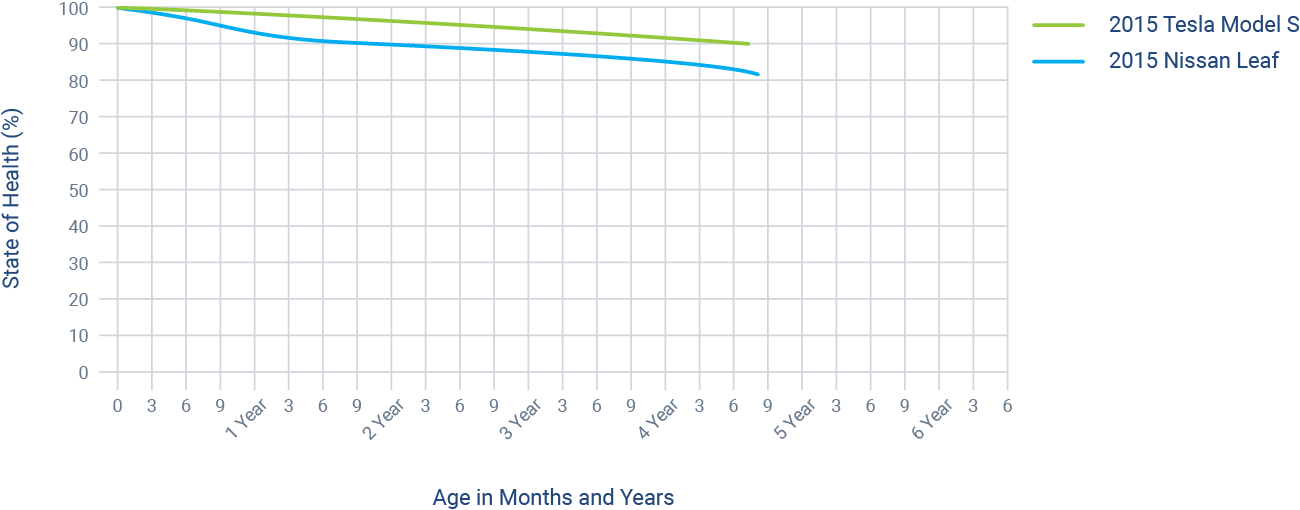
     

    Image: Geotab
    Battery degradation comparison of the 2015 Tesla Model S (liquid cooling) vs. the 2015 Nissan Leaf (passive air cooling).

    The loss over time is not necessarily linear, although this is generally the case. Early on, the battery may suffer a substantial loss, which is then followed by more moderate losses. But the study shows that regular use has no effect on the marginal change. The study does show that the local climate is decisive – and it is batteries in hot regions that degenerate the fastest.

    Battery life is impacted by 5 factors; time, high temperatures, operating at a high and low state of charge, high electric current and Usage (energy cycles).

    Quick charging accelerates the aging process, and in combination with a hot climate, the study reported a loss of ten percent after six years. Geotab recommends owners who want to maintain the service life to keep the charge between 20-80 percent of the battery capacity.

    There is also a practical reason to stay within this interval since above and below this, the chemistry is not able to deliver its full power and this change is so apparent that it even affects the driving experience, according to Geotab.

    “Battery degradation is a natural process that permanently reduces the amount of energy a battery can store or the amount of power it can deliver. The batteries in EVs can generally deliver more power than the powertrain components can handle. As a result, power degradation is rarely observable in EVs and only the loss of the battery’s ability to store energy matters,”

    – GeoTab says in an online post.

    For more information, go to GeoTab’s online tool to see the data that pertains to each individual model of electric car sold in the US.


    Share. Facebook Twitter Pinterest LinkedIn Tumblr Email Copy Link

    Related Posts

    The Rise of Range Extended Electric Vehicles (REEVs): A New Era of Hybrid Mobility

    February 6, 2025

    Across The Atlantic On Hydrogen? A Liquid Hydrogen Plane Paves Way for Zero Emission Flight

    December 12, 2021

    The Experimental Engine That Could Get Us Anywhere in the World in 2 Hours

    December 11, 2020

    Making a Case for Returning Airships to the Skies

    August 29, 2019

    Alaka’i Technologies Unveils Skai, a Hydrogen-Powered Air Taxi

    June 23, 2019

    Daimler and Bosch to Test Self-Driving Taxis Next Year

    July 20, 2018
    Recent Posts
    • America’s Quiet Shift Into Fiscal Dominance: Why Inflation May Be Preparing for a Second Act
    • How the End of Bretton Woods Reshaped Our Economies — and Our Politics
    • Can the U.S. Really Handle 250% Debt-to-GDP? Why Jackson Hole’s Daring Paper Is Wrong
    • Japan’s Fiscal Trap: What Happens If Austerity Is No Longer an Option?
    • The Rise of Range Extended Electric Vehicles (REEVs): A New Era of Hybrid Mobility
    • The Great Capital Rotation: A Shift from U.S. Treasuries to Gold and Real Assets
    • The Hidden Risks of Short-Term Debt: A Balancing Act in U.S. Fiscal Policy
    • The Looming U.S. Debt Spiral: Understanding the Risks
    • The Looming Recession: Seven Economic Indicators Flashing Red for 2025
    • Europa Clipper: NASA’s Mission to Unlock the Secrets of Jupiter’s Icy Moon
    © 2025 Illustrated Curiosity

    Type above and press Enter to search. Press Esc to cancel.

    This website uses cookies to improve your experience. We'll assume you're ok with this, but you can opt-out if you wish.Accept Reject Read More
    Privacy & Cookies Policy

    Privacy Overview

    This website uses cookies to improve your experience while you navigate through the website. Out of these, the cookies that are categorized as necessary are stored on your browser as they are essential for the working of basic functionalities of the website. We also use third-party cookies that help us analyze and understand how you use this website. These cookies will be stored in your browser only with your consent. You also have the option to opt-out of these cookies. But opting out of some of these cookies may affect your browsing experience.
    Necessary
    Always Enabled
    Necessary cookies are absolutely essential for the website to function properly. This category only includes cookies that ensures basic functionalities and security features of the website. These cookies do not store any personal information.
    Non-necessary
    Any cookies that may not be particularly necessary for the website to function and is used specifically to collect user personal data via analytics, ads, other embedded contents are termed as non-necessary cookies. It is mandatory to procure user consent prior to running these cookies on your website.
    SAVE & ACCEPT