
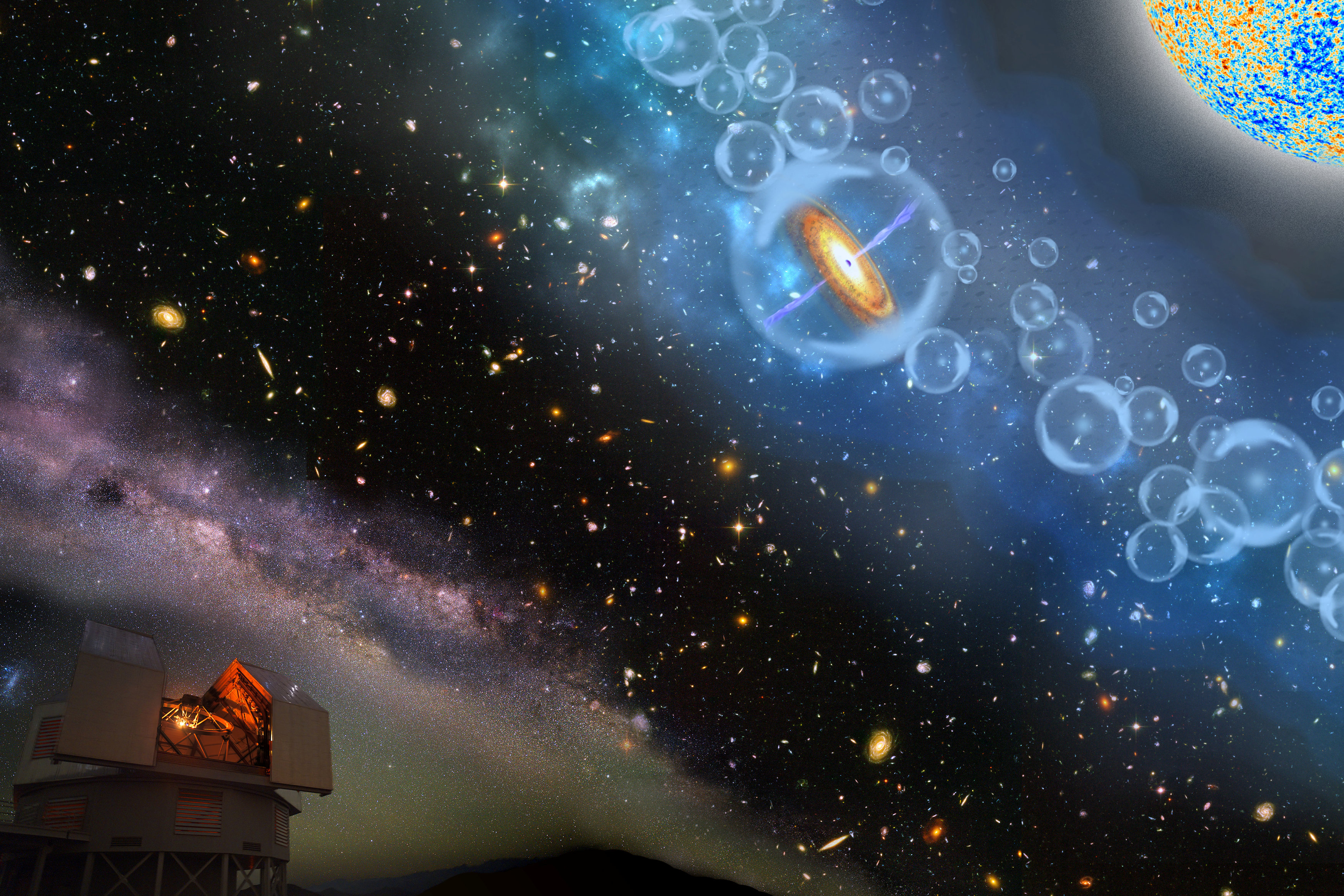
Credit: Robin Dienel, courtesy of the Carnegie Institution for Science
A new record-big black hole has been discovered. American researchers have discovered a supermassive black hole that is extremely old, big and bright. The discovery of such an immense black hole at the edge of cosmic dawn has astronomers puzzled.
Unlike ordinary black holes that form when stars die, scientists do not exactly know how these supermassive black holes are formed.
The hole may have been formed by the collapse of a huge star, but it could also be the result of a collapsing cloud of gas or something else that researchers have not yet to discover.
A common black hole has a mass of about the same size as the sun, while a supermassive black hole can have a mass of up to ten billion times the mass of our sun.
This particular black hole is measured to be about 800 million times as massive as our sun. It is a Goliath by modern-day standards and a relative anomaly in the early universe.
The team of astronomers was led by MIT, with astronomers from the Carnegie Institution for Science, NASA and the Max Planck Institute for Astronomy.
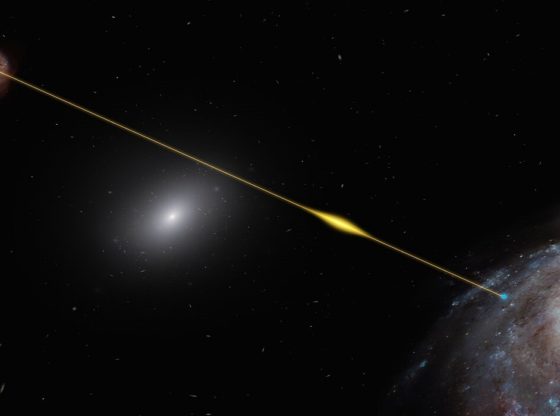
The black hole sits at the center of an ultrabright quasar, and it enabled the researchers to detect this supermassive black hole.
Consuming the surrounding gas results in a bright light that was emitted just 690 million years after the Big Bang. Since the light source is so far away, what we see now happened a very long time ago, in a very young universe, only 690 million years after the Big Bang, which is about five percent of the universe’s lifetime.
The light we detect has taken about 13 billion years to reach us, a timespan early equal to the age of the universe. It makes it the oldest supermassive black hole that has been known so far.
“It has an extremely high mass, and yet the universe is so young that this thing shouldn’t exist. The universe was just not old enough to make a black hole that big. It’s very puzzling,”
– MIT co-author and physics professor Robert Simcoe.
The astronomers believe that the newly discovered quasar existed during a fundamental transition of the universe, when stars were turned on throughout the universe and their photons reacted with neutral hydrogen, ionizing the gas, setting off what’s known as the epoch of re-ionization.
Since black holes grow by absorbing mass from the surrounding environment, extremely large black holes, such as this one, should form over periods much longer than 690 million years.
“If you start with a seed like a big star, and let it grow at the maximum possible rate, and start at the moment of the Big Bang, you could never make something with 800 million solar masses — it’s unrealistic,”
“So there must be another way that it formed. And how exactly that happens, nobody knows.”
– Robert Simcoe
The discovery can provide valuable insights into the history of the universe and also provide astronomers with valuable data on how long it takes for such a massive black hole to be formed.
The researchers published their findings today in the journal Nature.
Reference:
Bañados et al., An 800 million solar mass black hole in a significantly neutral Universe at a redshift of 7.5, published in Nature on December 6, 2017, doi: 10.1038 / nature25180