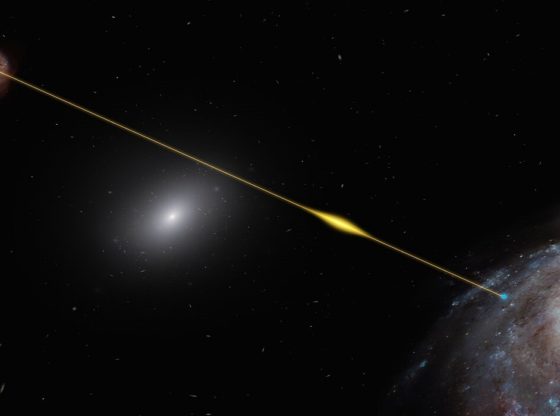

The fastest stars in our galaxy appears to be intergalactic in origin, according to new research.
Hyperspeed
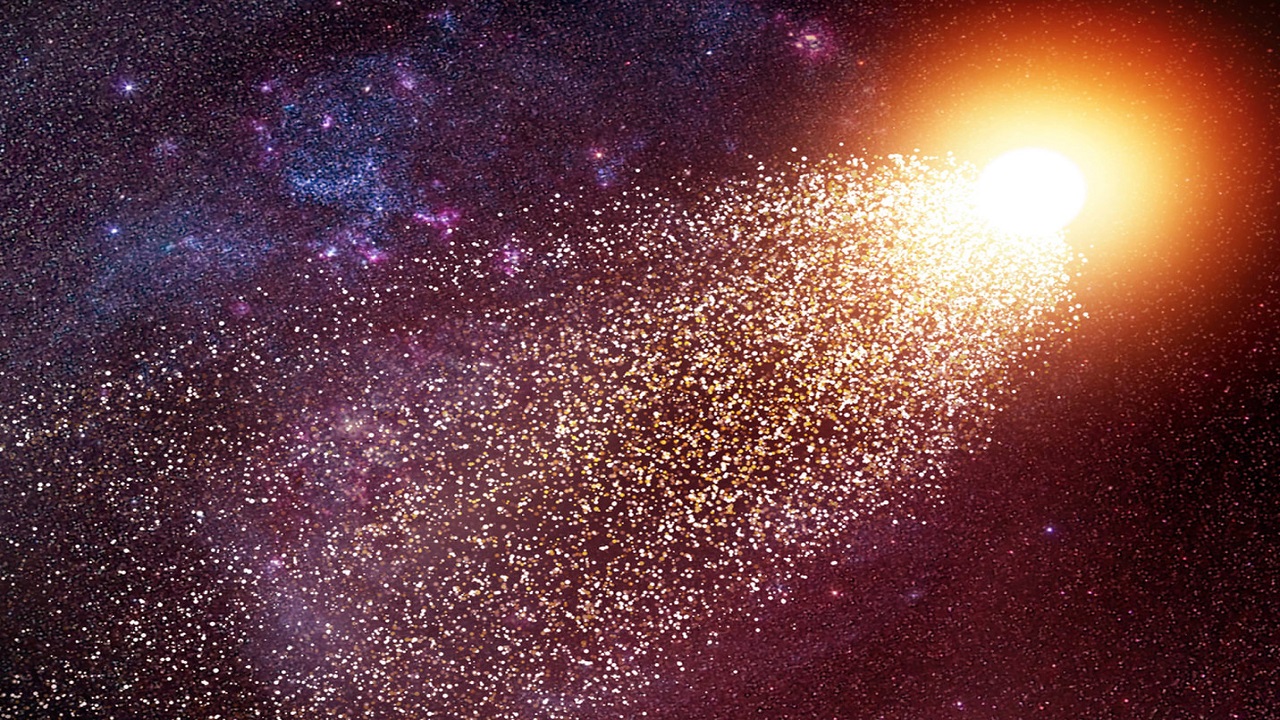
About 20 so-called hypervelocity stars have been observed in the Milkyway so far. Astronomers have been trying to figure out where they come from.
These incredibly fast-moving objects are substantially different from that expected for a star belonging to the normal distribution of stars in a galaxy.
Ordinary stars in the Milky Way have velocities on the order of 100 km/s, whereas hypervelocity stars have velocities on the order of 1000 km/s.
These stars have velocities so great that they exceed the escape velocity of the galaxy leading to the conclusion that they are actually gravitationally unbound to the Milky Way.
Intergalactic fugutives
A previous hypothesis was they at they gain their enormous speed when a supermassive black hole at the center of a galaxy devours one star in a binary system and ejects its twin, flinging it through space at superfast speeds. New research offers another more explanation based on extensive observations and computer simulations.
With the help of extensive observations and computer simulations, British researchers from Cambridge University noticed that hypervelocity star trajectories were consistent with an origin point outside the Milky Way.
The Magellanic Cloud
They now claim that these stars come from our neighboring galaxy The Large Magellanic Cloud (LMC). Contrary to its name, The LMC is a small galaxy orbiting the Milky Way. Rich in gas and dust, it is currently undergoing vigorous star formation activity.
These stars have just jumped from an express train – no wonder they’re fast,”
– Rob Izzard, one of the researchers and co-author of the paper published in the journal Monthly Notices of the Royal Astronomical Society.
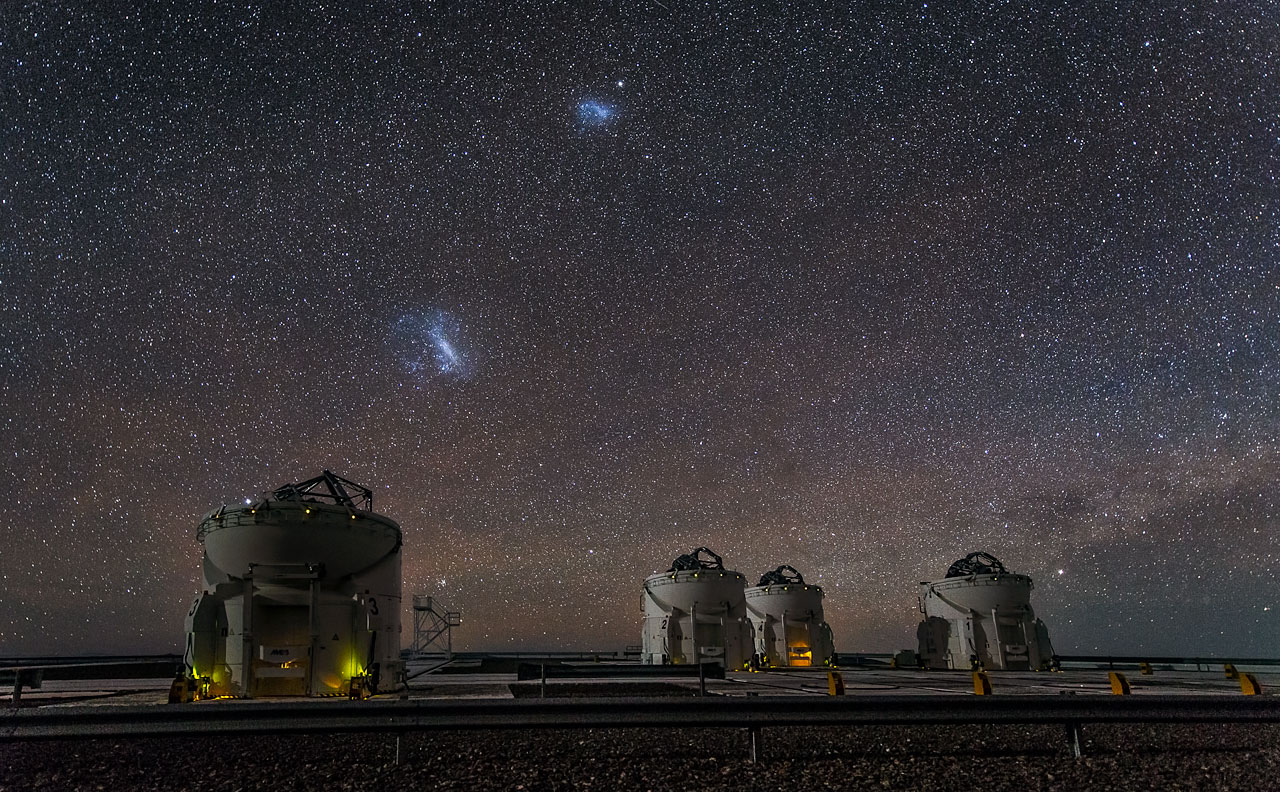
The Cambridge researchers hypothesize that these stars were once part of double star systems, in which one star exploded. The violent power of this supernova would have pushed the surviving star with such power for it to leave its galaxy to arrive in the Milkyway.
The Large Magellanic Cloud being only about 10% of the mass of our galaxy the fastest runaway stars are easily able to escape the galaxy’s pull, the speed of these escaping stars would be the velocity they were booted at plus the velocity of the LMC.
Reference:
D. Boubert, D. Erkal, N. W. Evans and R. G. Izzard. “Hypervelocity runaways from the Large Magellanic Cloud.” Monthly Notices of the Royal Astronomical Society (2017). DOI: 10.1093 / mnras / stx848.)