
Image credits R. Terik Daly, Peter H. Schultz, 2018, Planetary Sciences.
The source of Earth’s water is a bit of a mystery. There are theories that it may have come from objects crashing into our young planet. New research provides a possible explanation.
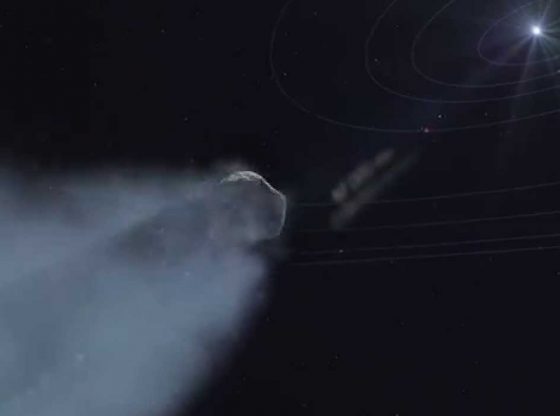
Asteroids can contain water in the form of ice. If they hit a planet, the ice melts and immediately converts to water vapor due to the resulting heat from the impact.
A new study, published in Science advances, details how scientists replicated asteroid impacts on a tiny scale in a laboratory setting to find out if asteroids could deliver water to other planets. Since traditional impact models show that all water vapor instantly disappears into its smaller components oxygen and hydrogen due to the extreme heat generated by the impact. The researchers wanted to find out if this holds true.
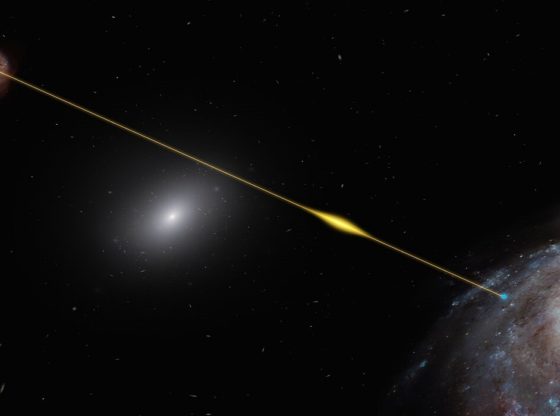
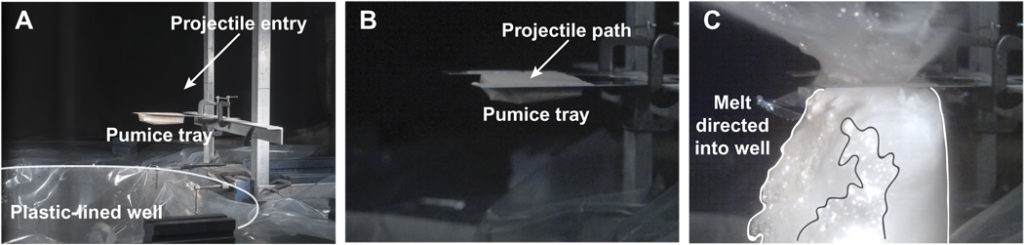
Since scientific models do not always provide the whole picture, the researchers decided to do complementary experiments. In the main experiment, they used an aqueous mineral, antigorite, which occurs in stone meteorites. Illustrating an asteroid, or meteor on an impact trajectory with Earth.
As a target, dried pumice stone was used, which mimics the surface material of many celestial bodies including Earth. The researchers then shot the antigorite into the pumice stones at a speed of five kilometers per second.
The results showed that 30 percent of the water in an asteroid can be preserved during an impact. Although much of the water vaporized into atoms, a large amount of water vapor may be caught by other materials formed during the impact.
The study, therefore, clearly shows that it is possible that large amounts of water may have come to Earth or any other planet via comets, meteoroids or asteroids.
“Impact models tell us that [asteroids] should completely devolatilize at many of the impact speeds common in the solar system, meaning all the water they contain just boils off in the heat of the impact,”
“But nature has a tendency to be more interesting than our models, which is why we need to do experiments.”
– Study co-author Peter Schultz, a professor in Brown’s Department of Earth, Environmental and Planetary Sciences, said in a statement.
Experiments are really important for advancing science and the researchers aimed to mimic what happens in real life, even better understanding would result from examining what the real world results are when examining real impact of asteroids and planets in our solar system, which we possibly will be able to do in the future.
Reference:
R. Terik Daly, and Peter H. Schultz The delivery of water by impacts from planetary accretion to present DOI: 10.1126/sciadv.aar2632