Close Menu
Illustrated Curiosity | Economics, History, Science, Space, Technology, Health, Physics, Earth
    Facebook X (Twitter) Instagram YouTube
    Illustrated Curiosity | Economics, History, Science, Space, Technology, Health, Physics, Earth
    • Earth
    • Economics
    • Environment
      • Environmental Tech
      • Pollution
      • Wildlife
    • Health
      • Health Tech
      • Medicine
      • Nutrition
      • Exercise
    • History
      • Prehistory
      • Ancient History
      • Postclassical Era
      • Modern History
    • Humans
      • Human Brain
      • Psychology
    • Life
      • Animals & Plants
      • Genetics
      • Paleontology
      • Evolution
      • Genetic Engineering
    • Physics
    • Space
      • Astrobiology
      • Astronomy
      • Extrasolar Planets
      • Space Tech
      • Spaceflight
    • Technology
      • Artificial Intelligence
      • Energy
      • Engineering
      • Materials
      • Robotics
      • Vehicles
    Illustrated Curiosity | Economics, History, Science, Space, Technology, Health, Physics, Earth
    Home » Our sleeping Sun erupts with significant flares
    Astronomy

    Our sleeping Sun erupts with significant flares

    October 2, 20171 Min Read
    NASA's Solar Dynamics Observatory captured this image of a solar flare – as seen in the bright flash on the right side – on Sept. 10, 2017. The image shows a combination of wavelengths of extreme ultraviolet light that highlights the extremely hot material in flares, which has then been colorized. Image: NASA, Public Domain
    Share
    Facebook Twitter LinkedIn Pinterest Email

    The solar flare activity in September came as a surprise to astronomers. The increase in activity occurred during a period when researchers wouldn’t expect that kind of activity.
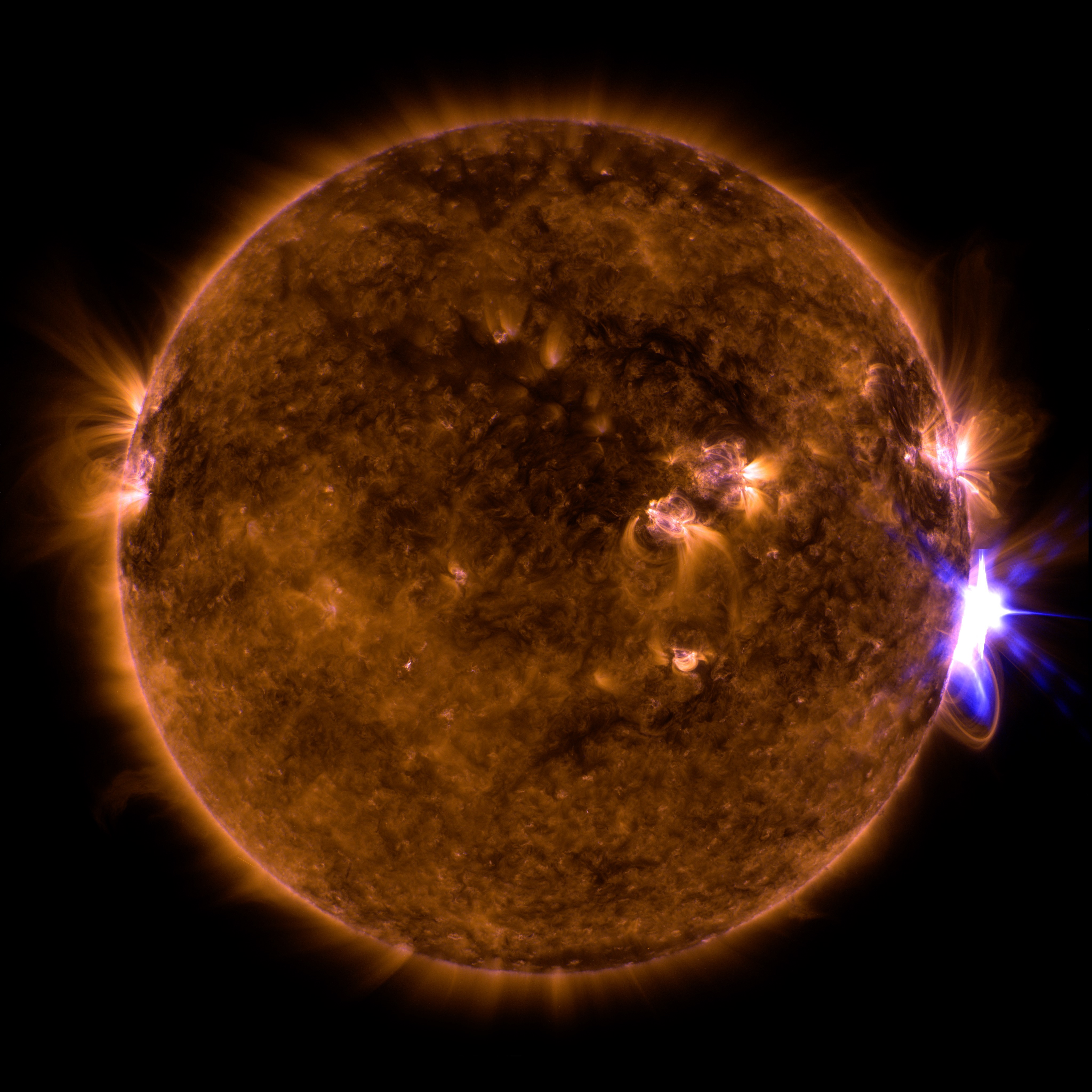
    Since the beginning of September, several solar outbursts have occurred. The outbursts can be linked to a huge sunspot that scientists have been growing ever larger.
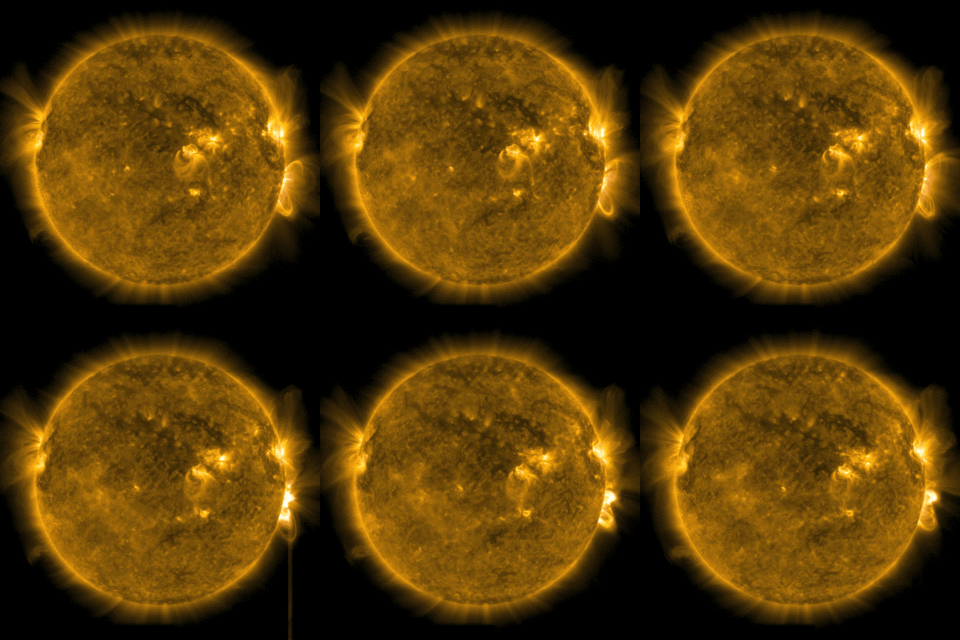
    This sunspot is peculiar according to researchers because the sun should be in an inactive period at the moment, a so-called solar minimum.

    The researchers count the number of sunspots to keep an eye on how active the sun is, and during a solar minimum, a period of least solar activity in the 11-year solar cycle of the sun, sunspot and solar flare activity diminishes and often does not occur for days at a time.

    Compared to a solar minimum, a solar maximum could mean between 50 and 200 sunbeds at any given time. When the number of spots is at least, the number can be close to zero.

    In September, we have seen four solar flares – 4th, 6th, 8th, and 10th. The latest solar storm has not reached us yet.

    Reference:
    NASA: Sun Erupts With Significant Flare
    Solar flars Sun spot The Sun
    Share. Facebook Twitter Pinterest LinkedIn Tumblr Email Copy Link

    Related Posts

    The James Webb Space Telescope DeliversThe Deepest Image of the Universe (yet)

    July 13, 2022

    There Is Now Rigorous Evidence for Water on the Moon

    November 2, 2020

    The Dwarf Planet Ceres Might Be Home to an Underground Ocean of Water

    August 12, 2020

    Mysterious Repeating Fast Radio Burst Traced to Nearby Galaxy

    January 13, 2020

    Mercury Transit 2019 4K UHD

    November 12, 2019

    A Second Interstellar Visitor Detected in Our Solar System

    September 20, 2019
    Recent Posts
    • Oil Shocks, Policy Mistakes, and the Risk of a Second Inflation Wave (Part II)
    • Oil Shocks, Policy Mistakes, and the Risk of a Second Inflation Wave (Part I)
    • Microsoft Stored a Movie on Glass — And It Could Last Centuries
    • AI, Automatic Stabilizers & Inflation
    • Largest Battles in History: Cannae — Rome’s Darkest Day
    • The Day the Alliance Died
    • Evaluating Heart Disease: How Cumulative Diet Choices Compound Your Risk
    • What Would Happen If China Attacked Taiwan?
    • Geopoliticisation as a Structural Tailwind for Commodity Prices
    • America’s Economic Remodel: Who’s Really Paying the Bill?
    © 2025 Illustrated Curiosity

    Type above and press Enter to search. Press Esc to cancel.