
Geographical areas and features on the dwarf planet Pluto have now given names with more or less imaginative names. How about, about Sleipnir Fossa, Voyager Terra and Sputnik Planitia.
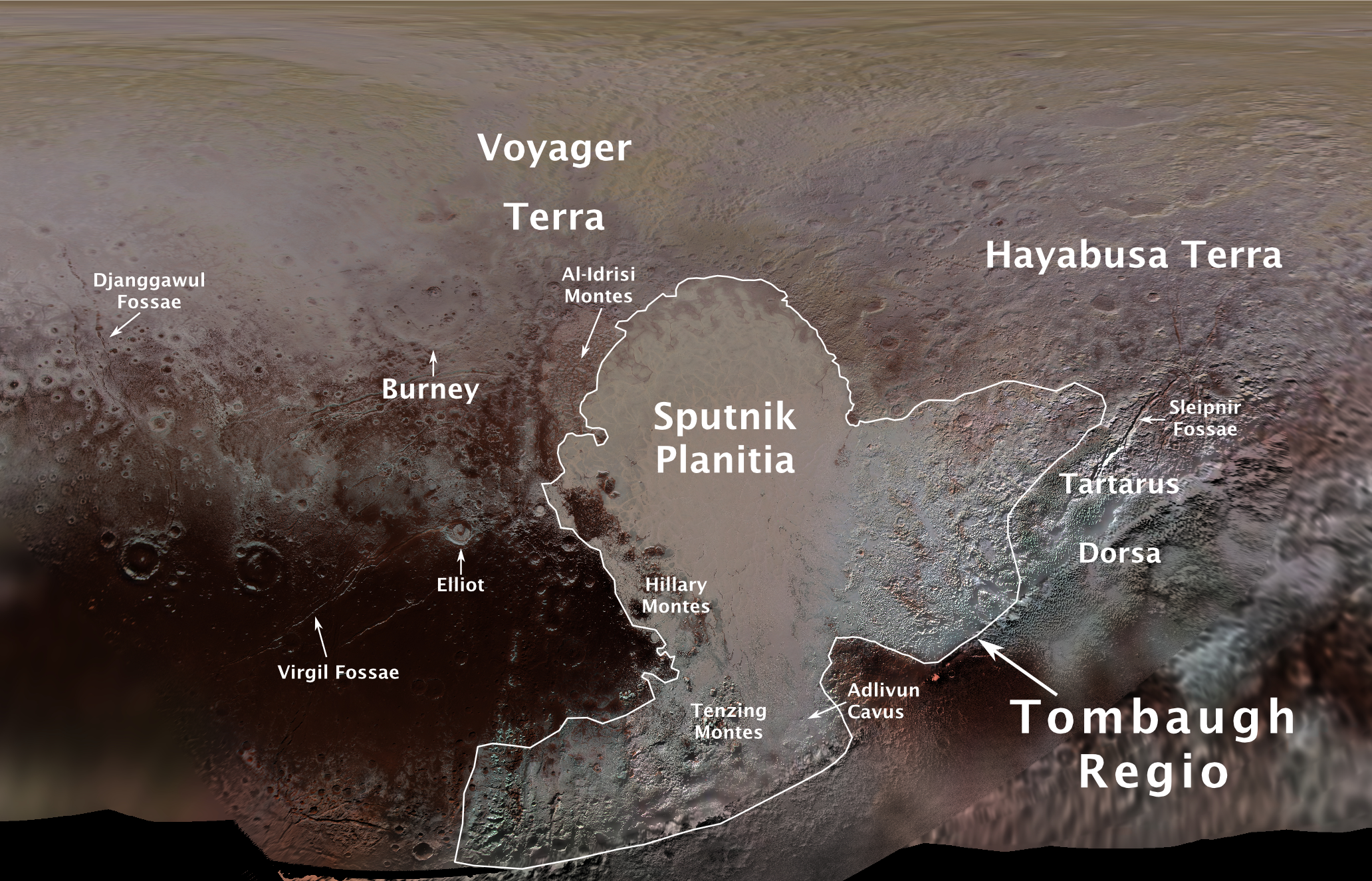
Credits: NASA/JHUAPL/SwRI/Ross Beyer
The names have been given since discovered by the NASA spacecraft New Horizons that passed Pluto a few years ago. The pictures taken by the spacecraft gave astronomers new knowledge of the dwarf plane’s surface with plains, craters and mountain ranges. Another example is a crater called Burney, named after the British girl Venetia Burney, who in 1930, suggested that the dwarf planet should be dubbed Pluto.
The list:
Tombaugh Regio honors Clyde Tombaugh (1906–1997), the U.S. astronomer who discovered Pluto in 1930 from Lowell Observatory in Arizona.
Burney crater honors Venetia Burney (1918-2009), who as an 11-year-old schoolgirl suggested the name “Pluto” for Clyde Tombaugh’s newly discovered planet. Later in life she taught mathematics and economics.
Sputnik Planitia is a large plain named for Sputnik 1, the first space satellite, launched by the Soviet Union in 1957.
Tenzing Montes and Hillary Montes are mountain ranges honoring Tenzing Norgay (1914–1986) and Sir Edmund Hillary (1919–2008), the Indian/Nepali Sherpa and New Zealand mountaineer were the first to reach the summit of Mount Everest and return safely.
Al-Idrisi Montes honors Ash-Sharif al-Idrisi (1100–1165/66), a noted Arab mapmaker and geographer whose landmark work of medieval geography is sometimes translated as “The Pleasure of Him Who Longs to Cross the Horizons.”
Djanggawul Fossae defines a network of long, narrow depressions named for the Djanggawuls, three ancestral beings in indigenous Australian mythology who traveled between the island of the dead and Australia, creating the landscape and filling it with vegetation.
Sleipnir Fossa is named for the powerful, eight-legged horse of Norse mythology that carried the god Odin into the underworld.
Virgil Fossae honors Virgil, one of the greatest Roman poets and Dante’s fictional guide through hell and purgatory in the Divine Comedy.
Adlivun Cavus is a deep depression named for Adlivun, the underworld in Inuit mythology.
Hayabusa Terra is a large land mass saluting the Japanese spacecraft and mission (2003-2010) that performed the first asteroid sample return.
Voyager Terra honors the pair of NASA spacecraft, launched in 1977, that performed the first “grand tour” of all four giant planets. The Voyager spacecraft are now probing the boundary between the Sun and interstellar space.
Tartarus Dorsa is a ridge named for Tartarus, the deepest, darkest pit of the underworld in Greek mythology.
Elliot crater recognizes James Elliot (1943-2011), an MIT researcher who pioneered the use of stellar occultations to study the solar system – leading to discoveries such as the rings of Uranus and the first detection of Pluto’s thin atmosphere.
The names are official because they are approved by the International Astronomical Union, IAU.
Reference: