
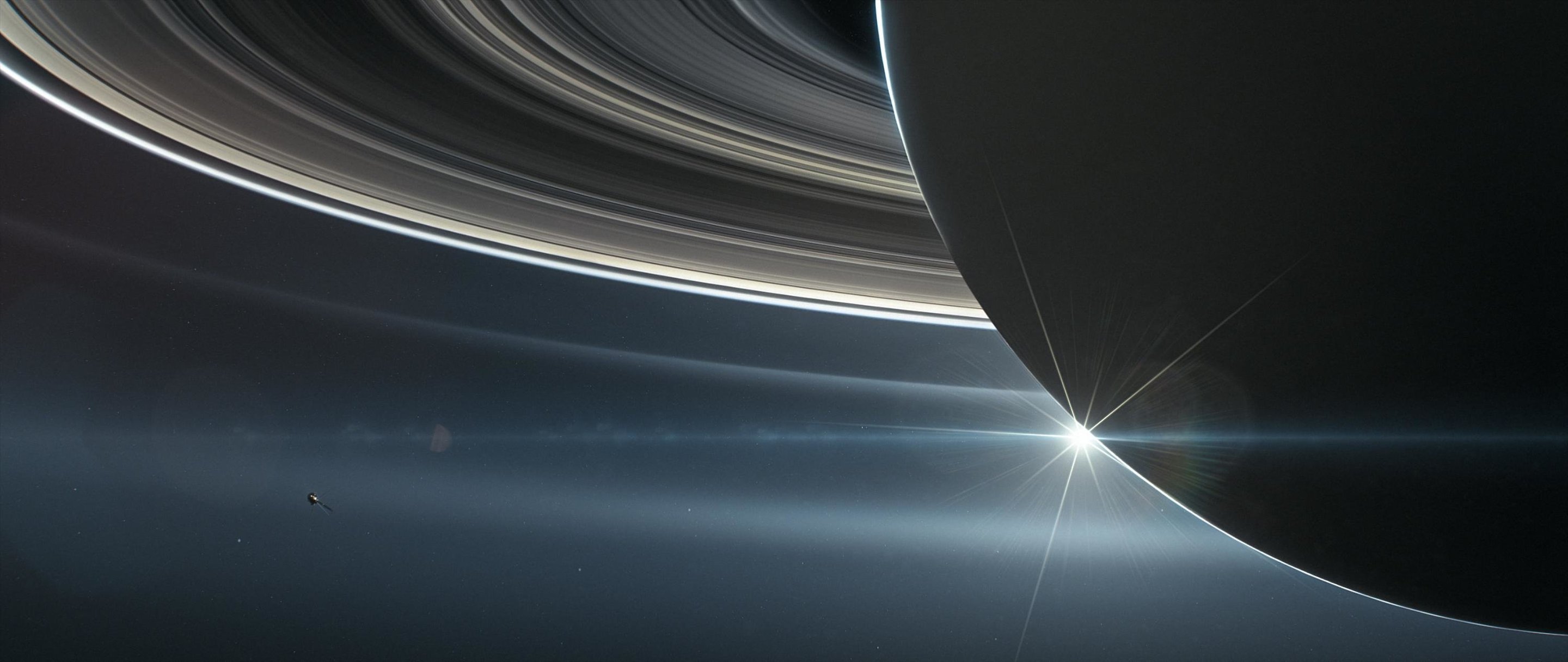
It has been more than a year since the iconic Cassini probe ended its mission by diving into the atmosphere of Saturn, the planet it studied for more than a decade. However, Cassini is the mission that just keeps on giving. Scientists are still analyzing the data collected by Cassini during its final days, and they now say the spacecraft encountered an unexpected phenomenon near Saturn.
The new research emerging from the final orbits of NASA’s Cassini spacecraft represents a huge leap forward in our understanding of the Saturn system — especially the mysterious, never-before-explored region between the planet and its rings. The space probe has revealed that the gas giant’s innermost ring sheds icy showers of rain and organic molecules into the planet’s upper atmosphere at an incredible rate.
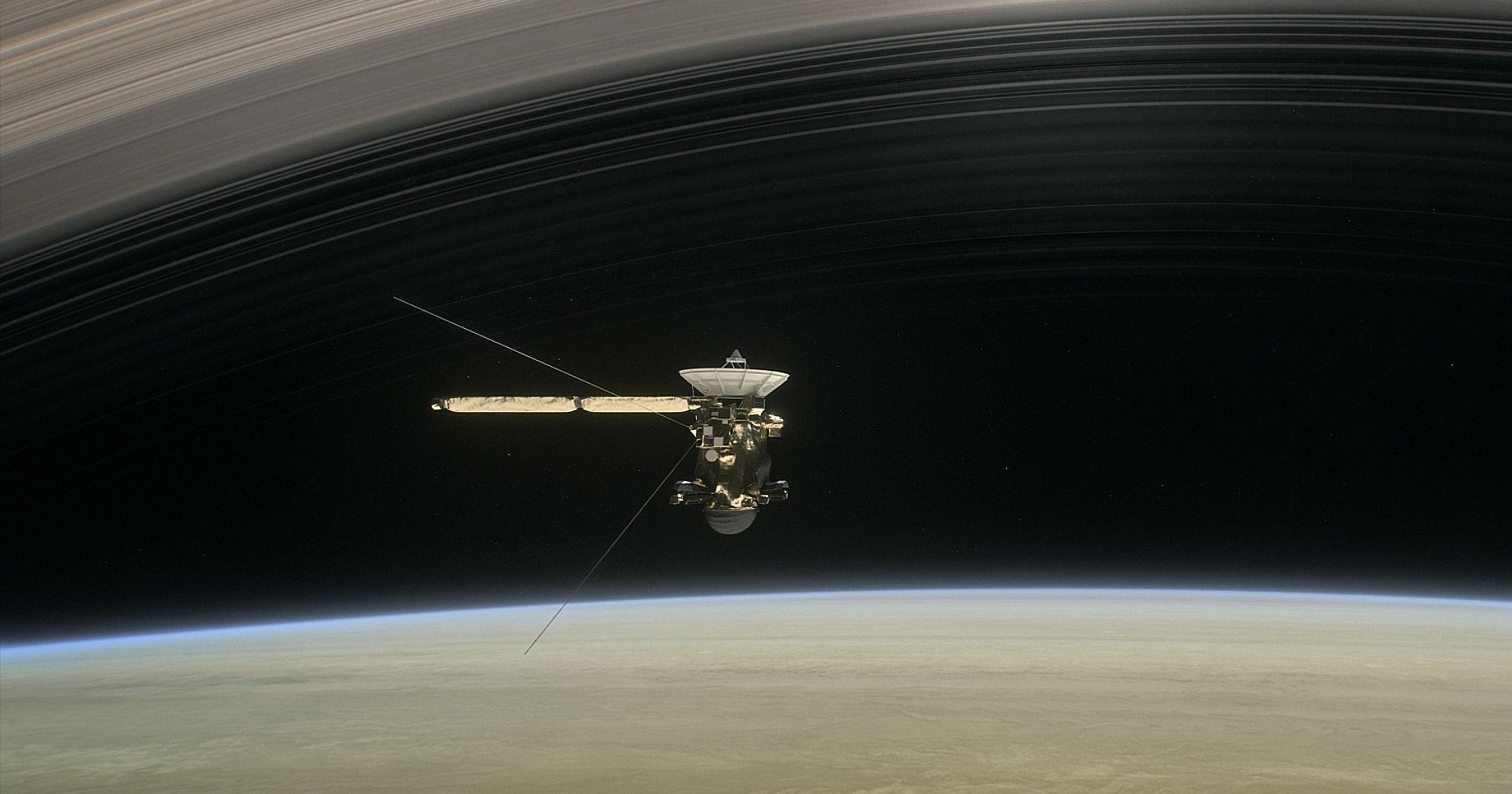
During the final few orbits of Saturn, Cassini’s Ion and Neutral Mass Spectrometer (INMS) detected water ice and complex organic molecules falling from the rings into the clouds of Saturn. Scientists long expected some transfer of material from the rings to the planet, but they were not prepared for the volume — it was a downpour.
Scientists are now releasing a truckload of results from the probe’s Grand Finale, including six papers out today in the journal Science and five in the journal Geophysical Research Letters.
The INMS found that they contained not only water but also methane, ammonia, carbon monoxide, molecular nitrogen, and carbon dioxide as well.
“What was a surprise was the mass spectrometer saw methane – no one expected that,”
“Also, it saw some carbon dioxide, which was unexpected. The rings were thought to be entirely water. But the innermost rings are fairly contaminated, as it turns out, with organic material caught up in ice.”
– Thomas Cravens, coauthor of the paper published in Science and a professor at the University of Kansas.
Cassini’s data shows that 10,000 kilograms (22,000 pounds) of material rains down on Saturn every second. The INMS also characterized what was in the rain. It was molecular hydrogen and helium, but 3.4 percent of it was more complex. There was water, of course, but also organic (carbon-containing) compounds. That included methane, carbon monoxide, and even “complex” organics like butane and propane.
Reference:
Michele K. Dougherty et al. Saturn’s magnetic field revealed by the Cassini Grand Finale. Science 4 oktober 2018. DOI: 10.1126/science.aat5434
E. Roussos et al. A radiation belt of energetic protons located between Saturn and its rings. Science 4 oktober 2018. DOI: 10.1126/science.aat1962
L. Lamy et al. The low-frequency source of Saturn’s kilometric radiation. Science 4 oktober 2018. DOI: 10.1126/science.aat2027
Hsiang-Wen Hsu et al. In situ collection of dust grains falling from Saturn’s rings into its atmosphere. Science 4 oktober 2018. DOI: 10.1126/science.aat3185
D. G. Mitchell et al. Dust grains fall from Saturn’s D-ring into its equatorial upper atmosphere. Science 4 oktober 2018. DOI: 10.1126/science.aat2236
J. H. Waite Jr. et al. Chemical interactions between Saturn’s atmosphere and its rings. Science 4 oktober 2018. DOI: 10.1126/science.aat2382