Close Menu
Illustrated Curiosity | Economics, History, Science, Space, Technology, Health, Physics, Earth
    Facebook X (Twitter) Instagram YouTube
    Illustrated Curiosity | Economics, History, Science, Space, Technology, Health, Physics, Earth
    • Earth
    • Economics
    • Environment
      • Environmental Tech
      • Pollution
      • Wildlife
    • Health
      • Health Tech
      • Medicine
      • Nutrition
      • Exercise
    • History
      • Prehistory
      • Ancient History
      • Postclassical Era
      • Modern History
    • Humans
      • Human Brain
      • Psychology
    • Life
      • Animals & Plants
      • Genetics
      • Paleontology
      • Evolution
      • Genetic Engineering
    • Physics
    • Space
      • Astrobiology
      • Astronomy
      • Extrasolar Planets
      • Space Tech
      • Spaceflight
    • Technology
      • Artificial Intelligence
      • Energy
      • Engineering
      • Materials
      • Robotics
      • Vehicles
    Illustrated Curiosity | Economics, History, Science, Space, Technology, Health, Physics, Earth
    Home » The Plot Thickens Concerning the Interstellar Cigar-Shaped Celestial Body
    Astronomy

    The Plot Thickens Concerning the Interstellar Cigar-Shaped Celestial Body

    July 3, 20183 Mins Read
    Illustration: Illustrated Curiosity
    Share
    Facebook Twitter LinkedIn Pinterest Email

    Remember that cigar-shaped interstellar object that whizzed through our Solar System last year? The cigar-shaped celestial body got a lot of attention when it was discovered last year, as it is the first known object that came from another solar system. Now, a study shows that the interstellar space explorer may be more comet-like than we thought from the beginning.

    On October 19th, 2017, the Panoramic Survey Telescope and Rapid Response System-1 (Pan-STARRS-1) telescope in Hawaii announced the first-ever detection of an interstellar asteroid – I/2017 U1 (aka. ‘Oumuamua). Originally thought to be a comet, follow-up observations conducted by the European Southern Observatory (ESO) and others confirmed that ‘Oumuamua was actually a rocky body that had originated outside of our Solar System.

    But a new study published in the journal Nature questions the assumption that it really was an asteroid or a comet. Since there are a couple of oddities to it being a comet, in particular, its unusual shape. A comet is usually formed by colliding with smaller objects and substances that assemble over time, and this process should produce an elongated shape.
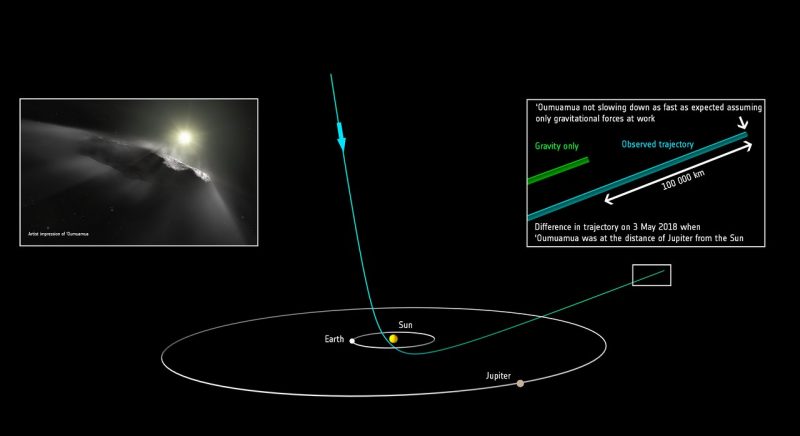
     

    But the scientists behind the new Nature Study have reviewed observations from both ground and space-based observations and found that a certain outflow of gas in a typical comet would be needed to explain the path of the object as it traverses through our solar system.

    The authors of the new study write that ‘Oumuamua’ was venting material from its surface, typical for a comet. Solar heating is producing an effect called outgassing, and the material ejected from the object’s surface is creating a tiny amount of thrust.

    So, if it isn’t an asteroid, nor a comet, what is it? The researchers made sure that the acceleration effect was not being caused by something else; they considered scenarios like solar wind, a collision with another object, its mass being different from what was calculated, and other known or suspected astrophysical phenomena. However, “these explanations are all either physically unrealistic or insufficient to explain the observed behavior,” write the authors in the study.

    http://www.illustratedcuriosity.com/files/media/42770/befpwmsewhnlbmaw3qat.mp4

    Also, the unlikely theory that ‘Oumuamua’ is an interstellar spaceship was rejected. The smooth and continuous change in speed is not typical for thrusters, and the object is tumbling on all three axes, speaking against it is an artificial object.

    Simply put, we aren’t able to define the object using any categories of celestial bodies available to us today.

    Reference:

    Marco Micheli et al. Non-gravitational acceleration in the trajectory of 1I / 2017 U1 (‘Oumuamua). Nature June 27, 2018. DOI: 10.1038 / s41586-018-0254-4)
    Asteroid Comet Interstellar Space
    Share. Facebook Twitter Pinterest LinkedIn Tumblr Email Copy Link

    Related Posts

    The James Webb Space Telescope DeliversThe Deepest Image of the Universe (yet)

    July 13, 2022

    There Is Now Rigorous Evidence for Water on the Moon

    November 2, 2020

    The Dwarf Planet Ceres Might Be Home to an Underground Ocean of Water

    August 12, 2020

    Mysterious Repeating Fast Radio Burst Traced to Nearby Galaxy

    January 13, 2020

    Mercury Transit 2019 4K UHD

    November 12, 2019

    A Second Interstellar Visitor Detected in Our Solar System

    September 20, 2019
    Recent Posts
    • Oil Shocks, Policy Mistakes, and the Risk of a Second Inflation Wave (Part II)
    • Oil Shocks, Policy Mistakes, and the Risk of a Second Inflation Wave (Part I)
    • Microsoft Stored a Movie on Glass — And It Could Last Centuries
    • AI, Automatic Stabilizers & Inflation
    • Largest Battles in History: Cannae — Rome’s Darkest Day
    • The Day the Alliance Died
    • Evaluating Heart Disease: How Cumulative Diet Choices Compound Your Risk
    • What Would Happen If China Attacked Taiwan?
    • Geopoliticisation as a Structural Tailwind for Commodity Prices
    • America’s Economic Remodel: Who’s Really Paying the Bill?
    © 2025 Illustrated Curiosity

    Type above and press Enter to search. Press Esc to cancel.