
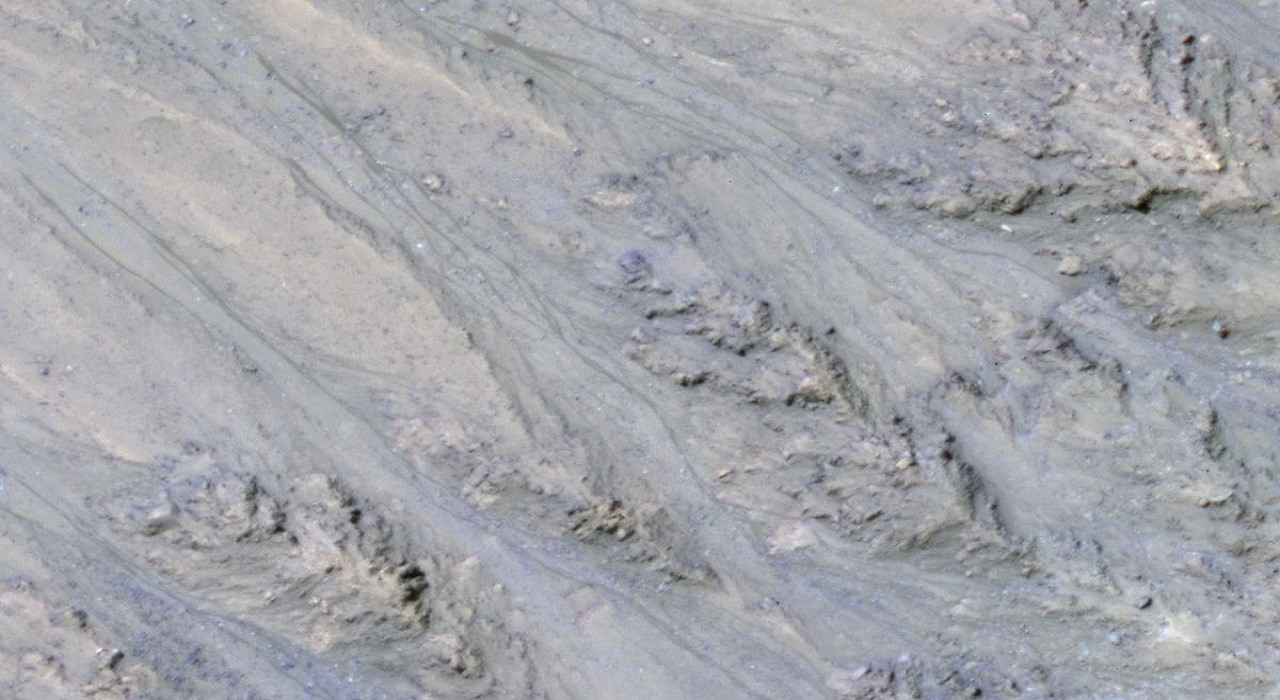
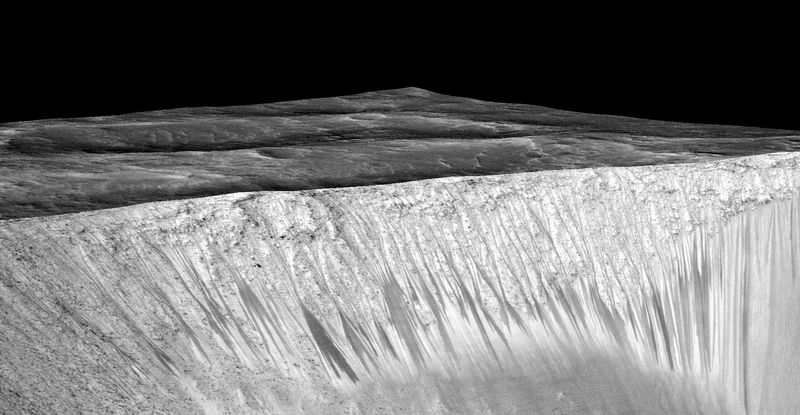
Credit: NASA/JPL/University of Arizona/USGS
The typical formations we see on Mars are probably natural sand formations according to researchers in a new study examining whether there is liquid water on the surface of Mars.
Has there been or is there liquid water on the Mars surface? It has long been a hot topic among researchers. The dark features that repeatedly occur on slopes on Mars have long been thought to be the result of liquid water. These are dark streaks that show up periodically on Martian hills, known as recurring slope lineae or RSLs.
We wrote about the formations just recently, Streaks on Mars’ surface are evidence of water when high-resolution images of the Mars surface and data collected from instruments on the NASA Mars Reconnaissance Orbiter appeared to confirm that the formations are indeed caused by flowing water. Data from the Mars Reconnaissance Orbiter found that the RSLs were made up of hydrated salts, meaning they were mixed with water molecules.
But now, Scientists from the USGS, the University of Arizona, Durham University (England) and the Planetary Science Institute establishes that these formations are more likely to occur after dust and sandstorms. They are, therefore, not the result of flowing water.
“We’ve thought of RSL as possible liquid water flows, but the slopes are more like what we expect for dry sand,”
“This new understanding of RSL supports other evidence that shows that Mars today is very dry.”
– USGS scientist and lead author Colin Dundas.
The researchers studied the shapes of 151 RSLs and found that all of them are located on slopes steeper than 27 degrees. They also noticed that the flows appear to stop when the slopes become less steep, which water wouldn’t do.
The study is, however, not an end to the discussion about the possible existence of liquid water on the surface of Mars. And a definitive answer may not be available to us until we visit these formations with robotic landers or even manned missions to the planet.
Reference:
Dundas et al. “Granular flows at recurring slope lineae on Mars indicate a limited role for liquid water”. Nature Geoscience. November 20, 2017. Doi: 10.1038 / s41561-017-0012-5.